

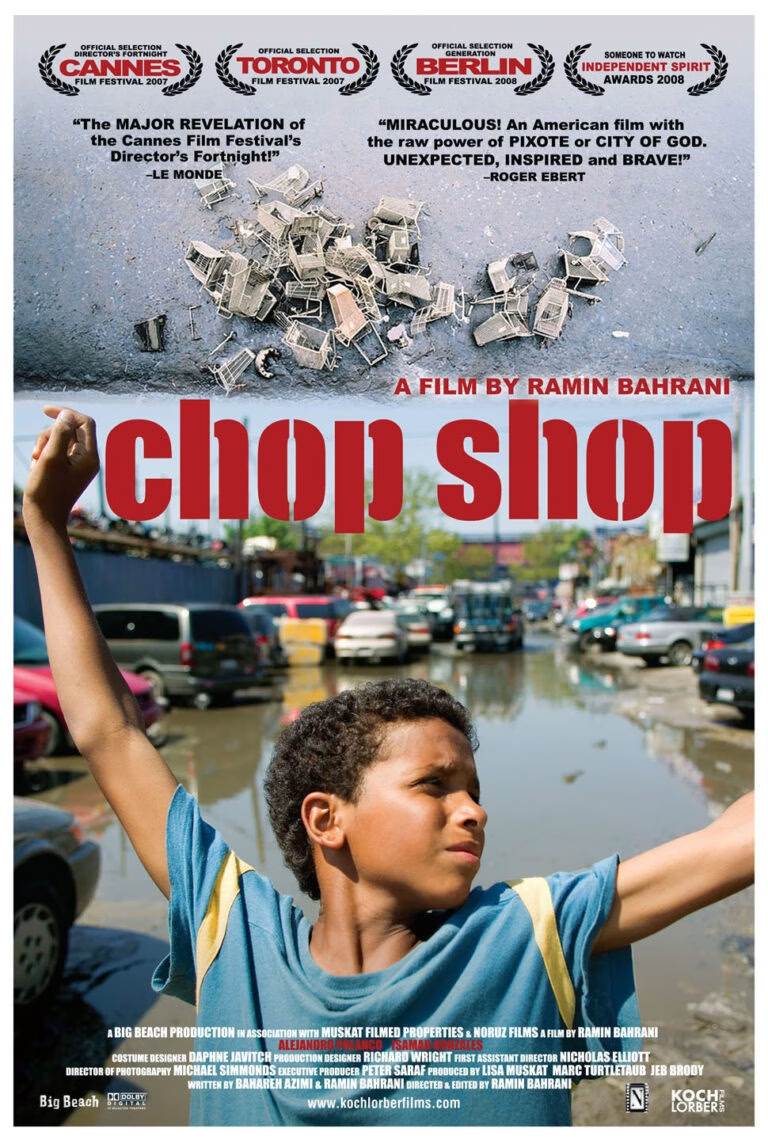
Cinema sometimes captures time and space with such immediacy that you forget whether what you are watching on the screen is a fictional narrative or a documentary torn from the very heart of life. Director Ramin Bahrani’s 2007 masterpiece, “Chop Shop,” opens with exactly this staggering sense of reality. We find ourselves in New York, in the shadow of the now-demolished Shea Stadium, within the chaotic marketplace known as the Iron Triangle, a labyrinth of makeshift auto-body shops.
This place is a modern reflection of what F. Scott Fitzgerald called the “Valley of Ashes” in The Great Gatsby. However, this time we view the story not through the eyes of the wealthy, but through 12-year-old Alejandro, who is fighting for survival amidst this junkyard. If you were to replace the cars with horse-drawn carriages, you would be left with a flawless Charles Dickens novel.
Ale: The Optimistic Entrepreneur of the Streets
Despite being at the bottom rung of the system, Ale is a surprisingly optimistic and entrepreneurial child. He lives in a plywood room under the roof of a shop owned by a man named Rob, earning 5 dollars for every car he steers toward the garage. This income—supplemented by selling candy on the subway, peddling pirated DVDs, stealing hubcaps, and even occasional snatch-and-grabs—does not make him a criminal; he is simply a survivor. He is attempting to climb the most fundamental steps of the American Dream with his own hands and by his own rules.
His struggle for survival takes on an entirely new dimension when his sister, Isamar—four years his senior—moves in with him. The makeshift room Ale prepares for her, and the pure pride he feels over the small refrigerator and microwave he places inside it, forms the emotional core of the film.
Flawless Aesthetics and the Illusion of Naturalism
Bahrani personally spent months in the “Iron Triangle” while writing the script. The greatest fruit of this dedication is hidden within the casting and performances. Aside from Ahmad (Ahmad Razvi), who handles the shady business in the film, no one is a professional actor. Ale’s boss, Rob, is actually the real Rob Sowulski who runs that very shop. The leads, Alejandro Polanco and Isamar Gonzales, were simply ordinary students.
How, then, does such a naturalism—one that would make professionals envious—emerge from this amateur cast? Through the methodical genius of Bahrani and cinematographer Michael Simmonds.
- Hidden Cameras and Improvisation: Sets without clapperboards, moments where actors were allowed to adapt lines into their own street jargon, and extras who were unaware they were being filmed…
- Visual Craftsmanship: Behind this documentary-like naturalism lies millimetric cinematography. Compositions where characters are constantly pushed to the left (more problematic) side of the screen, scrap piles in the background that are never there by accident, and unique portrait lighting referencing Sven Nykvist—the legendary cinematographer of Ingmar Bergman. Bahrani is an auteur in total control of every detail, much like Antonioni painting the grass to make it greener in Blow-Up.
The Loss of Innocence and the Confrontation with Reality
At its heart, Chop Shop is a gritty coming-of-age story. Ale’s entire effort is directed toward buying a taco truck that he and his sister can run together. He saves every dollar for this dream. However, when he realizes the heartbreaking truth of how Isamar is earning extra money, the film shifts direction. Ale never directly confronts his sister; instead, he begins to work harder so she won’t need that money, taking on the responsibility of a breadwinner rather than just an older brother.
These moments, where he confronts the limits of his own power and realizes just how far down the American Dream actually begins, sit like a lump in the viewer’s throat.
Bahrani’s Invisible Americans
The son of an Iranian immigrant family born in North Carolina, Ramin Bahrani has always been a director who turns his camera toward America’s invisible people. Like Man Push Cart (2005), which tells the story of a Pakistani street vendor in Manhattan, and Goodbye Solo (2008), which focuses on a Senegalese taxi driver, Chop Shop is the story of those who build the foundation of this country with their hands but never find a place in the shop window.
In conclusion, Chop Shop is not only one of the best independent American films of the 2000s; it is also one of the most powerful, aesthetic, and heartbreaking representatives of Neo-Realism in the 21st century. Between those rusted cars and the oily asphalt, you will find cinema in its purest form.