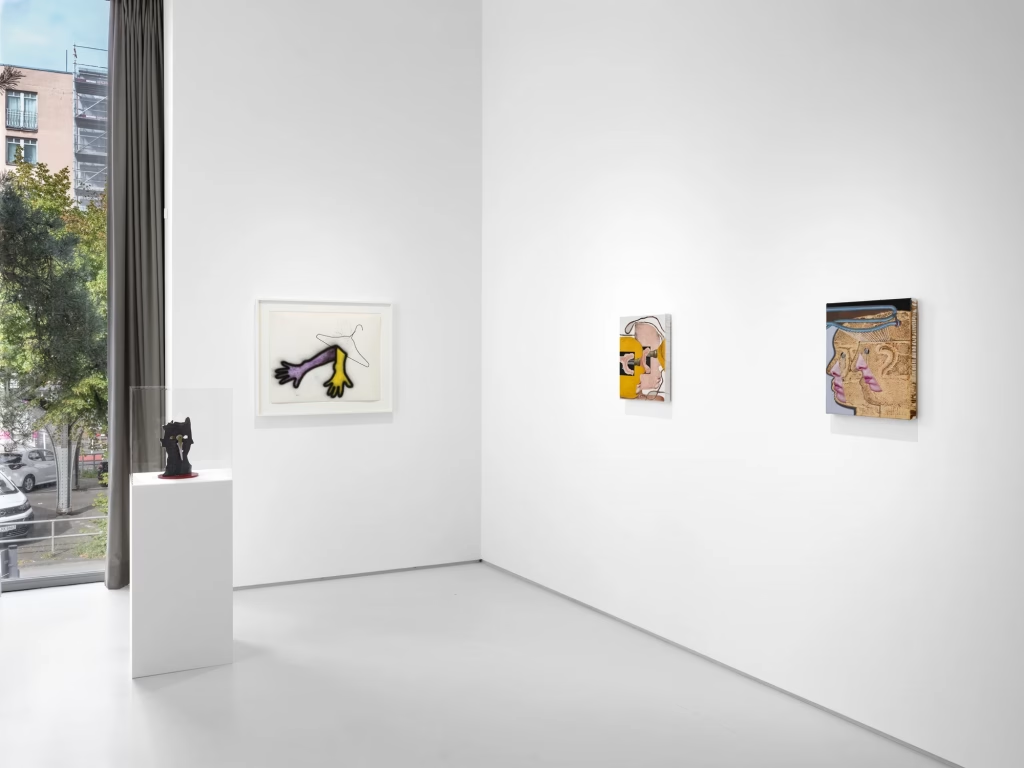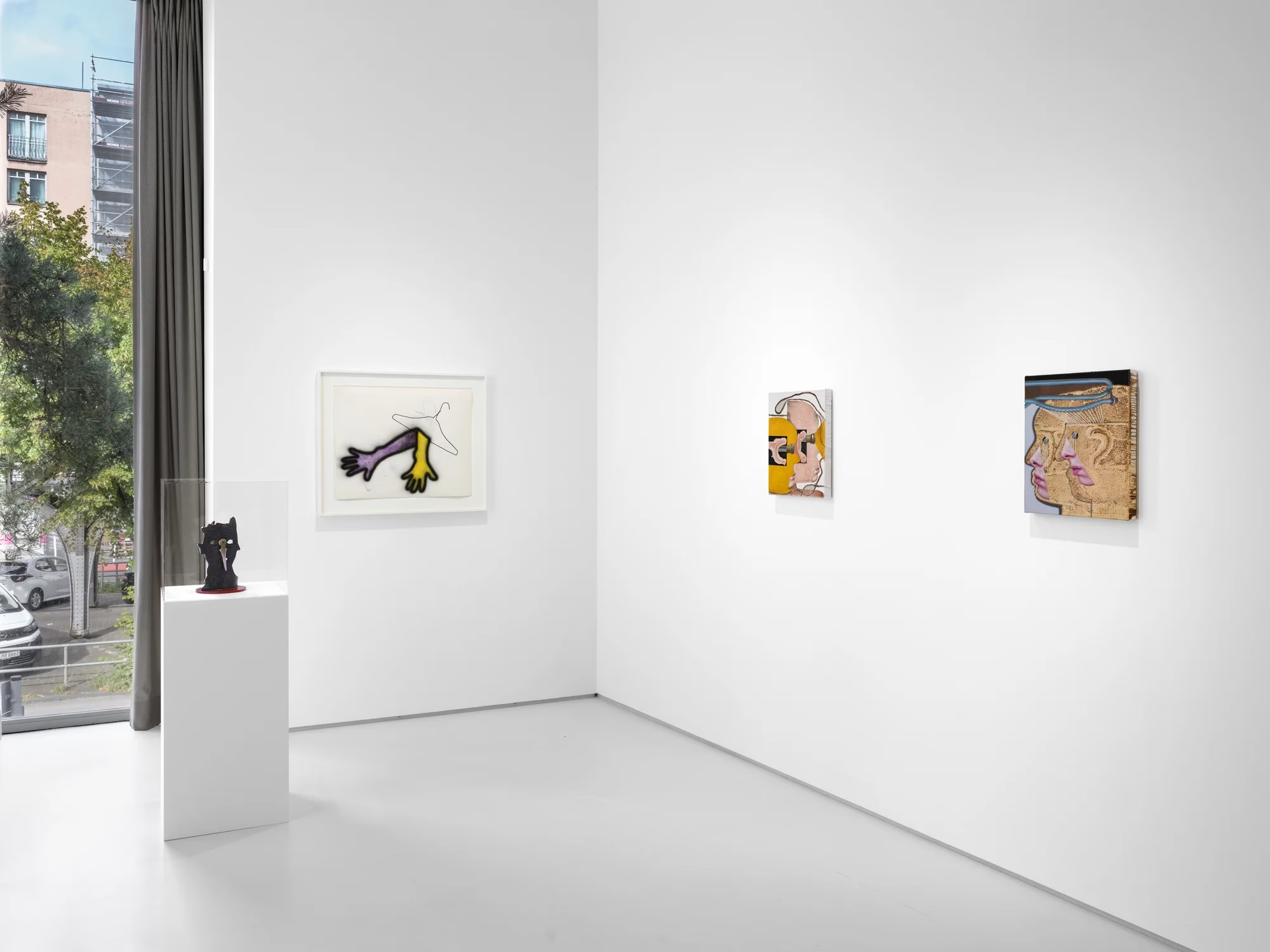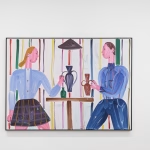


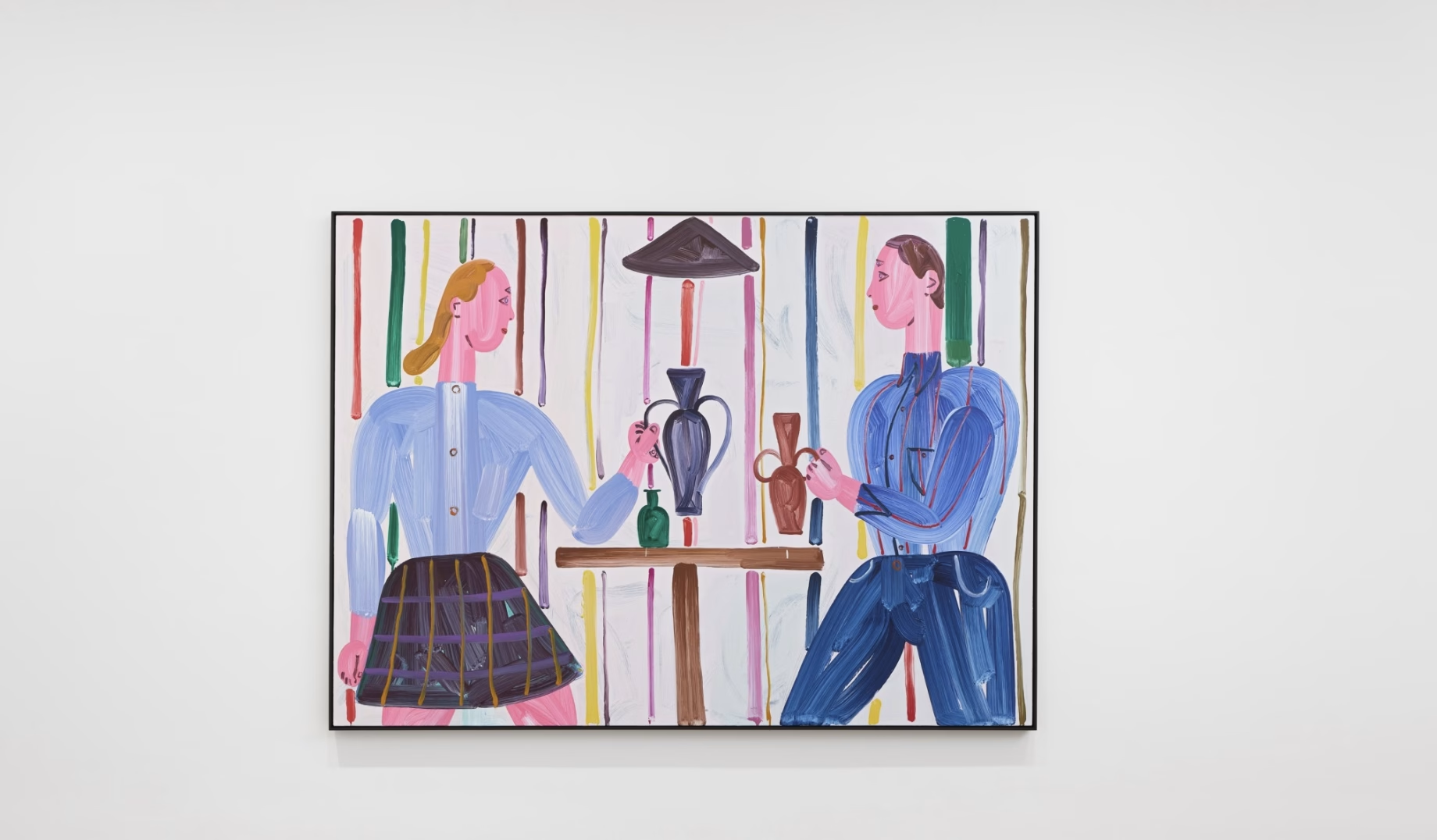
A solitary figure sits pensively in a low-backed chair; a couple raise a glass from opposite ends of a table; vertical bands of colour suggest doorways just behind them. Step into Galerie Max Hetzler’s Bleibtreustraße space in Berlin, and the domestic intimacies of a modern home abruptly take on the solemn quietude of an ancient ceremonial ground. In Parataxis, her seventh solo exhibition with the gallery, Grace Weaver seizes the most ordinary micro-rituals of everyday life, recasting them across the canvas into a near-sacred choreography.
At first glance, the scenes are disarmingly familiar. Yet this ritual gravitas is continually punctured by a wry, aloof formal humour that Weaver deftly smuggles onto the canvas. Bodies elongate and buckle against the confines of the frame; seen in profile, pairs of legs collapse into a single contour; heads resolve into pristine circles while torsos mirror the silhouettes of terracotta amphorae resting on tabletops. The impulse James Joyce voiced in A Portrait of the Artist as a Young Man—to encounter ‘for the millionth time the reality of experience’—finds physical form in Weaver’s figures: here, the most routinely repeated gestures are elevated into monuments bearing the sediment of time.
The exhibition takes its title from the Ancient Greek verb paratassō: to place side by side, or to arrange in battle order. Weaver’s compositions operate on precisely this logic. Stripped of the illusion of depth, the shallow pictorial plane aligns figures and architectural markers alongside one another rather than weaving them into space, setting them into the surface almost like low-reliefs. A table lamp is reduced to a stark triangle; chairs and door frames to rhythmic geometric lines. Bearing the composure of Mesopotamian cylinder seals, these silhouettes establish a mute visual rhyme with the domestic objects around them—shoulders echo the contours of Trojan drinking vessels, while torsos mimic the swell of shallow bowls. The rigid upright of a chair back finds its counterweight in a figure’s ramrod posture; yet the emotional weight of each painting springs not from dramatic facial expression, but from the fraught tension sustained between line, colour, and negative space.
Beneath this figurative discipline lies a meticulously layered technique. After building up the canvas through patient preparation, Weaver resolves the final image in a single wet-on-wet pass. As wet paint meets wet ground, figure, space, and colour coalesce simultaneously. Drawing inspiration from Mycenaean frescoes, striking cobalt blues and luminous primaries appear less like an applied surface layer than a grain woven directly into the fabric of the linen. In her large-scale works, the artist applies paint from left to right, unspooling the composition much like an ancient scroll; vertical brushstrokes and the visceral texture of the medium sweep across the canvas in rhythmic, script-like succession.
Directly opposite monumental canvases such as Nebeneinander, Libation Bearers, and Nostos hang small-scale works that test this visual idiom in miniature. Across panels measuring mere centimetres, Weaver’s brushwork turns sharper, intensely economical: the anatomy of a hand is resolved in a few decisive strokes, while a fingernail glints from a single pinpoint of paint. The sheer monumentality of the large paintings finds its equilibrium in the concentrated focus of these smaller studies.
Presented in Berlin as a collaboration between Galerie Max Hetzler and Soy Capitán, Parataxis runs at Bleibtreustraße 45 through 24 October 2026. For those curious to see how classical forms can converse with the solitude of the modern apartment, the exhibition offers a compelling occasion to reconsider the formal possibilities of paint.