

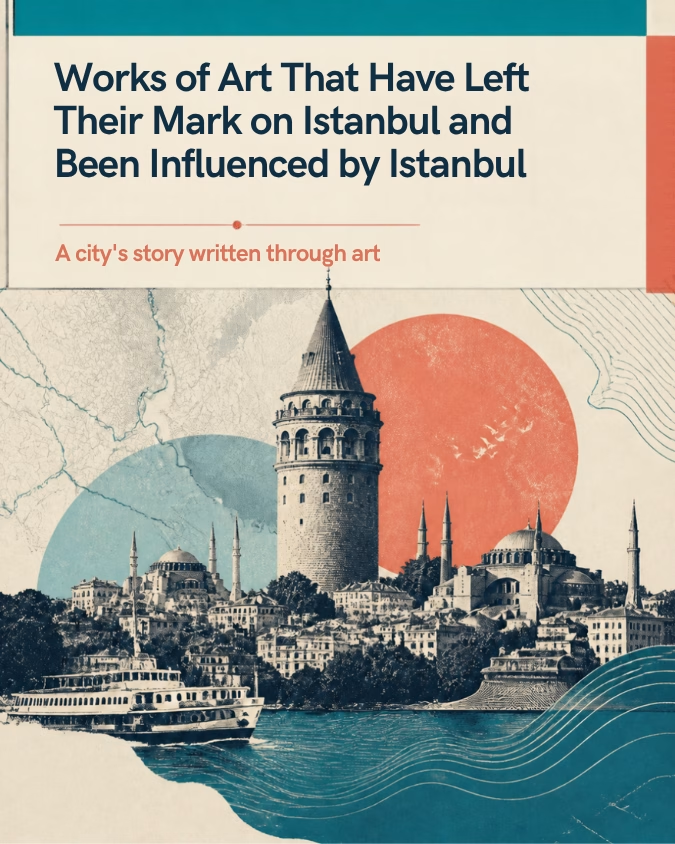
Artworks That Shaped Istanbul and Were Shaped By It
10 Oct 2026 · @İlkay
Throughout history, Istanbul has been far more than a monumental landscape where artworks were produced; across the ages, it has served as a central subject, a source of inspiration, and at times the primary protagonist for artists. Spanning architecture, painting, sculpture, photography, literature, music, cinema, and the performing arts, this broad spectrum reveals Istanbul’s layered position within global cultural memory.
The featured works have been selected based on two core criteria. First are the landmark creations that have defined the city’s identity and iconic skyline—such as the Hagia Sophia, the Süleymaniye Mosque, Matrakçı Nasuh’s cartographic miniatures, or Ara Güler’s black-and-white photographs. Second are those works directly taking the city as their subject, inspired by Istanbul to continuously re-imagine its image—such as Aivazovsky’s Bosphorus views, Ahmet Hamdi Tanpınar’s novel Huzur (A Mind at Peace), or Le Corbusier’s Journey to the East. Over time, these two vectors have forged a dynamic, mutually enriching space of dialogue.
Architecture
Above all, it is Istanbul’s monumental structures that define its visual identity and place within global architectural history. Shaping the city’s skyline, these works have inspired architects and geographies for centuries. The principal monuments that have left their mark on the city include:
-
Hagia Sophia (532–537): The domed spatial model for Byzantium and later the Ottoman Empire for a millennium; the city’s most universal symbol.
-
Theodosian Walls (413; restored 447): A three-tiered defensive system that protected the city for over a thousand years, defining the historical boundary of its land border.
-
Galata Tower (1348): Built by the Genoese; an iconic historical symbol of the northern shore of the Golden Horn.
-
Topkapı Palace (from 1459 onward): The administrative seat of the Ottoman Empire for four centuries, completing the skyline of Sarayburnu (Seraglio Point).
-
Süleymaniye Mosque (1550–1557): Mimar Sinan’s masterpiece crowning a hill overlooking the Golden Horn; the structural backbone of the Istanbul skyline.
-
Blue Mosque (Sultan Ahmed Mosque) (1609–1616): Rising directly opposite the Hagia Sophia with its six minarets, defining the iconic “Blue Mosque” image.
-
Maiden’s Tower (Byzantine origins; current structure 18th century): An islet tower at the entrance of the Bosphorus; an emblematic element of literature and visual arts through its legends. Reopened to visitors following an extensive restoration from 2021 to 2023.
-
Dolmabahçe Palace (1843–1856): A showcase of Ottoman modernization and Bosphorus waterfront architecture.
-
15 July Martyrs (Bosphorus) Bridge (1973): The first suspension bridge connecting the two continents in Istanbul; a 20th-century landmark of engineering.
Universal Impact of Hagia Sophia. Ottoman architecture adopted and transformed the spatial configuration of Hagia Sophia nearly a thousand years after its construction. Mimar Sinan reinterpreted Hagia Sophia’s semi-dome system in the Şehzade and Süleymaniye mosques, integrating side spaces into the unity beneath the main dome to achieve a brighter interior volume. This architectural scheme subsequently spread across the entire Ottoman geography. In the Christian world, the Saint Sophia Cathedral in Kyiv took both its name and decorative program from it, while Saint Mark’s Basilica in Venice modeled itself on the Church of the Holy Apostles (Apostoleion) in Istanbul.
Le Corbusier and the Journey to the East (1911). In 1911, a 23-year-old Le Corbusier (Charles-Édouard Jeanneret) visited Istanbul as part of his journey to the East, spending several weeks in the city. In his Voyage d’Orient sketchbooks, he examined and drew numerous structures, ranging from Sinan’s monumental mosques to timber residential architecture. The relationship between dome, light, volume, and silhouette he experienced at Hagia Sophia and Süleymaniye profoundly influenced his architectural philosophy. In his 1923 book Vers une Architecture (Towards an Architecture), he cited the plans of Hagia Sophia and the Green Mosque in Bursa as exemplary models. According to scholars such as Cânâ Bilsel, his impressions of Istanbul played a major role in shaping his concepts of the “green city” and pure geometric volumes.
A Synthesis from Modern Istanbul. In the 20th century, the city’s architecture continued to intersect with fine art. Sedad Hakkı Eldem’s Taşlık Tea House (1947–1948) reinterpreted traditional Turkish domestic architecture through a modernist lens. Built between 1959 and 1967, the Istanbul Drapery Market (İMÇ) stands as one of the finest examples of Istanbul modernism, seamlessly integrating architecture and art through mosaics by Bedri Rahmi Eyüboğlu, sculptures by Kuzgun Acar, and ceramic panels by Füreya Koral.
Painting, Miniatures, and Engravings
Istanbul is among the most depicted cities in both Western and Eastern pictorial arts. The principal works that shaped the city’s visual image chronologically include:
-
Gentile Bellini, Portrait of Sultan Mehmed II (1480): The most famous Renaissance portrait rendered in Istanbul; heavy 19th-century retouching sparked debates over its attribution to Bellini.
-
Matrakçı Nasuh, Depiction of Istanbul in Beyân-ı Menâzil (1537): One of the earliest Ottoman bird’s-eye views detailing the topometrical and monumental fabric of the city. Earlier European precedents include Cristoforo Buondelmonti’s map (c. 1420) and Giovanni Andrea Vavassore’s view (c. 1520).
-
Jean-Baptiste Vanmour, Diplomatic Audience Scenes and Costume Series (1699–1737): The foundational visual source for the Turquerie vogue in Europe.
-
Antoine-Ignace Melling, Voyage pittoresque Album (1819): A monumental album of engravings documenting the Bosphorus and its waterfront palaces with meticulous precision.
-
Thomas Allom’s Engravings (1838): One of the most influential engraving suites shaping 19th-century Europe’s perception of Istanbul.
-
Amedeo Preziosi’s Watercolors (1840s–1882): Hundreds of paintings by the Maltese artist living in Istanbul, documenting everyday street life.
-
Ivan Aivazovsky, Istanbul Vistas (1845–1890): Over 200 paintings capturing the city’s light and waters.
-
Fausto Zonaro, Court and Street Scenes (1896–1909): Canvases capturing the everyday and social life of the Ottoman capital.
-
Osman Hamdi Bey, Figurative Interior Compositions (1880s–1910): Canvases reconstructing the image of the “Orient” from within, through the eye of an Ottoman intellectual.
-
Paul Signac, Golden Horn (La Corne d’Or) Series (1907–1909): The encounter between Neo-Impressionist pointillism and Istanbul light.
-
Hoca Ali Rıza and the 1914 Generation, Bosphorus and Üsküdar Landscapes: The evolution of Impressionist landscape painting in Turkish art, centered around Istanbul.
Ivan Aivazovsky. Born into an Armenian family in Feodosia, Crimea, Aivazovsky first arrived in Istanbul in 1845 with a Russian naval expedition, returning eight times until 1890. His more than 200 paintings depicting the city form one of the vastest visual archives of the 19th-century capital. Sultan Abdülaziz commissioned over thirty works from him in 1874; thirty of these are housed today in Dolmabahçe Palace and other Turkish museums. Blending light, sea, and urban silhouette with a dramatic Romanticism, his painting View of Constantinople and the Bosphorus set an auction record for the artist, selling at Sotheby’s London in 2012 for approximately $5.2 million.
Fausto Zonaro. Arriving in Istanbul in 1891, the Italian painter was appointed Ressam-ı Hazret-i Şehriyârî (Court Painter to the Sultan) by Abdülhamid II in 1896. Alongside monumental canvases such as The Imperial Cavalry Regiment of the Ertuğrul Crossing the Galata Bridge, he brought the daily rhythm, festivals, and tradespeople of Istanbul’s streets to canvas with a realist eye. Stripped of his title in 1909, he returned to Italy, where he continued to paint nostalgic Bosphorus scenes until his death.
Paul Signac. Visiting the city in the spring of 1907, the Neo-Impressionist master Paul Signac produced a series focusing on the Golden Horn and mosque silhouettes; his catalogue raisonné lists eleven Istanbul views (nine from 1907 and two from 1909). La Corne d’Or, Constantinople reflects a phase in post-Seurat pointillism where the technique evolved into a freer, more luminous brushstroke under the spell of Istanbul’s light.
Republican Era Painting. Istanbul remained a primary subject for painters throughout the Republican era. Bedri Rahmi Eyüboğlu’s vibrant urban views, Nuri İyem’s canvases portraying working-class citizens, and the New Group’s (Yeniler Grubu) 1941 exhibition The Harbor City of Istanbul (Liman Şehri İstanbul) demonstrate this unbroken continuity.
Sculpture and Public Monuments
Istanbul’s public sculpture history was shaped by two major disruptions. In antiquity and the Byzantine era, the city functioned as a vast open-air museum of sculpture—a heritage largely destroyed during the Fourth Crusade in 1204. During the Ottoman period, figurative public sculpture was virtually non-existent. With the advent of the Republic, sculpture returned to the city as a visual and political locus of public squares.
Sarayburnu Atatürk Monument (1926). Crafted by Austrian sculptor Heinrich Krippel and unveiled on October 3, 1926, this was the Republic of Turkey’s first public monument. Depicting Atatürk in civilian attire, the bronze statue pioneered the transformation of public space.
Taksim Republic Monument (1928). Designed by Italian sculptor Pietro Canonica and inaugurated in August 1928 (sources cite August 8 or 9), the monument depicts the War of Independence on one facade and Republican Turkey on the other. Alongside Atatürk, the composition features İsmet İnönü, Fevzi Çakmak, Tevfik Rüştü Aras, as well as Soviet commander Mikhail Frunze and diplomat Semyon Aralov, who supported the National Struggle. Since its erection, the monument has remained a central focal point of the city’s political and social memory.
Other Monumental Works. Zühtü Müridoğlu’s Barbaros Hayreddin Pasha Monument in Beşiktaş (1944), the iconic bronze Bull Statue in Kadıköy (attributed to 19th-century French sculptor Isidore Bonheur), and İlhan Koman’s stylized bronze female figure Mediterranean (Akdeniz, 1980) on the Yeniköy waterfront serve as key visual landmarks across the city.
Contemporary Sculpture and Installation. Following modernist achievements such as Kuzgun Acar’s relief sculptures at the İMÇ, the Istanbul Biennial (established in 1987) has provided a stage for contemporary site-specific installations that re-examine the city’s historical architecture and public spaces.
Photography
Istanbul was among the earliest cities to be photographed following the invention of the medium, with French photographer Joseph-Philibert Girault de Prangey capturing street scenes and panoramas in 1843. By the second half of the 19th century, studios established in Pera shaped the visual memory of the Eastern Mediterranean.
Abdullah Frères and Sébah & Joaillier. Founded by brothers Viçen, Hovsep, and Kevork Abdullahyan, the Abdullah Frères studio became official court photographers to Sultan Abdülaziz in 1863, documenting city panoramas, monuments, and social “types.” Meanwhile, Pascal Sébah and the subsequent Sébah & Joaillier studio shaped the visual imagery of Istanbul for Victorian travelers and international collections. The expansive photo albums gifted by Sultan Abdülhamid II to the Library of Congress and the British Museum stand as early examples of photography used as an instrument of visual diplomacy.
Selahattin Giz. Working for Cumhuriyet newspaper from the 1930s through the 1950s, press photographer Selahattin Giz documented snow-covered streets, ferries, and daily life; his photographs are famously featured in Orhan Pamuk’s Istanbul: Memories and the City.
Ara Güler (1928–2018). Widely known as “The Eye of Istanbul,” Ara Güler was a Magnum photojournalist who defined himself as a visual historian. His black-and-white photographs of Beyoğlu, Galata, the Golden Horn, Zeyrek, and Tahtakale from the 1950s and 1960s put human stories, urban melancholy, and disappearing wooden architecture at the center, becoming the very bedrock of collective visual memory known as “Old Istanbul.” Opened on August 16, 2018, at Bomontiada, the Ara Güler Museum and its Ara Güler Archives and Research Center (AGAVAM) preserve this vast repository.
Literature
In literature, Istanbul is far more than a passive geographic backdrop; it is a living entity possessing its own character, soul, and melancholy.
Turkish Literature:
-
Halit Ziya Uşaklıgil, Aşk-ı Memnu (Forbidden Love, 1900): Set in Bosphorus mansions, the novel chronicles the elite life and decline of Ottoman Istanbul.
-
Peyami Safa, Fatih-Harbiye (1931): Explores the East-West dichotomy through a young woman torn between the traditional district of Fatih and the Westernized neighborhood of Harbiye.
-
Yahya Kemal Beyatlı, Aziz İstanbul (Beloved Istanbul, published posthumously 1964): Exalts the city as a living extension of Ottoman history, poetry, and architecture.
-
Ahmet Hamdi Tanpınar, Beş Şehir (Five Cities, 1946) and Huzur (A Mind at Peace, 1949): Huzur intricately weaves the Bosphorus, classical Turkish music, and architecture with the interior life of an Ottoman intellectual caught between East and West.
-
Sait Faik Abasıyanık: Crafts deceptively simple short stories centered around Burgazada, local fishermen, coffeehouses, and the marginalized figures on the city’s periphery.
-
Orhan Veli Kanık, “I Am Listening to Istanbul” (“İstanbul’u Dinliyorum”, 1947): Reconstructs the urban image down to the street level through everyday sounds.
-
Reşat Ekrem Koçu, Istanbul Encyclopedia (İstanbul Ansiklopedisi, 1958–1973, unfinished): Transforms the city’s eccentric, marginal, and daily history into a monumental compendium.
-
Orhan Pamuk, The Black Book (Kara Kitap, 1990), Istanbul: Memories and the City (2003), The Museum of Innocence (Masumiyet Müzesi, 2008): Winner of the 2006 Nobel Prize in Literature, Pamuk anchors urban identity around a collective hüzün (melancholy)—a shared state of mind offered to residents living amidst the ruins of an empire. The Museum of Innocence documented the material culture of the 1970s city, culminating in a physical museum opened in Çukurcuma in 2012.
Foreign Literature. Pierre Loti’s Aziyadé (1879) deepened the French Orientalist vision of Istanbul. Italian author Edmondo De Amicis’s Constantinople (Costantinopoli, 1877) was among the most widely read books on the city in the 19th century. Agatha Christie’s Murder on the Orient Express (1934)—legendarily written in Room 411 of the Pera Palace Hotel—positioned the city as the nexus of intrigue and luxury rail travel. In Virginia Woolf’s Orlando (1928), the protagonist’s sudden transformation from man to woman while serving as ambassador in Constantinople stands as one of literature’s most intriguing images of urban metamorphosis. Writers like Ian Fleming (From Russia, with Love, 1957) and Nobel laureate Ivo Andrić (The Damned Yard, 1954) similarly placed the city at the core of their narratives.
Music
Istanbul’s musical history spans a vast spectrum: from classical modal traditions originating in the Ottoman court, Enderun, and Mevlevi lodges to early encounters with Western music and modern popular culture.
Classical Turkish Music. The city became the capital of modal classical music through masters like Itri (1640–1712) and Dede Efendi (1778–1846). In the 20th century, Münir Nurettin Selçuk’s Istanbul songs carried this tradition to new audiences.
European “Alla Turca”. In the 18th century, the influence of Ottoman Mehter military music sparked the “alla turca” craze across Europe. Mozart’s opera The Abduction from the Seraglio (Die Entführung aus dem Serail, 1782) and his Rondo alla Turca became symbols of this trend, though these works drew more from European fantasies of the Ottomans than genuine Istanbul music.
Giuseppe Donizetti (Donizetti Pasha). Invited to Istanbul in 1828 following Sultan Mahmud II’s dissolution of the Janissary Corps and the Mehter Band in 1826, Donizetti took charge of the Muzıka-yı Hümayun (Imperial Ottoman Band), laying the foundations for Western polyphonic music at court and in the city. Composer of the Mahmudiye and Mecidiye marches, Donizetti served the Empire for 28 years and was interred in the crypt of the Cathedral of the Holy Spirit in Pera. During his tenure in 1847, Franz Liszt visited Istanbul to give a series of recitals.
Popular Urban Music. The anonymous folk song “Üsküdar’a Gider İken” (Katibim) became a melody adapted into numerous languages across the Balkans and the Middle East. The Four Lads’ 1953 hit “Istanbul (Not Constantinople)” brought the city’s name change into global pop culture. From the 1960s onward, rural migration catalyzed the rise of arabesque music, led by figures like Orhan Gencebay, becoming one of 20th-century Istanbul’s most potent musical expressions. Sezen Aksu’s “İstanbul İstanbul Olalı” (1995) offered a soulful elegy to the changing city. Fatih Akın’s documentary Crossing the Bridge: The Sound of Istanbul (2005) introduced the world to the city’s polyphonic musical landscape, spanning psychedelic rock, arabesque, hip-hop, and folk.
Cinema
The epicenter and namesake of Turkish cinema is inextricably tied to Yeşilçam Street in Beyoğlu. Istanbul served both as a backdrop for local cinema’s exploration of social transformation and as an exotic backdrop for international cinema’s tensions between East and West.
Turkish Cinema on Istanbul:
-
Halit Refiğ, Birds of Exile (Gurbet Kuşları, 1964): One of the earliest cinematic depictions of internal migration from Anatolia and the struggle to anchor oneself in the metropolis.
-
Metin Erksan, Time to Love (Sevmek Zamanı, 1965): A poetic romance set on Büyükada.
-
Atıf Yılmaz, Ah Beautiful Istanbul (Ah Güzel İstanbul, 1966): A classic dedicated to the city by its very title, dramatizing the clash between old and new Istanbul.
-
Lütfi Ömer Akad, The Bride, Wedding, Dowry Trilogy (Gelin, Düğün, Diyet, 1973–1974): A sociological dissection of migration, industrialization, and urban alienation.
-
Yavuz Turgul, The Bandit (Eşkıya, 1996): Istanbul seen through the eyes of a bandit released after 35 years in prison, encountering an alienated megacity.
-
Ferzan Özpetek, Steam: The Turkish Bath (Hamam, 1997): An Italian architect’s enchantment with the city after inheriting a traditional bathhouse.
-
Nuri Bilge Ceylan, Distant (Uzak, 2002): The isolation of two men in a snow-covered, melancholic Istanbul; winner of the Grand Prix at Cannes.
-
Ceyda Torun, Kedi (2016): A documentary observing the neighborhoods and human fabric of Istanbul through the eyes of its street cats.
International Cinema. Istanbul hosted three James Bond films (From Russia with Love, 1963; The World Is Not Enough, 1999; Skyfall, 2012), turning the Basilica Cistern, the roofs of the Grand Bazaar, and the Bosphorus into canonical espionage locations. Jules Dassin’s heist film Topkapi (1964), Alain Robbe-Grillet’s experimental L’Immortelle (1963), Elia Kazan’s America America (1963), and Ron Howard’s Dan Brown adaptation Inferno (2016) similarly placed the city’s sites at the core of their narratives.
A Matter of Perception. Most foreign films treat Istanbul either as a postcard backdrop or a perilous “Orient.” The most controversial example remains Midnight Express (1978)—which, despite being set in Istanbul, was filmed in Malta, long casting a shadow over Turkey’s international image. Conversely, Turkish directors frame the city from within as a space of migration, solitude, and urban transformation.
Theatre and Performing Arts
Traditional Stage. In Ottoman Istanbul, popular performance found its voice in Karagöz shadow play, orta oyunu (open-air theatre), and meddah (storytelling). Karagöz was inscribed on UNESCO’s Representative List of the Intangible Cultural Heritage of Humanity in 2009, and meddahship in 2003. The archetypes on the Karagöz screen—Armenian, Greek, Jewish, Laz, Albanian, and neighborhood toughs—mirror the multicultural mosaic of Ottoman Istanbul.
Modern Theatre, Opera, and Ballet. Evolving in 19th-century Pera around Güllü Agop’s Gedikpaşa Theatre and the opera-hosting Naum Theatre, the performing arts were institutionalized in 1914 with the establishment of the Darülbedayi (today’s Istanbul City Theatres). Key milestones include Muhsin Ertuğrul’s theatrical reforms and Haldun Taner’s 1964 musical play The Ballad of Ali of Keshan (Keşanlı Ali Destanı)—a Brechtian epic set in an Istanbul squatter settlement. The roots of Turkish ballet were also planted in Istanbul: in 1948, under the guidance of Dame Ninette de Valois (founder of the Royal Ballet), a ballet school opened in Yeşilköy, marking the inception of professional ballet in Turkey.
Atatürk Cultural Center (AKM). Designed by Hayati Tabanlıoğlu and rising on Taksim Square, AKM opened in 1969, reopened in 1978 after a 1970 fire, and served as the epicenter of opera, ballet, and theatre for decades. Closed in 2008 and demolished in 2018, it was replaced by the new AKM designed by Murat Tabanlıoğlu, which opened in 2021.
Contemporary Art. The city also became a direct subject for contemporary visual artists. Kutluğ Ataman’s video installation Küba (2004), comprising interviews with residents of an Istanbul squatter neighborhood, remains one of the most powerful examples.
Assessment: Shared Images of Istanbul
Read collectively, artistic works centering on Istanbul cluster around shared motifs: silhouette and water, East-West synthesis, mystery and memory, hüzün and ruin, migration and metropolis, urban diversity. Some of these themes—particularly the enigmatic, contradictory “Orient”—are products of external Orientalist perspectives. Conversely, themes of hüzün, migration, and internal interrogation represent authentic, insider readings by the city’s own artists. Istanbul’s unique place in global art history lies precisely in the uninterrupted, reciprocal reproduction of this shared historical and urban landscape by two distinct lenses: the outsider’s gaze of Aivazovsky, Le Corbusier, and Loti, alongside the insider’s vision of Sinan, Tanpınar, Pamuk, and Ara Güler.