

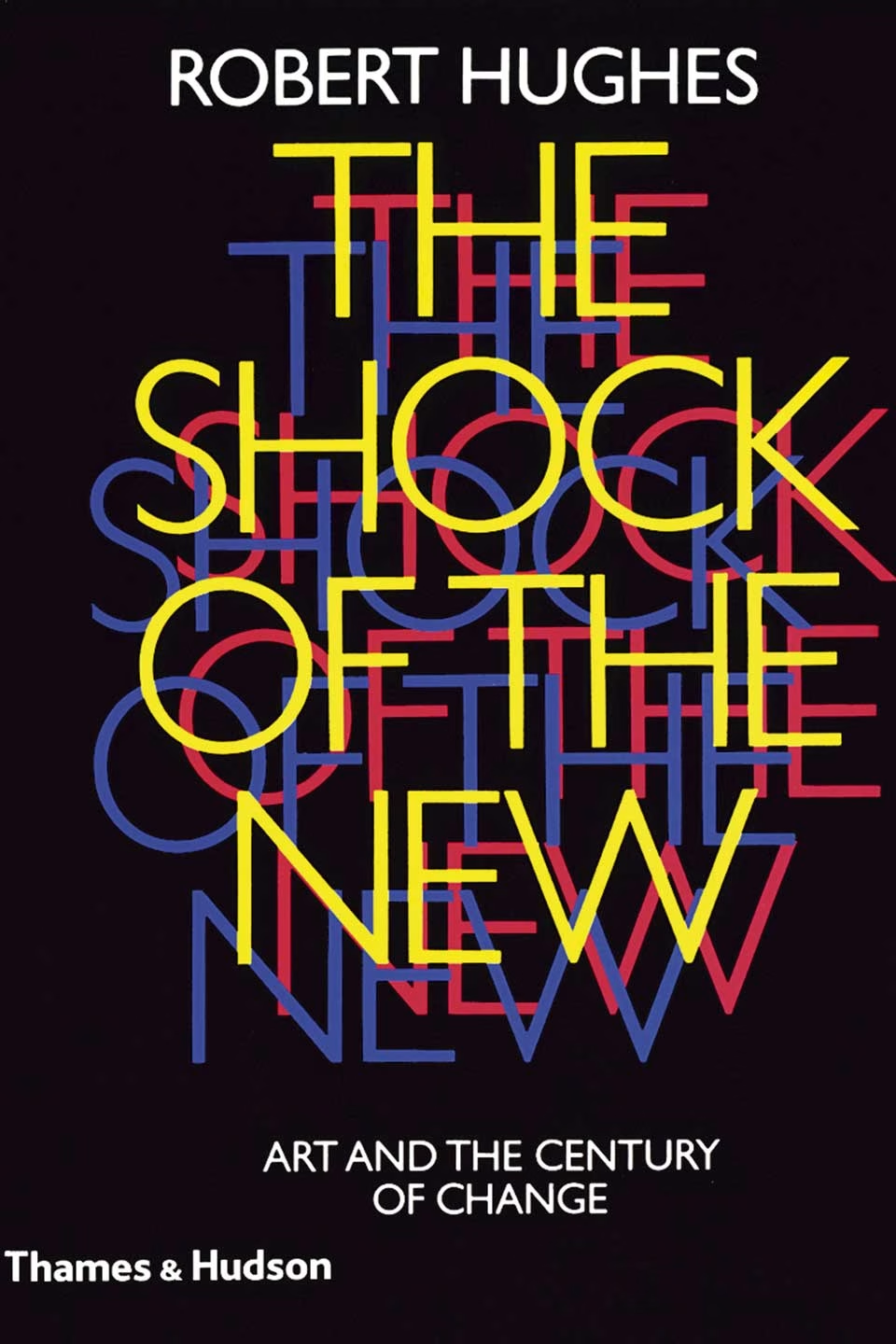
Premiering on BBC Two in the autumn of 1980, the eight-part series The Shock of the New stands as one of those rare landmark productions that fundamentally redefined television’s engagement with visual art. Turning his lens toward the monumental yet fragile surfaces of modernism, critic Robert Hughes charted art’s century-long trajectory not through rigid chronology, but through thematic ruptures. Produced by Lorna Pegram in association with Time-Life Films—and accompanied by a seminal book of the same title—the project retains its vitality, augmented by Hughes’s one-hour 2004 update, The New Shock of the New.
A Critic with a Razor-Sharp Pen
Born in Australia in 1938, Robert Hughes emerged as one of the most arresting voices steering the art world through his writing for Time magazine from 1970 onward. Once described by The New York Times as “the most famous art critic in the world,” Hughes crafted his prose with literary finesse while maintaining an unyielding conservatism in his aesthetic judgment. His onscreen presence extended far beyond mere museum docent; it was a display of uncompromising intellect, dissecting the conceptual underpinnings behind canvas and concrete with surgical precision.
From the Illusion of the Future to the End of the Avant-Garde: A Thematic Journey
Rather than dividing art into calendar decades, the series focuses on the collision of overarching ideas:
- The Mechanical Paradise and Politics: The opening episode, “The Mechanical Paradise,” examines the exhilarating and ominous momentum generated by technology between the 1880s and World War I through the lenses of Cubism and Futurism. The subsequent episode turns its gaze to art’s violent reckoning with politics, mechanized warfare, fascism, and communism.
- Nature, Utopia, and the Inner Realm: Tracing a narrative path from the Impressionists to Matisse—and humanity’s quest to reconcile with nature—the trajectory crashes into the unyielding terrain of modern architecture in “Trouble in Utopia.” Spanning from Le Corbusier to the sterile urban grid of Brasília, Hughes delivers a scathing critique of ambitious architects who sought to impose their social utopias onto populations through concrete monoliths. Alongside this axis, the passionate terrain of Surrealism and interior expressionisms, nourished by the dark, craggy recesses of the human psyche, take distinct shape.
- The Screen Revolution and Modernism in Retreat: The Pop Art era (Davis, Rauschenberg, Johns, and Warhol), which contends with the rise of television, advertising, and mass communication, yields in the final chapter to modernism’s loss of its heroic ambitions and the final pockets of resistance against the commercialization of art.
The Aesthetics of Slow Looking and the Dust of Time
The brooding synthesizer scores of the late 1970s, meticulously curated archival footage, and a deliberate edit that permits the camera to rest undisturbed upon artworks grant The Shock of the New a cadence of “slow looking” that feels increasingly rare today. Yet the palpable 1980s gloom permeating the series is impossible to miss: the disillusionment surrounding modern artists’ ideals to reshape society, and the seemingly inevitable demise of the avant-garde.
Naturally, the series carries its own inescapable blind spots. The geographic and demographic scope of artists on screen—from Cézanne and Matisse to Picasso and Warhol—is overwhelmingly Western and male. While the glossing over of female artists and non-Western modernist ruptures, alongside the boundaries of Hughes’s own aesthetic biases, do not diminish the series’ historical significance, they remain critical parentheses to hold in mind during a contemporary viewing.
The Residue in Visual Memory
Regarded by visual culture historians as perhaps the most authoritative art documentary series ever produced, this classic continues its intellectual work long after the credits roll. Ultimately, whether passing through the shadow of a modernist building or lingering inside a gallery, one finds oneself observing through Hughes’s lens—questioning the utopia lurking behind cold, sculptural concrete: Who intended to orchestrate what kind of future, and for whom?