

Waking Up Inside a Dream: Richard Linklater’s Visionary Masterpiece “Waking Life” (2001)

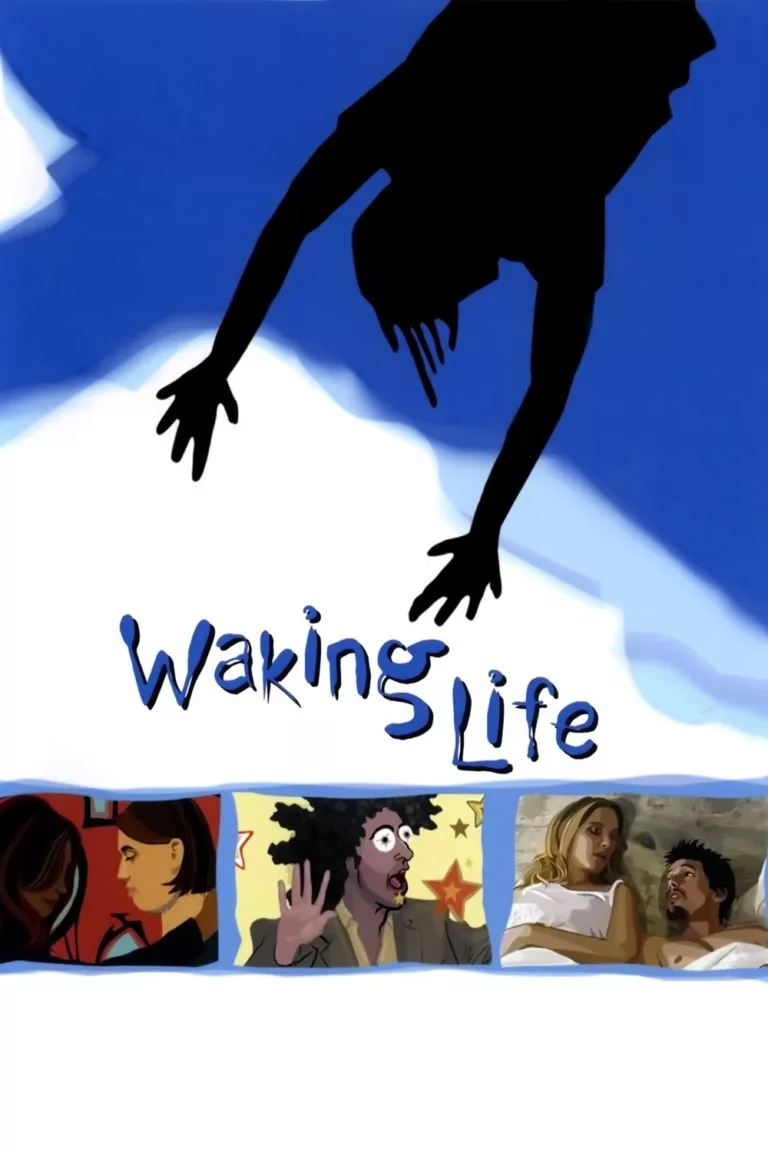
“Is all that we see or seem / But a dream within a dream?” Perhaps no film in cinema history embodies this legendary line by Edgar Allan Poe as vividly as Richard Linklater’s Waking Life. Cinema, by its very nature, invites the audience into a collective dream. However, Linklater does more than just invite us into a dream; he leaves us within a never-ending and fascinating philosophical labyrinth where we constantly believe we are waking up, only to fall into an even deeper sleep. We can clearly see how this universe Linklater created is a unique simulation of the subconscious. Let us descend together into the layers of this incomparable cinematic experience, which the late great critic Roger Ebert once praised beyond measure.
A Striking “Subconscious” Aesthetic: The Rotoscope Technique
Waking Life does not overwhelm its audience with ordinary surrealist fantasy—characters with pinwheels for eyes or people being sucked into black holes. Instead, it integrates its visual world directly with the film’s philosophical structure. The film was first shot on digital video with real actors and then transformed frame-by-frame into animation using a rotoscoping technique developed on Mac computers by a software genius named Bob Sabiston.
- Visual Fluidity: Thanks to this technique, backgrounds undulate and the facial features of characters shift form along with their thoughts. This is one of the most perfect depictions in cinema of the flickering, fluid nature of dreams, always ready to dissipate at any moment.
- Low-Budget Genius: Long before multi-million dollar motion-capture technologies seen in films like Beowulf or 300, Linklater proved that creativity does not require massive budgets.
The Power of Dialogue: An Intellectual Dream Traveler
The film’s unnamed protagonist (played by Wiley Wiggins) is caught in a loop where he constantly gets out of bed, splashes water on his face, goes out into the street, and realizes he is still dreaming. Yet, this dream is not one of monsters or absurd events; it is a dream of deep philosophical conversations held in cafes, bars, and on street corners.
Much like Linklater’s famous film Slacker (1991), the camera moves from one character to another. Heavy topics such as evolutionary theory, reincarnation, existentialism, free will, and life after death are discussed in a remarkably casual and fluid language. Our character is usually in the position of a listener. The people he encounters are so intelligent that one cannot help but wonder:
Who are these characters who appear in a dream and tell us things we do not know? If we are creating them, how can they tell us something we ourselves do not know? Or is the dream capturing a universal signal coming from the outside?
Parallel Universes and the Rigid Rules of Dreams
One of the most enjoyable aspects of the film is how it plays with the paradoxes of dreaming. One of the most iconic “dream tests” in cinema history appears in this film:
“The Light Switch Test:” A friend tells the protagonist that it is possible to control dreams, but there is one rule that can never be changed: lights. If you are in a dream and you try to turn the light on or off by flipping a switch on the wall, it will never work. Our hero tries this, flips the switch, and of course, the light does not change. Dream logic has taken over.
Furthermore, Linklater includes his own cinematic universe in this dream. Julie Delpy and Ethan Hawke, the unforgettable duo from the Before Sunrise and Before Sunset series, appear in an impossible scene where they lie in bed and talk. This scene takes place in that unknown time between the two films, providing a graceful hint that what we are watching might be Linklater’s own dream.
An Intellectual Antidote to Despair
Waking Life was released in October 2001, immediately following the September 11 attacks in the United States. Amidst the heavy despair, sense of paralysis, and trauma that settled over society, this film functioned almost as a mental sanctuary. It reminded viewers that asking questions, remaining curious, and thinking independently are the very things that keep us alive. Instead of surrendering to a dead-end hopelessness, it offered the chance to surrender to the healing flow of intelligence and philosophy.
A Director Who Is Never Boring
Richard Linklater is one of the most unique figures in American independent cinema. Throughout his career, he has produced a wide range of work, from mainstream comedies like The School of Rock to bold experimental pieces set in a single room like Tape. However, they all share one common trait: they are never boring. Linklater is passionately connected to his subject matter and always avoids clichéd formulas.
Waking Life is not just a visual experiment or philosophical chatter; it is a dizzying masterpiece that everyone who loves wandering the boundaries of the mind and questioning their existence should experience at least once. Watch this film—before you wake up from your dream.