

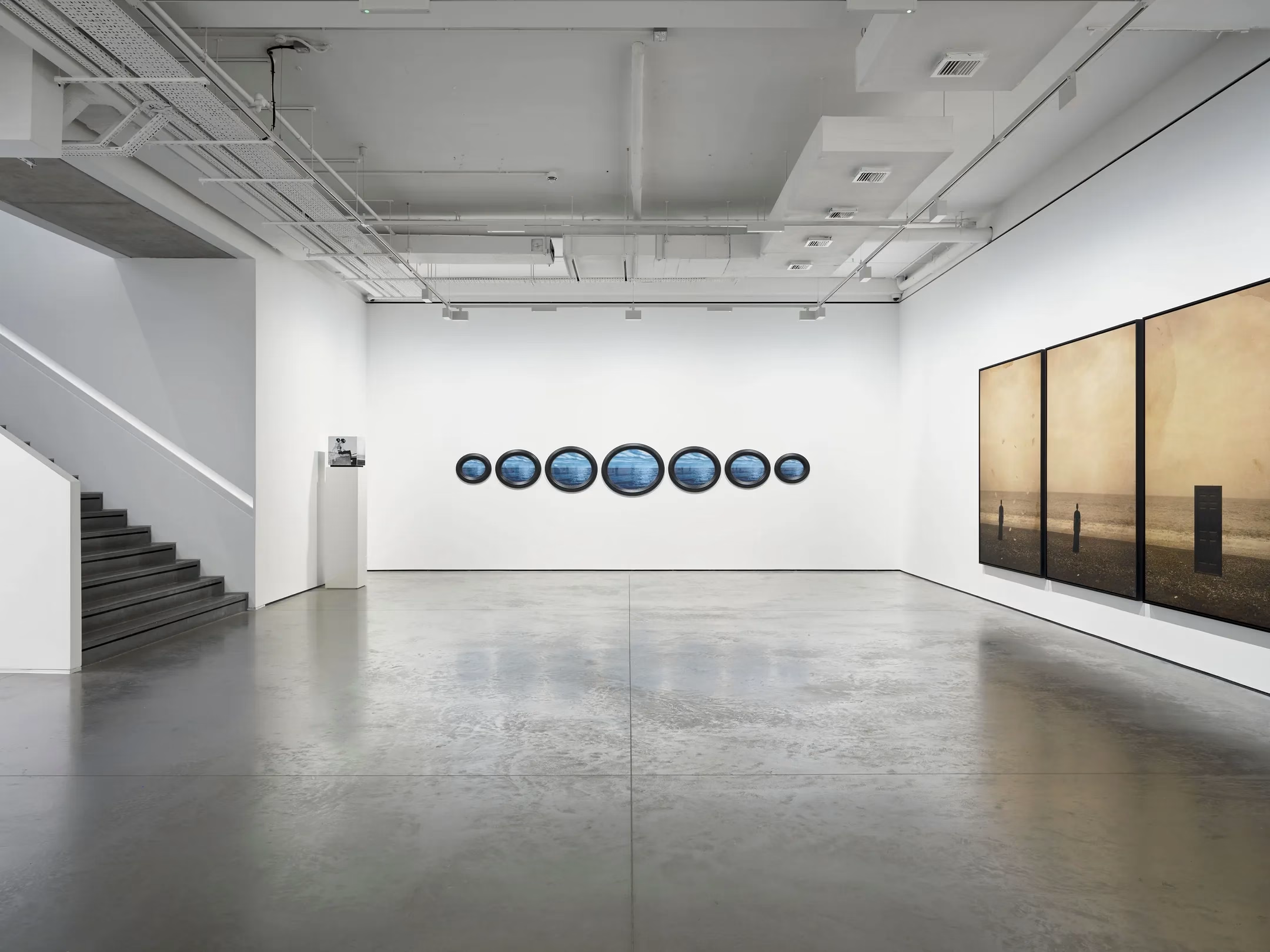
Upon examining the conceptual backbone and visual language of Carrie Mae Weems’ new exhibition at Goodman Gallery London, one can fully grasp the meditative atmosphere that permeates the space. I invite you on a conceptual tour of this staggering exhibition, which I have personally visited.
For over forty years, Carrie Mae Weems has been redrawing the boundaries of photography, video, and performance art. Standing on that uncanny threshold between history and image, she turns her focus in this new London exhibition to the unhealing wounds of migration, belonging, and the Atlantic crossing.
The Burden the Horizon Cannot Carry: Seaside
Undoubtedly one of the most poignant moments of the exhibition is the five-panel photographic series titled Seaside, where Weems returns to her iconic self-portraiture strategy of using her own body as a “witness.”
When you turn your eyes to this work, you see the artist sitting on a pebbly beach, her back to the vast horizon of the ocean. An easel stands before her; she is struggling to translate the unimaginable scale of the Atlantic crossing—that indescribable trauma—onto paper. However, as the series progresses, the artist stands up, and the wind ruthlessly scatters the pages of her sketchbook. This series serves as a silent yet screaming manifesto on how human representation, art, and even the image itself fall short in the face of displacement and historical trauma.
A Trial of Size and Irony: Immense Pain in Miniatures
While Weems emphasizes the ocean’s vast scale in Seaside, she adopts the opposite strategy in another corner of the gallery. The series titled The Law of Diminishing Returns consists of five small, oval-framed photographs. Reminiscent of early portrait photography, these miniatures imprison the massive tragedy of human bodies’ transoceanic journeys—spanning from the transatlantic slave trade to today’s modern economic migrations—within a tiny form. The modest dimensions of the work physically force the viewer to lean in, compelling them to witness those heavy historical consequences “up close” and directly.
Right beside it, the seven-part Ocean Line series, which isolates the horizon in a deep, saturated blue tone, proves that colors are areas of political resonance rather than mere aesthetics. That blue refers both to vast contemplation and to a bruised, battered body, transforming the horizon into a weighted field of reflection.
Accidental Abstractions: The Aesthetics of Censorship
The part of the exhibition that touches upon contemporary social memory emerges with the Painting the Town series. Photographing the shopfronts boarded up with chipboard and plywood during the civil protests following the murder of George Floyd, Weems leaves the viewer with an exquisite optical illusion.
At first glance, these nearly life-sized prints appear to be gestural, abstract expressionist paintings. In reality, however, Weems documents how those hasty brushstrokes—applied to shut down, hide, and censor protest and dissent—unintentionally create a new visual language and an accidental abstraction.
In Conclusion
Having filled her career with countless honors—from the Hasselblad Award to the MacArthur “Genius” Grant—and recently receiving the National Medal of Arts from President Joe Biden, Weems reckons with both the ghosts of the past and the political realities of today in this exhibition. As a side note, a new film by the artist, prepared for the launch of V&A East on April 17, is also currently screening in London.
There are only two and a half weeks left to physically experience this multi-layered, mind-bending, and empathy-provoking exhibition at Goodman Gallery. If you are in London, do not miss this historical confrontation.
Save the Date:
Venue: Goodman Gallery, London
Exhibition Dates: Until May 23, 2026 (Final weeks!)
Key Themes: Transatlantic history, censorship, and the politics of the horizon.