

What defines a nation? Is it a piece of land drawn with rulers and borders, or the endless dreams constructed in the minds of those who live on it, those who leave it, and those who return to it? Nigeria emerges not merely as a geography, but as a constantly shifting, flexible, and reinvented “field of images” with every generation. The exhibition “Nigeria Imaginary: Homecoming,” hosted by the Museum of West African Art (MOWAA), follows precisely this fluid identity, freeing the viewer from the illusion that Nigeria is a monolithic structure and inviting them to see it as a process.
From Venice to Benin City: The Anatomy of a Confrontation
This selection, which created a major international resonance as the Nigeria Pavilion at the 60th Venice Biennale in 2024, now returns to its own soil, to its true audience. Yet this “homecoming” goes far beyond a simple logistical operation. Freed from Venice’s sterile, outsider-observer atmosphere, the works begin to radiate an entirely different energy when merged with the historic and cultural fabric of Benin City. Curator Aindrea Emelife places the exhibition at the very heart of debates, contradictions, and hopes unfolding within Nigeria. Here, the concept of nation is no longer an academic discussion topic; it becomes an urgent reality that is lived, sweated over, and rebuilt every morning.
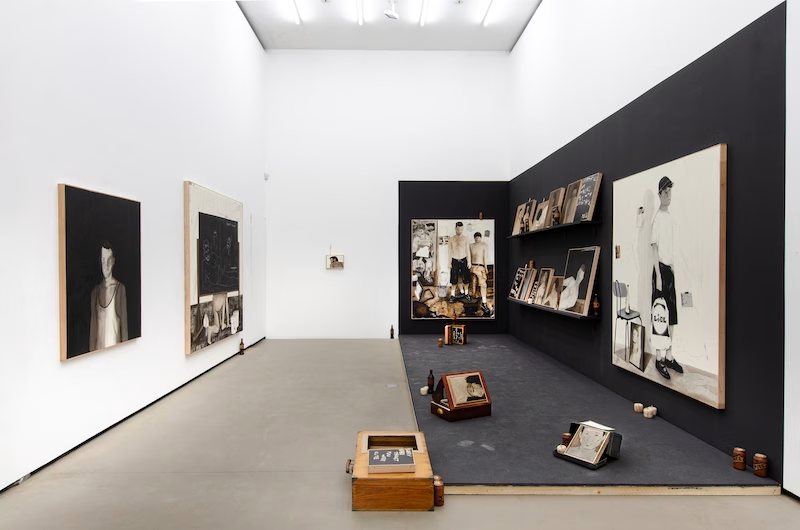
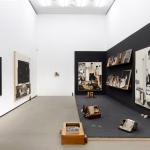
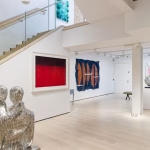
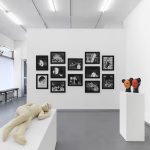
Spread across various points of the MOWAA campus, the exhibition takes the viewer on both a physical journey and a mental training that shakes inherited narratives. Located in the museum’s new research and conservation wing, these works concretely demonstrate how ancient traditions can be blended with the possibilities offered by modern technology.
Eleven Artists, Eleven Different Dreams
The real strength of the exhibition lies in the intergenerational dialogue created by eleven different artists. Each artist brings their own Nigeria to the table. Sometimes this Nigeria hides in the corner of an archival document, sometimes in the uncanny shadow left by a sculpture’s void, sometimes in the parasitic sounds of a film.
- Kelani Abass transforms archival materials and memories into visual puzzles that show how time layers itself. For Abass, the past is not a frozen moment but a fuel that constantly nourishes the present.
- Ngozi-Omeje Ezema takes ceramics beyond traditional molds, constructing enormous forms from thousands of suspended fragments. This fragmentation becomes the most elegant metaphor for Nigeria’s polyphonic yet somehow cohesive social structure.
- Yinka Shonibare addresses postcolonial confusion and cultural hybridity in his distinctive style, questioning Nigeria’s place in global history with ironic and striking language.
- Precious Okoyomon uses vegetal and ecological transformations to remind us that identity, like nature, exists in a constant cycle of formation, decay, and rebirth.
The exhibition spans a wide spectrum—from Tunji Adeniyi-Jones’s figurative dances arriving from London to Toyin Ojih Odutola’s meticulous portraits that build new skin with every line. For some artists, this exhibition represents the first opportunity to meet such a broad audience in their own country. When the “distant gaze” of diaspora artists meets the “inner voice” of local artists, the reality hits hard: Nigeria does not have a single story; it is composed of millions of stories stitched together.
MOWAA: Conservation and Future-Building
The journey of the exhibition is inseparably linked to MOWAA’s institutional vision. Rising in Benin City, this museum is not merely a cold storage space for objects; it is a living laboratory for the preservation, research, and transmission of West African heritage to the future. “Nigeria Imaginary: Homecoming” stands as the most significant proof of the museum’s protective yet innovative stance.
The curatorial team shows great courage by presenting the image of Nigeria not as nostalgic romanticism but as a contested and living field. The exhibition design moves the viewer from being a mere “observer” to becoming part of this collective imagination. At times you lose yourself in a text, at times you are confronted with the shocking reality of a film.
Reconstruction of Meaning and Collective Consciousness
“Homecoming” means far more than physically moving an exhibition from one place to another. It represents the deep and sometimes painful bond art establishes with its own roots. What is Nigeria’s national culture? How is this culture produced, and whose monopoly is it under? The multitude of different materials encountered throughout the exhibition—textile, sculpture, video, sound—all whisper the same thing: identity is not a frozen heritage but a process that is reinvented every moment.
Walking through the MOWAA campus, you encounter a different Nigeria at every corner. One struggles with the burden of colonial history, another gazes toward the bright yet uncertain light of a technological future. This exhibition once again proves how vital Nigeria is as an “experimental field” not only for West Africa but for world art as a whole.
In conclusion, “Nigeria Imaginary: Homecoming” invites us to free Nigeria from the fixed lines on maps and lose ourselves in the infinite geography created in the brushes, hands, and minds of artists. When the viewer leaves the gallery, they carry not only aesthetic pleasure in their pocket but also the question “Where am I in this dream?” And perhaps the true victory of art lies precisely in this question.