

Gallery Weekend Berlin: Transient Loves, Coagulated Blood, and Street Interventions in the Streets of Mitte

It is Gallery Weekend time in Berlin; as beautiful, dense, and yet transient as the cherry blossoms seeking refuge in the cracks of Mitte’s sidewalks. The galleries stretching along Linienstraße are bursting at the seams under the sun with art collectors, crypto investors, and youngsters debating just how authentic the works inside really are. In this most refined neighborhood of the city, we take a deep journey into the four most remarkable destinations of the 2026 edition that spill off the gallery walls and spread out into the streets.
1. Brett Charles Seiler: ‘occasional lovers’ — Galerie EIGEN + ART
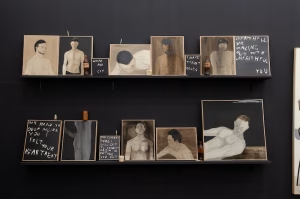
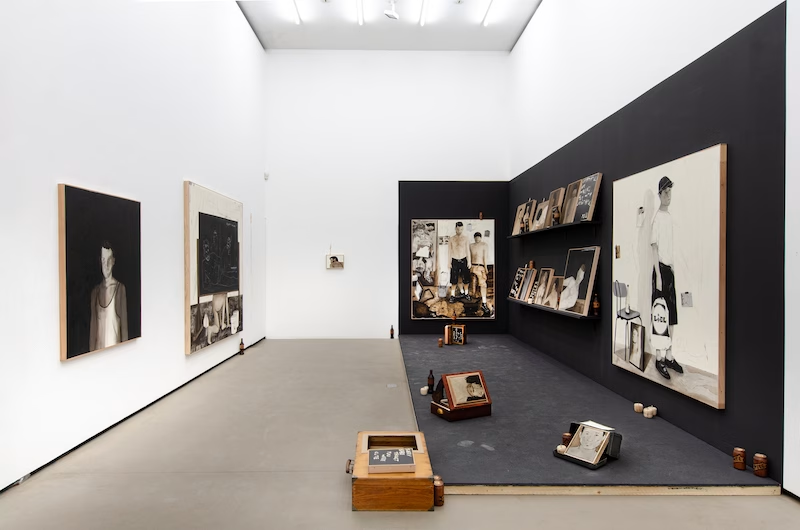
The moment you step through the doors of Eigen + Art, that sense of reality the teenagers talk about hits you right in the face. In his exhibition combining painting and installation, Brett Charles Seiler transfers figures from his studio onto canvas using bruised, soft color tones. Poetic fragments scribbled onto small canvases carry the literal intimacy of an old Tumblr post:
“The closest consumer relationship I can have with you is to eat you.”
Seiler has even included the gallery’s cleaning supply closet in the exhibition; hanging in that dark corner among the brushes and tools is a text-painting dedicated “To the last man standing in the darkroom.” Suitcases, serving as the visual traces of transient relationships, and half-smoked cigarette marks left on the gallery wall invite us into the artist’s intimate memory chamber like confidants.
- Core Themes: Loneliness, community, and raw proximity.
- Exhibition Dates: May 1 – June 20, 2026
- Address: Auguststraße 26, 10117 Berlin
2. Huang Rui: ‘《89》Ink-Stained Books’ — Nagel Draxler Kabinett
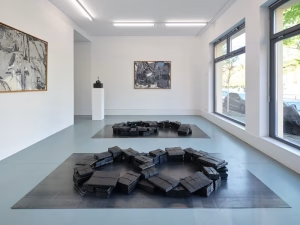
Following a short pedal toward Rosa-Luxemburg-Platz, we reach the exhibition of Chinese avant-garde artist Huang Rui, which digs deep into historical memory. Right in the center of the space, stacks of ink-stained books are arranged to form the numbers “8” and “9”. These two digits pay direct tribute to 1989, a shattering year of shared memory for both Beijing (Tiananmen Square) and Berlin (the Fall of the Wall).
Rui likens Karl Marx’s 6-volume corpus, tied up with ropes and covered in ink, to coagulated black blood. Noticing a single smooth stone bound with ropes resting atop this stack of books catches the eye. This stone is a kekkai stone, traditionally used to guard sacred boundaries and ward off negative energies. Under the weight of this ancient stone, the books are preserved like a forbidden wound, as if waiting to break free from their ropes one day.
- Core Themes: Political memory, censorship, and historical confrontation.
- Exhibition Dates: May 2 – June 27, 2026
- Address: Rosa-Luxemburg-Straße 33, 10178 Berlin
3. Björn Heyn: ‘Ätschi Bätsch’ — Galerie Gegen & Lücke
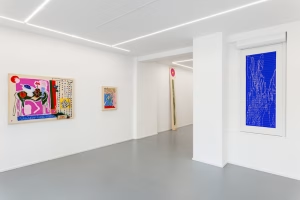
Two doors down at Gegen & Lücke, we are welcomed by Björn Heyn’s world bursting with joy and childlike energy. Dressed in clothes perfectly matching the colors of his artwork, the artist creates a performative warmth for visitors by noisily pulling up a painted spiral shutter that divides the gallery space.
Heyn’s paintings, which merge elements of still life with childlike drawings, have a highly unconventional production process. To create these primitive and raw forms, the artist works by tying his brushes or pencils to the end of a golf club or a thick block of wood. Pasting pieces cut from old canvases onto his new paintings as abstract shapes and flower petals, Heyn offers highly meticulously thought-out collages that completely reject hierarchy in art.
- Core Themes: Rulelessness, childlike dynamism, and performative joy.
- Exhibition Dates: April 30 – June 6, 2026
- Address: Rosa-Luxemburg-Straße 35, 10178 Berlin
This gallery tour in Berlin demonstrates that art is not merely a luxury investment vehicle exhibited within white walls; it can find life in the bed of a pickup truck on the street, among brooms in a storage room, or within a coagulated ink stain.