

The famous Gallery Weekend is finally here—that time of year when every street transforms into a festival ground and galleries cluster within walking distance of one another. Despite being locals, we dressed up a notch higher than usual, embraced that sweet “tourist” vibe, and set off toward the familiar routes of Schöneberg. The mixture of anticipation and satisfaction on the faces of the crowds flowing from one exhibition to the next, like traffic on a two-lane highway, heralded the arrival of spring and Berlin’s transition into its high-frequency summer energy.
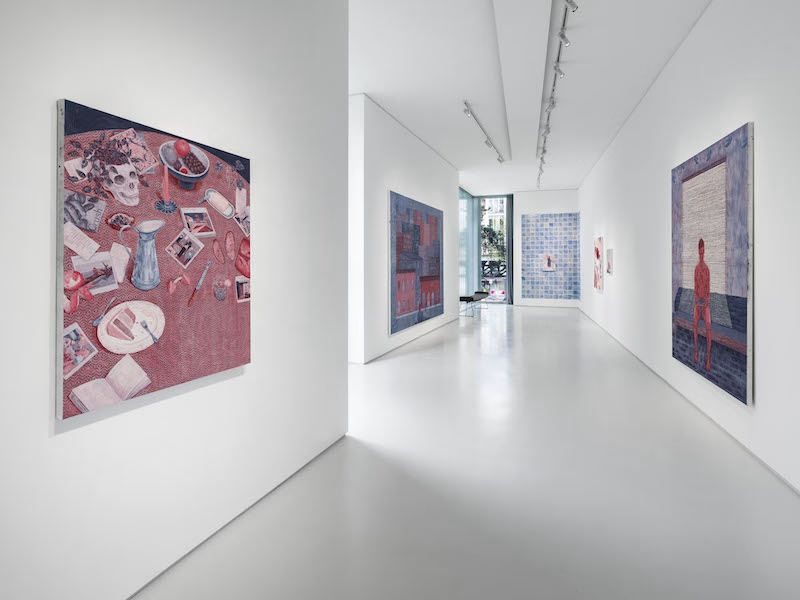
Our first stop of the day was Die Tankstelle (Galerie Judin), a charming space converted from an old 1950s gas station that invites you in with its lovely red-awning cafe out front. As soon as we stepped into the luminous gallery, we were confronted by Adam Lupton’s exhibition, ‘Too Sure of the Sun.’ Lupton possesses a self-revolving, deeply intimate, and introspective world. His figures—staring into the void or lying face down—are surrounded by the debris of the everyday: kitchen table scraps, to-do lists, or bathroom tiles. A restricted blue-red color palette and masterfully composed contrasting textures (the juxtaposition of stained skin against a geometric rug) transform these ordinary objects into a highly specific map of an inner world. It was a jarring and, frankly, unforgettable start to the day.
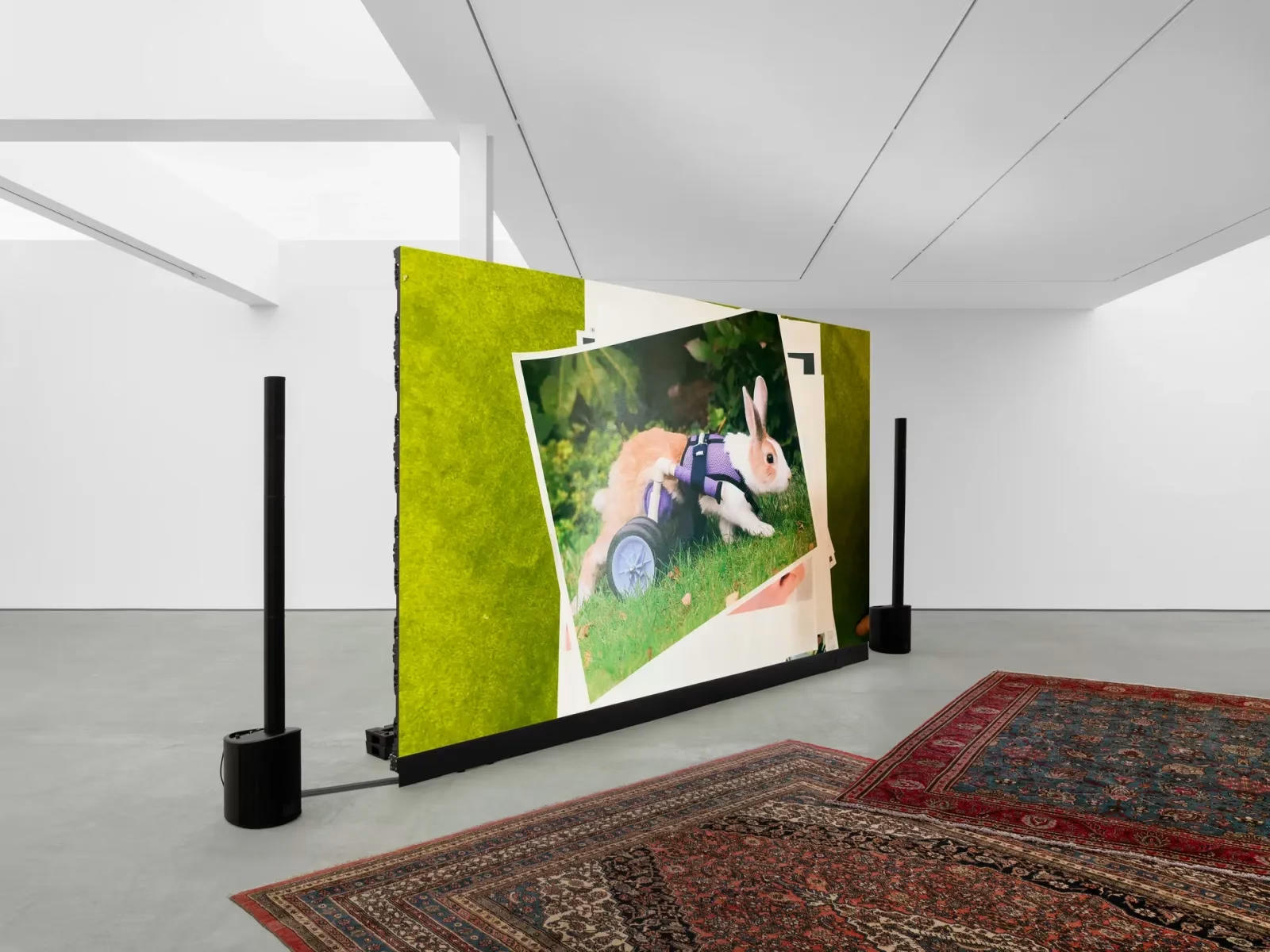
Just around the corner, we moved on to Galerie Molitor for Ketuta Alexi-Meskhishvili’s solo exhibition. After Lupton’s hyper-personal and graphic world, this felt like a visual blind spot. The room was filled with massive chromatic prints that appeared entirely analog at first glance but were actually the product of a camera-less process (a technique using aluminum sublimation and C-prints derived from the artist’s Instagram screenshots). Focusing on the uncanny ambiguity of the female form, Alexi-Meskhishvili chooses to deliberately obscure reality rather than reveal it. I suppose that’s the best part of gallery-hopping: seeing how meaning and sensation flow in sharp contrast from one space to the next.
One of the most “quintessentially Berlin” stops on our route was undoubtedly Schiefe Zähne. There are no directional signs outside—just a small name on an old doorbell. You climb three flights of beautiful old stairs and dive directly into an apartment that serves as the heart of the exhibition.
When we entered, the artist Lukas Quietzsch was sipping a cappuccino next to the coffee machine, right by the exhibition texts lined up on the kitchen counter. The text for the exhibition, titled ‘The Appeal of Individualism,’ was an experimental narrative describing the strange tension of being an individual within a crowd. This loose and ambiguous structure continues in his massive abstract canvases, where figure and background never quite fully detach. And the key detail: Quietzsch paints these canvases not with brushes, but with teddy bears! That childlike playfulness, combined with the intimacy of the space, resulted in a deeply sincere experience.
The Chaos of Mercator Höfe and a Return to the Middle Ages
Following these three stops, we merged into the dense courtyard complex of Mercator Höfe on Potsdamer Straße, the heart of Schöneberg. Coffee stands, music, queues stretching from one building to another… You could take the elevator up to Esther Schipper or join the crowd at the door of Max Goelitz.
Our favorite in this courtyard was the José Montealegre exhibition at Galerie Thomas Schulte, located on a warm second floor that felt almost like a living room: ‘Drastic Measures.’ It is rare in contemporary art to see modern grievances expressed through a medieval visual language. The show featured empty armor made of steel hammered to the artist’s own body measurements, meticulously arranged metallic “bouquet” forms, and wall drawings reminiscent of old fresco preparations. Violence and fragility stood shoulder-to-shoulder in perfect balance within a single room.
We concluded the day by returning to where we started, at the main space of Galerie Judin. For Jorinde Voigt’s exhibition, ‘Non Fiction,’ every room had been painted in deep, saturated colors. Standing before Voigt’s massive paper works created with ink and pastel, you cannot decipher whether you are looking at a microscopic cellular structure, bodily tissue, or a vast cosmic atmosphere. The sense of eerie intimacy and mystery contained within that massive scale provided a perfect meditative space to end the day.
Of course, it is impossible to fit the entirety of Gallery Weekend’s massive map across the whole city into a single day. However, this Schöneberg route alone reminded us once again how meaning is carried organically through the streets with the right sequence and curation.
Exhibitions on the Route:
- Adam Lupton – “Too Sure of the Sun” | Galerie Judin (Die Tankstelle) | May 1 – June 14, 2026
- Ketuta Alexi-Meskhishvili – “Georgia” | Galerie Molitor | May 2 – June 19, 2026
- Lukas Quietzsch – “The Appeal of Individualism” | Schiefe Zähne | May 1 – June 26, 2026
- José Montealegre – “Drastic Measures” | Galerie Thomas Schulte | May 1 – June 6, 2026
- Jorinde Voigt – “Non Fiction” | Galerie Judin | May 1 – June 6, 2026