

Seeing the World from the Other Side: Rodney Graham and the Upside-Down Oaks in London

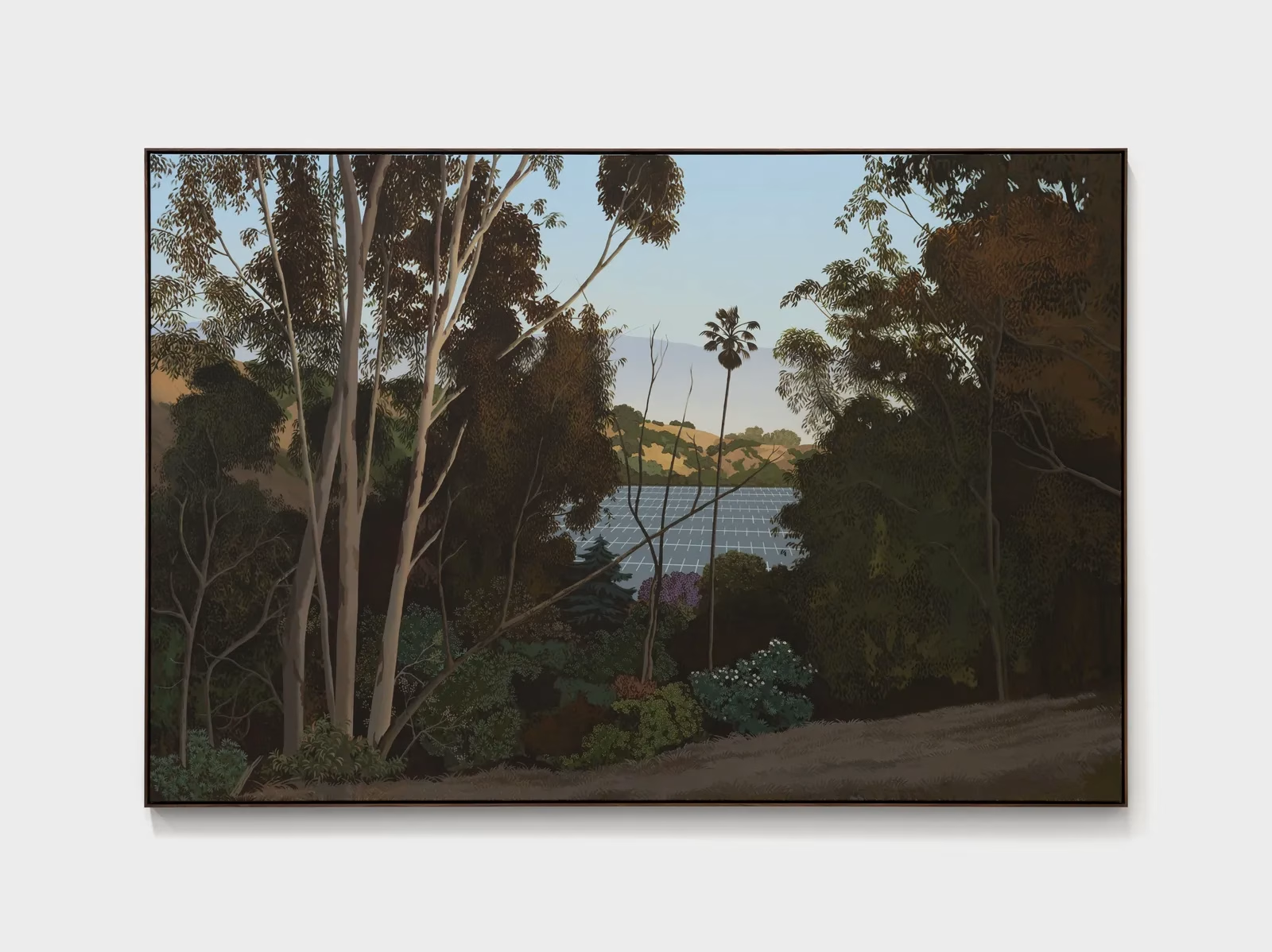
London’s hazy February morning on Bell Street greets us today with nature in its most honest form—yet through an utterly unfamiliar perspective. On the London floor of Apartment No:26, the windows this month open onto impenetrable forests and colossal oak trees hanging upside down. The late artist Rodney Graham’s 15th solo exhibition at Lisson Gallery, titled “Who Does Not Love a Tree?”, combines his utterly singular bond with nature with melancholic humor and technical brilliance. Graham sees trees not merely as shade-giving plants, but sometimes as thirty-thousand-limbed monsters, sometimes as actors waiting under stage lights. This exhibition is a tribute to the pure, “uncorrected” state of vision before the retina passes the image to the brain. If you are tired of life’s chaos and longing for a story of “taking root,” the air on this floor will offer you both a familiar calm and an unsettling reversal of the mind.
The Honesty of the Retina: Why Are the Oxfordshire Oaks Upside Down?
At the heart of the exhibition lies Graham’s Oxfordshire Oaks series—black-and-white photographs taken in 1990 between Oxfordshire and the Cotswolds. Shot with a large-format camera, these monumental oaks are hung upside down on the gallery walls. This is no curatorial mistake; it is the result of Graham’s obsessive fascination with the principles of the camera obscura.
Our eyes actually perceive the world upside down; the brain corrects the image in fractions of a second. Graham refuses this intervention, leaving the oaks exactly as they are—before the brain steps in. This “iconic inversion” transforms the trees from natural objects into heroes suspended in empty space. Walking the corridors of our apartment and looking at these photographs creates a dizzying sensation—as though the building’s foundations are in the sky and its roof is buried deep underground.
The Ghost of the Trees in Max Porter’s Language
Accompanying the exhibition is an “accidental novella” written by the acclaimed author Max Porter (known for Lanny and Grief is a Thing with Feathers). Porter describes Graham as a sentimental silviculturist. Presented in bursts of 100 words each, these texts complete the exhibition’s uncanny yet poetic atmosphere. In Porter’s words, the trees become one of Graham’s thousand-faced characters—sometimes a generous shade, sometimes a silent stranger watching us.
Voices from the Boiler Room: Potatoes and Helicopters
On the lower level of the exhibition—referencing our building’s Boiler Room (Cinema/Video) section—two opposing poles await us: a noisy surveillance tower and an absurd performance.
Edge of a Wood (1999): This two-screen installation shows a helicopter patrolling the edge of a forest, sweeping it with dark and menacing light. Here Graham takes the romantic image of the tree and collides it with the mechanisms of surveillance and control in the modern world. The forest is no longer a refuge; it becomes an uncanny zone where the “unknown” is being watched.
Lobbing Potatoes at a Gong (2006): In this work Graham pays homage to the Fluxus and Dada movements of the 1960s by portraying a long-haired musician throwing potatoes at a gong. Carrying echoes of Syd Barrett and Pink Floyd, this piece represents the peak of Graham’s famous aesthetic of “appearing to do something while doing nothing at all.”
Exhibition Details
Artist: Rodney Graham
Venue: Lisson Gallery, 27 Bell Street, London
Dates: February 18 – April 11, 2026
Don’t Miss: The conversation with writer Max Porter at the gallery on the evening of February 19—an unparalleled opportunity to understand the literary layers of the exhibition.
In Rodney Graham’s world, nothing is as it appears—or as it stands. In this rainy February in London, the London floor of Apartment No:26 invites you to think everything upside down.