

There are certain directors in cinema who don’t merely tell stories — they build worlds. Amanda Kramer is precisely that kind of “architect.” For those who love theatrical aesthetics, Brechtian alienation effects, and the artificial yet mesmerizing atmosphere of constructed realities, Kramer remains one of the most singular voices in contemporary filmmaking. Her latest film By Design, which premiered in the NEXT section of the 2025 Sundance Film Festival, elevates this distinctive vision to a new level: Juliette Lewis’s soul becomes trapped inside an elegant wooden chair.
The Desire to Become a Chair
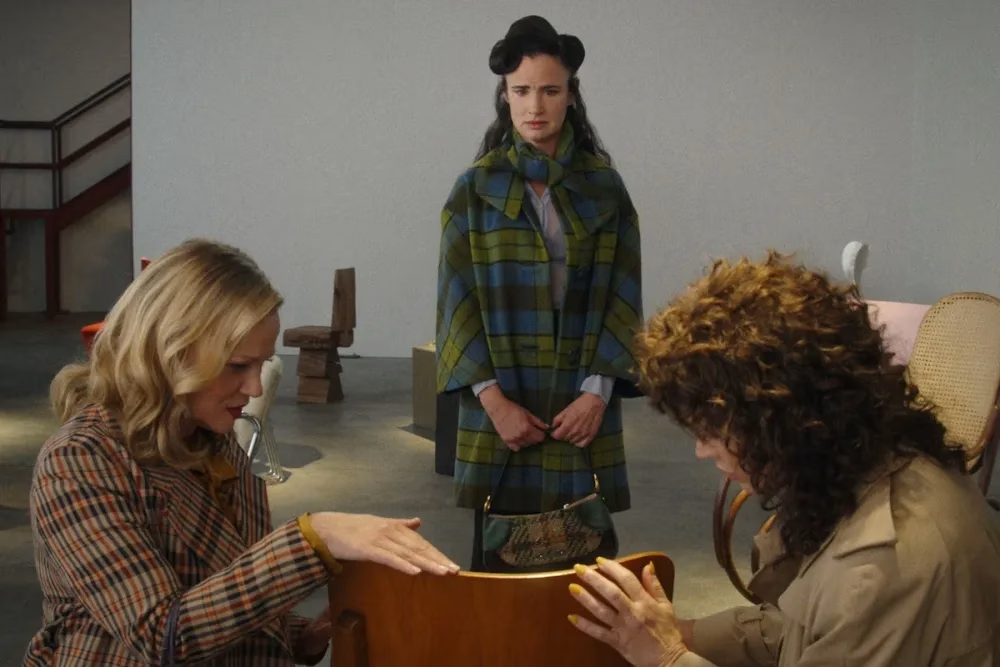
In the film, Juliette Lewis brings Camille to life. While browsing shop windows with friends, Camille falls in love with an ordinary yet captivating wooden chair (a Baumann design). Unable to purchase it, she returns the next day with all her savings, only to learn the chair has already been sold. The woman who bought it (Marta) sent it as a farewell gift to her ex-lover, the pianist Olivier (Mamoudou Athie). Overwhelmed by grief at this loss, Camille’s soul leaves her body and enters the perfectly crafted object — the chair. While Camille’s body remains an empty shell, a strange and unsettling bond forms between Olivier and the “chair.”
Kramer’s Aesthetic Blender: “Not Stolen, but a Hypnagogic Memory”
From interviews with Kramer, we understand that the director despises the traditional mood-board method. To her, pasting a still from The Shining is nothing more than redundant repetition. Instead, she shuffles the “Rolodex” of her mind — her memory cards.
The film evokes the atmosphere of the mid-1980s — but not the 1980s of history books. In Kramer’s words, it is “a hallucinatory memory of the 1980s.” In this universe without cell phones, swipe gestures, or text bubbles, the story unfolds in that hazy “hypnagogic space” between dream and recollection. The director openly states that she is not interested in contemporary life, deliberately trapping us in a timeless aesthetic.
The Chair Selection: The Elegance of Unpretentiousness
The Baumann chair at the heart of the film was chosen after extensive research with production designer Grace Surnow. Kramer explains the philosophy behind this choice:
“We found a chair with no energy at all — ‘vibeless,’ beautiful but extremely simple. So plain that you would walk past it without noticing; but if you stop and look, you see its incredible elegance.”
For Kramer, this simplicity represents a desire many women strive for but fail to achieve because they don’t trust themselves to be simple/plain. Camille’s ontological bond with the chair is directly linked to her own insecurities and search for safety.
The “Dark” Inversion of the Body-Swap Genre
In cinema history, body-swap films are usually played for comedy: the panic of “Oh no, I’m in the wrong body!” generates laughter. Kramer, however, reimagines the genre as a horror and moral fable.
As she explains in interviews, these films typically end with the character realizing, “I actually loved my life and my body after all.” In By Design, Camille takes immense pleasure in spending the rest of her life as a chair. This is a radical and melancholic inversion that rejects the genre’s conventional “Christian moral” resolution.
Casting and Physicality
For Kramer, Juliette Lewis is not just an actress but a “magnificent doorway” through which other performers can enter. The director believes Lewis’s timid yet quietly resolute demeanor perfectly matches the chair’s unpretentious elegance.
Kramer’s theatrical background directly influences the use of the body in the film. She exploits cinema’s ability to fragment the body (showing only hands or feet) as if dismembering a mannequin. The ecstatic dance scenes juxtaposed with a completely motionless body (or chair) beautifully capture that uncanny void where the mind dances while the body remains silent.
Apartment No:26 Note
Amanda Kramer proves with By Design that cinema is not merely a storytelling medium but can also be a plastic art form. Echoing Peter Greenaway’s remark that “cinema could have been the painters’ medium, but it wasn’t,” Kramer reclaims cinema for painters and designers.
The film speaks in a shattering language about our pathological obsession with objects, our desire for objectification, and the dream of escaping the heavy burden of “carrying a soul” that comes with being human. If you are tired of the comfortable harbors of mainstream narratives and want cinema to act like a blender — mixing everything and serving you an entirely different dream — prepare to sit in this wooden chair. But be warned: you may not want to get up.