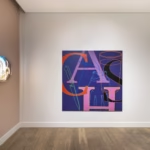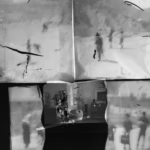


For nearly thirty years, Jeff Davis tried to completely erase the handprint—the inevitable messiness of being human—from his art. Throughout his painting and drawing journey, which began with a Master of Fine Arts, fingerprints on the canvas, imperfections of the paper, and the unexpected flaws of the physical world felt inadequate to him. He dreamed of a flawless, perfect process, akin to Plato’s ideal forms, Alan Turing’s algorithmic logic, or the generative art pioneer Vera Molnár. He found the solution in computer computation and transitioned to digital, generative systems. Lines were now governed by codes, producing mathematically perfect curves. The body and all the errors it brought along were left outside the process.
However, things changed midway through the artist’s career while preparing a retrospective exhibition. When he hung his early physical works right next to his recent digital, code-based pieces, he noticed something: his journey in art was not a linear progression, but merely a chosen direction. And directions could be changed whenever desired.
Doing What the Pixel Cannot: The Resistance of Paper
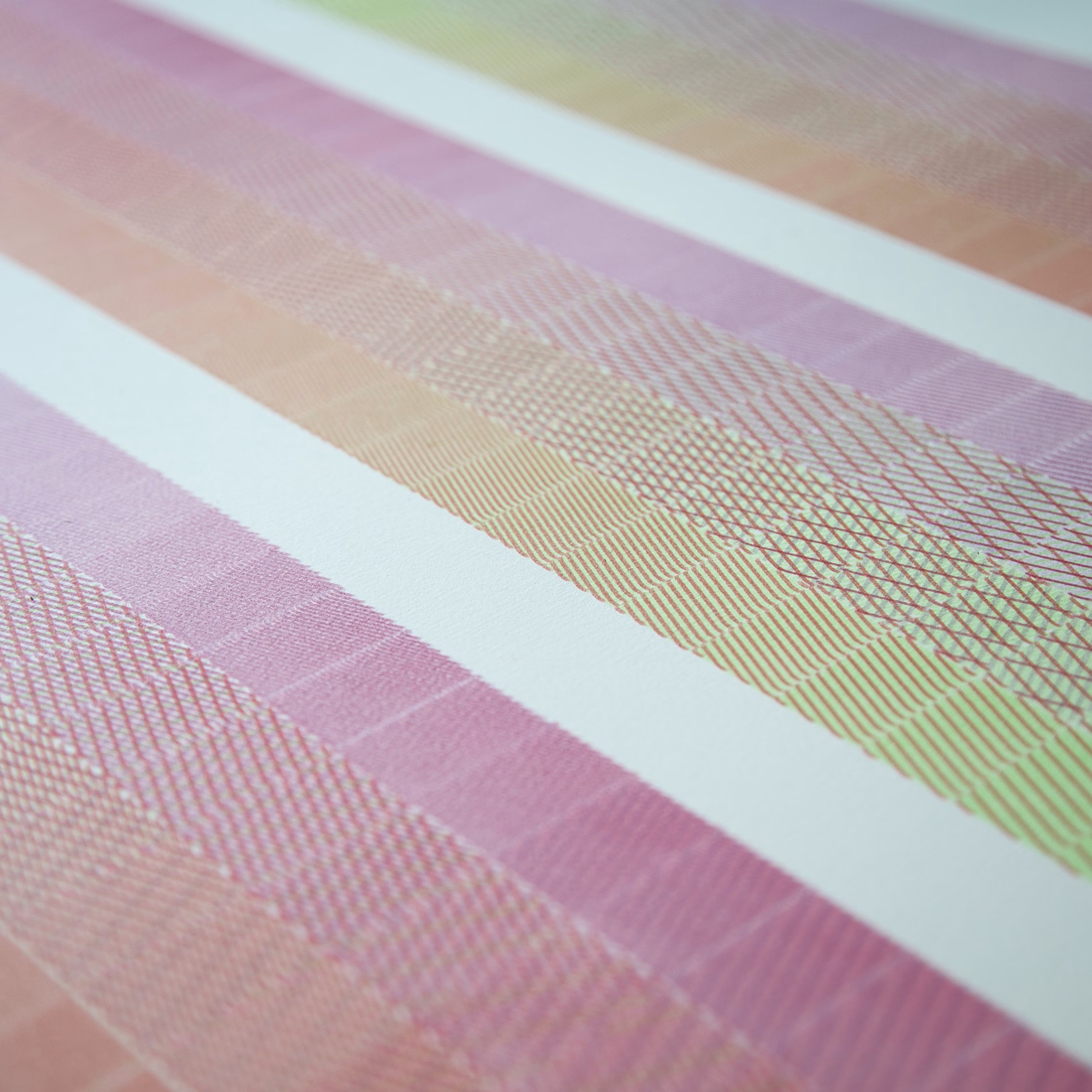
Opening its doors at OFFICE IMPART in Moabit, “Mechanical Drawings” is the story of this sharp return. The large-format drawings measuring 56 × 76 cm in the exhibition were algorithmically generated; however, this time they were not left on a digital screen. The codes were put onto paper using a standard graphite pencil attached to the tip of a plotter machine.
Each drawing requires approximately ten hours of uninterrupted labor at the machine. Instead of digital gradients, a color tone is constructed through mechanical scanning and shading done on the paper by four different pencils. This is exactly where the breaking point begins: every time the pencil rubs against the paper, the paper physically resists, the pencil tip dulls over time, and it leaves faint graphite smudges on the paper. Pixels never behave this way.
The Difference Sensed by the Eye
The question Davis asks is actually quite simple: Can the human eye distinguish this organic difference? Is it our intuition or our visual background that perceives that subtle optical distinction between the pencil-and-paper and the screen? Mechanical Drawings transforms this abstract question into a tangible, visible experience. Because when looking back at the past, what remains in the mind is not mathematical perfection, but those small errors and traces left behind by the material.
While the exhibition can be viewed physically at Waldenserstraße in Moabit, the artworks simultaneously continue to live on-chain on the Art Blocks platform. In this structure where the digital and the physical do not establish a hierarchical superiority over one another, the code merely gives the instruction, while that concrete graphite line on the paper becomes the true home of the artwork.
Exhibition Details:
- Venue: OFFICE IMPART, Waldenserstraße 2–4, Moabit / Berlin
- Artist: Jeff Davis
- Exhibition Title: Mechanical Drawings
- Dates: June 9 – July 3, 2026 (Opening today!)
- Admission: Open to the public and free of charge