

An Art-Filled Summer in Europe – 6 Extraordinary Itineraries from Churches to Tennis Courts, Shotgun-Blasted Novels to Sweet Revenges


For those who wish to step outside the standard summer itinerary of sea, sand, and sun, and fill their vacation with mind-refreshing contemporary art discoveries, we are spotlighting 6 of the most provocative, multi-layered, and paradigm-shifting summer exhibitions across Europe, selected by No-26 editors. Stretching from abandoned old churches to archives of personal failure in the Norwegian fjords, these routes are determined to add a completely different intellectual depth to the summer season.
Here are those fresh and striking exhibitions you should add to your European travel agenda:
1. A Tennis Match in a Gothic Church: Asad Raza (Kunsthal Gent, Belgium)
Dates: May 29 – August 30, 2026
When you step into Kunsthal Gent, converted from a former Carmelite monastery and church, you find yourself in an extraordinary dimension where three different social realities intertwine: historical church architecture, a contemporary art center, and an active tennis court. Artist Asad Raza’s installation titled “Untitled (plot for dialogue)” presents an active tennis court covered in an assertive orange among the Gothic church’s stained-glass windows, bare brick walls, and potted plants. In this work, where visitors are invited to play tennis on the court accompanied by an instructor, the rhythmic, metronome-like bouncing sound of the tennis ball echoing from the mezzanine floor draws you toward the philosophy of the venue like a hypnotic pendulum.
2. Fragile Bodies and the Boundaries of Material: Yein Lee (Cukrarna Gallery, Slovenia)
Dates: May 21 – August 30, 2026
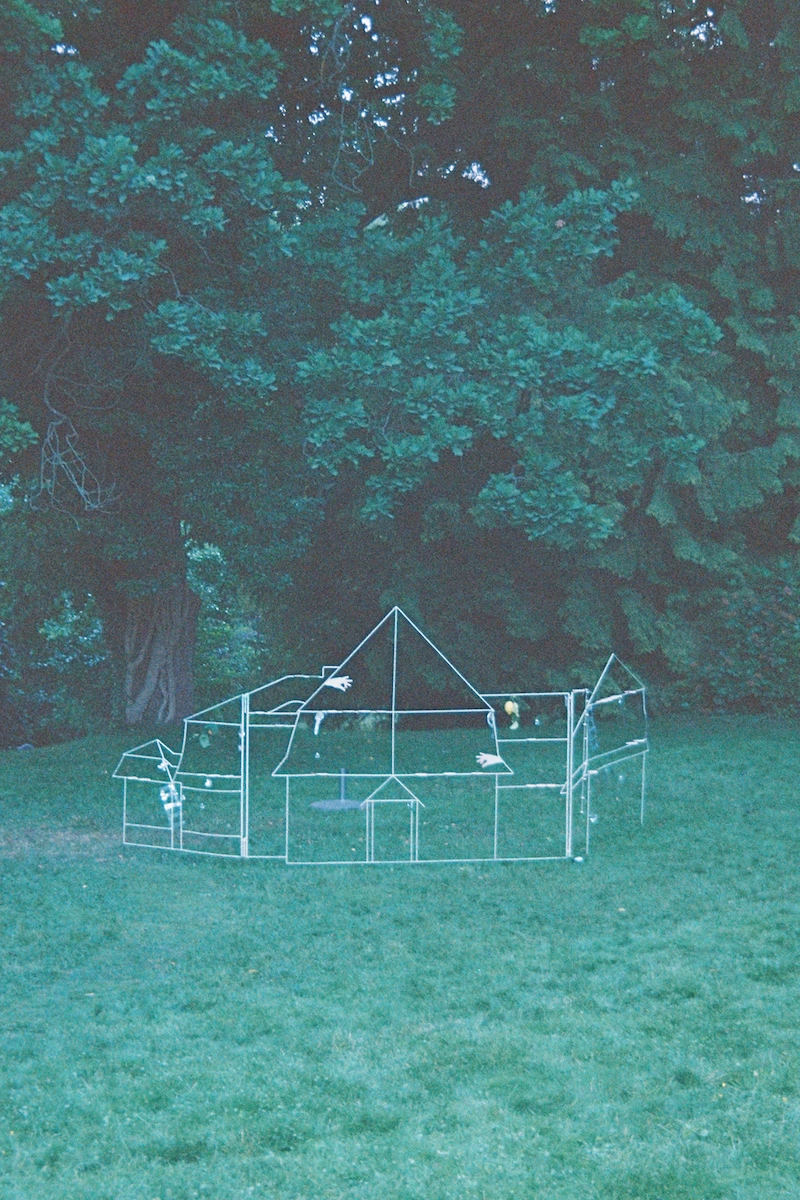
Taking place at Cukrarna Gallery in Ljubljana, “Accomplice” opened its doors as South Korean artist Yein Lee’s first major institutional solo exhibition. The sculptures in the exhibition, curated by Ema Ograjenšek, offer a complete performance of imbalance and fragility with forms that hang in the air, lean against surfaces, crouch, or root into the ground with branch-like extensions. Lee conceptualizes sculpture not as a static, finished, and frozen form, but rather as a living field of tension where those delicate, fragile, and incomplete relationships between bodies and materials are made visible.
3. “Sweet Revenge” Stripped of Identity Labels: Felix González-Torres (Museo Reina Sofía, Spain)
Dates: May 27 – October 12, 2026
Bringing together more than 50 works by the legendary artist Felix González-Torres, the exhibition “Dulce Venganza” (Sweet Revenge) meets viewers in Madrid. The artist’s previous exhibition in Washington had been criticized on the grounds that it covered up his gay identity. Curators Nancy Spector and Alejandro Cesarco state that the artist wanted his works to be read without identity labels, yet today, even thirty years after his death, it is impossible to separate his blue-cellophane-wrapped candy spills or paper stacks from the oppressive political climate of 1980s and ’90s America. Because the dark atmosphere of that time bears an eerie resemblance to today’s world.
4. Embracing Failures: Vibeke Tandberg (Kode, Bergen, Norway)
Dates: May 23 – September 13, 2026
What do you think Norwegian artist Vibeke Tandberg did when her first two novels were torn to shreds by critics? She bought all the remaining copies and shot at them with a shotgun! What remains of those bullet-ridden books greets visitors in a display case at the entrance of the Kode museum in Bergen. In the exhibition titled “De lever,” the rejection letters and documents of failure the artist received throughout her 30-year career are also proudly displayed. This includes an honest fax message from a curator at a photography institute in Rotterdam that begins with, “Bad news… Your project was found to lack depth.” It is a wonderful, witty, and bold slap in the face to the art world’s artificial illusion of perfection.
5. A Visual Ghazal on Linen: Suleman Aqeel Khilji (White Cube, Paris)
Dates: June 11 – July 25, 2026
In this exhibition, which is starting its farewell run as the end of July approaches and entering its final days to be experienced in Paris, Suleman Aqeel Khilji builds a literal visual ghazal on the walls of White Cube Paris. Inspired by the ghazal, a classical poetic form that passed from Arabic into Persian, Urdu, and Hindi, the artist uses free associations between symbols in his paintings rather than a plotline. In the works made with oil paint and pigments on linen, elongated figures in white cricket attire, curling flames, and stray dogs turn into symbols of loss, longing, and the traces left behind. The exhibition’s Urdu title, “Transmission | نشریات”, whispers the timeless frequency of messages and images sent from afar.
6. Hacking Empty Churches with Art: “Manifesta 16” (Ruhr Region, Germany)
Dates: June 21 – October 4, 2026
In Germany’s industrial heart, the Ruhr region, modernist Catholic churches shaped by the labor of immigrant workers during the urban reconstruction process are now left empty without a congregation. Around 20,000 churches across Germany are expected to be closed for worship over the next decade. This year, under the title “This is not a church,” the nomadic European biennial Manifesta 16 takes up residence in 12 former church buildings in Duisburg, Essen, Gelsenkirchen, and Bochum. Instead of renovating old church pews or organ pipes, the curators have installed works that achieve perfect harmony with the unique architecture of the buildings. For instance, Elizabeth Price’s video work “HERE WE ARE” (2025), exhibited at the Kulturkirche Liebfrauen in Essen, delves right into the church’s modernist structure and the memory of immigrant labor on-site. It is a powerful, site-specific experience that no sterile gallery environment could ever deliver.
NO-26 Recommendations
-
For Concept Enthusiasts: The idea of playing tennis in a church in Ghent, Belgium, offers a unique opportunity to experience the contrast between sacred space and secular play. If your path crosses it, definitely grab a racket!
-
For Memory Activists: While eating Felix González-Torres’s candies in Madrid, think about the heartbreaking parallels the work establishes with today’s political world.
-
For Courage Seekers: Look at Vibeke Tandberg’s bullet-ridden books in Bergen, Norway, and remind yourself that rejection and failure are just as intimate and transformative parts of art and life.