

In today’s contemporary art world, labels such as “women’s photography” or “women artists” are frequently trapped within that comfortable marketing space where feminism and capitalism intersect. Exhibitions of this nature, which attempt to generate value purely through identity politics while lacking authenticity and courage, unfortunately risk turning into a form of window dressing rather than serving genuine justice.
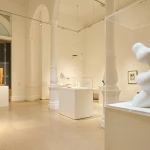
However, when it comes to bringing to light women whose names were deliberately or carelessly erased from history’s official narrative, this historical revision becomes an inescapable necessity. The exhibition New Woman, New Vision: Women Photographers of the Bauhaus, which opened its doors at the Museum für Fotografie in Berlin, stands as one of the most magnificent examples of this. While presenting the luminous contributions made to the movement by the women who attended the Bauhaus school, the exhibition offers living proof of how the camera transformed into a tool for financial emancipation and self-reinvention for a woman.
Forget the Bauhaus You Know: “Neues Sehen”
Let’s be honest; the image of Bauhaus in most of our minds is confined to architecture, iconic chair designs, rigid color theories, and that flawless balance between form and function. Including photography in this equation rarely crosses our minds.
Yet, the Neues Sehen (New Vision) movement embraced by Bauhaus professors viewed photography as an independent form of expression completely separate from the art of painting. Challenging the rigid and mechanical “New Objectivity” (Neue Sachlichkeit) movement of the period, this approach relied entirely on subjectivity. For them, the camera lens was an extension of the body—an extra eye to perceive the world, a new vision.
Rebellion in the Mirror: Masculine Attitude and Cigarette Smoke
The main pillar of Bauhaus was experimentation, and the self-portrait transformed into the most fertile playground for this spirit of inquiry. By turning their cameras upon themselves and one another, women photographers succeeded in carrying the female roles imposed by the era beyond binary gender norms:
- The Demolition of Social Roles: Short-cropped hair, trousers, and masculine jackets were the manifesto of an unmarried, financially independent woman earning her own money in the cosmopolitan atmosphere of the era.
- Grit Kallin-Fischer’s Cigarette: In the artist’s work Selbstporträt mit Zigarette (1928), her portrait lying carefree on the ground, lost in thought with a cigarette in hand, was revolutionary for its time. In those years, it was considered vulgar by society for a woman to smoke a cigarette in such a raw, melancholic manner without utilizing a cigarette holder. This frame was a radical aesthetic declaration of a woman’s mode of existence in society.
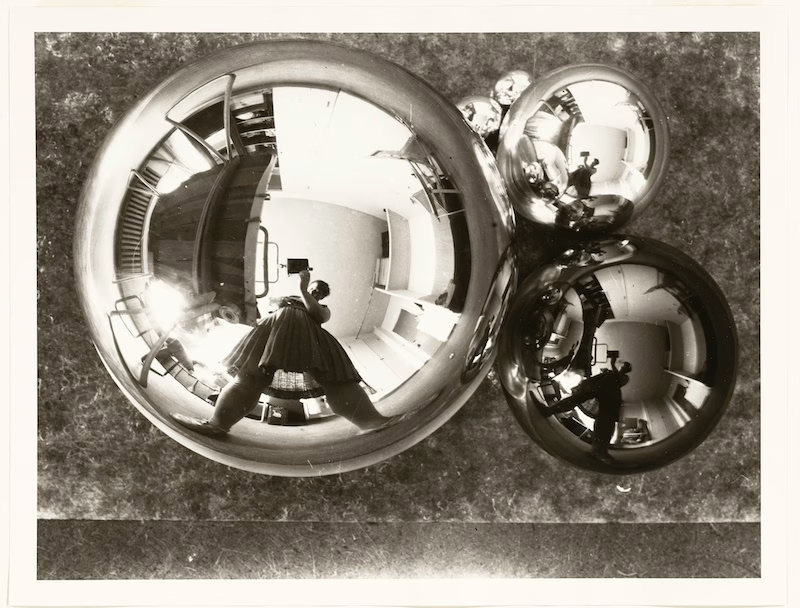
- Marianne Brandt and the Sphere: Brandt’s iconic self-portrait, capturing herself and her camera through the reflection of a metallic sphere in the studio, was one of the cleverest formulas for bending space and object.
Rulelessness in the Darkroom: From Minimalism to Layers
The clean lines, strict minimalism, and principle of clarity that come to mind when Bauhaus is mentioned yield their place in the hands of the women in this exhibition to a conscious chaos, embellishment, and abstraction. Instead of engaging in documentary documentation, they construct a language filled with textures and evocations.
The artists push the boundaries of photography through darkroom tricks such as double exposure, solarization processes, and photograms. For instance, Elsa Thiemann’s photograph of the Berlin Radio Tower, shot from the very bottom looking upward, transforms an ordinary steel structure into an abstract, kaleidoscopic portal. Lucia Moholy, on the other hand, merges the human figure with the geometric layers of architecture—stairs, verandas—in such a way that the body becomes a part of the space.
Redefining the Future
As noted by the Bauhaus-Archiv; “the visual archetype of the new woman finds its double in the experimental style of the new vision.” This synergy between women and the camera did not merely provide creative fulfillment; it gave them the opportunity to determine their own destiny, establishing a life filled with financial autonomy and artistic pleasure.
If a photograph is a tool that determines what is worth seeing and valuable in the world, these photographers took the lens into their own hands to both shout who they were to the world and shake aesthetic rules to their core, offering a brand-new vision of who they could become.
Exhibition Notes:
- Exhibition Title: New Woman, New Vision: Women Photographers of the Bauhaus
- Venue: Museum für Fotografie (Museum of Photography), Berlin
- Exhibition Dates: Running until October 4, 2026
- Key Techniques: Double exposure, solarization, photograms, unusual angles, and Neues Sehen aesthetics.