

Away from the noise of jukeboxes, slot machines, and television screens, we journey back to an old London where only pure conversation and a smoky, aristocratic idleness reigned supreme. Author Darren Coffield’s newly released biography, Hen: Mistress of Mayhem – A Portrait of Henrietta Moraes, retraces the footsteps of the legendary 1950s model, muse, and memoirist Henrietta Moraes, leading us straight into the ultimate sacred shrine of Soho: “The French House” pub (known at the time as the York Minster), which still stands today. This excerpt filtered from Coffield’s book offers a wonderful map for anyone wishing to escape the seamless sterilization of the modern world and seek refuge in the uncompromising, singular bohemian spirit of the past.
In the early 1950s, Soho—perched right in the heart of the West End—was an extraordinary village with its own rules, not yet sacrificed to a global entertainment industry. In reality, Henrietta’s unconventional life followed a highly disciplined rhythm. Late in the morning, she would emerge from her attic flat on Dean Street and walk with her lover, Michael Law, toward Café Torino—dubbed “The Madrid” by regulars—on the corner of Old Compton Street. It was a chaotic venue blended with the scents of old rubber, heavy disinfectant, and dead flies dangling from sticky strips on the ceiling. As she sat at marble tables listening to Spanish anarchists plot the overthrow of the dictator Franco, her eyes would always remain fixed on the French House across the street. The moment they saw the pub begin to fill, they would slip through its left door.
For women in the London of that era, The French House offered a rare sphere of freedom. While other pubs either rejected women entirely or confined them to isolated, segregated cubicles away from men, here they could walk in alone and sip their drinks completely undisturbed. It even served as a safe, off-duty sanctuary for the area’s sex workers; if a man dared to pester them, they simply had to complain to the mustachioed man behind the bar: Gaston Berlemont.
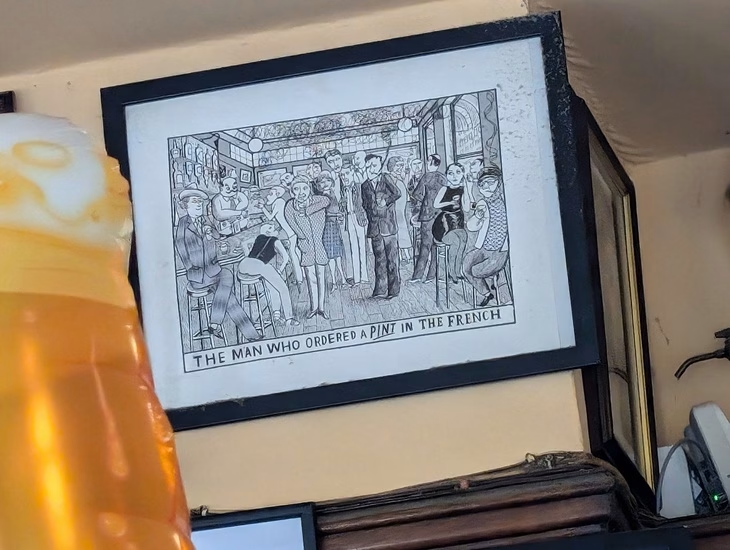
With his handlebar mustache, dark suit, and a mischievous glint in his eyes, Gaston managed the pub less like a business and more like an aristocratic club with its own rigid rules. It was impossible to find a full pint glass in the establishment; only half-pints were served. His greatest red line, however, was Coca-Cola. He never allowed cola into his bar, openly stating that he “did not care for the type of person who drinks cola.” In contrast, a continental and noble atmosphere prevailed, to the extent that women could sit alone and order themselves a quarter-bottle of champagne.
The bar maintained a ruthless internal caste system. The first area you entered through the left door was the “Shallow End.” After spending a few years rubbing elbows there and proving your worth, you were permitted to cross the boundary of the cash register in the exact center of the bar and were accepted into the “Deep End” or V.I.P. (Very Inebriated Person) zone. Promotion to this area was celebrated like a church ritual; Gaston would bring out a rare French absinthe from 1912, dating back to before the prohibition era, and serve it with a slotted spoon and a sugar cube. Granted, regulars would whisper that this highly expensive absinthe tasted shrewdly similar to the house’s cheap Pernod, but no one had any intention of spoiling the fun.
A Diplomatic Eviction
Gaston was a genius at managing drunks and eccentrics. Once, the bar froze when Henrietta threw a glass of champagne in the face of a boring man complaining about his life. While everyone expected her to be barred from the venue for life, Gaston simply twirled his mustache and smiled: “Mademoiselle, I see your glass is empty. Allow me to refresh it.” Yet, toward those who broke the order and deserved eviction, he was incredibly polite, putting people out on the street with such civility that those thrown out actually wanted to thank him, using his signature line: “One of us has to go, and I am afraid it is not going to be me!”
He would secretly hand banknotes over the bar to cash-strapped artists, noting down the debts in a small black notebook next to the register in a micro-precision handwriting. Behind this generosity lay a formidable commercial intellect: “Nine out of ten people pay their debts, one does not,” Gaston would say, “but the money that one person spends on drinks just coming in here to explain why they can’t pay their debt more than covers it.” Of course, he wasn’t flexible on everything; he would look with utter loathing at anyone who had the audacity to ask for extra ice in their drink, and when handing the key to a man wishing to use the restroom, he would shout across the bar for all to hear, “Who wants the toilet key!”, crushing the man under the gaze of all the regulars. Darren Coffield’s exquisite book pulls us away from the soulless, digital, and over-planned entertainment approach of the modern world, taking us back to the golden age of an analog bohemianism ruled by characters, mustaches, and uncompromising rules.
Book & Venue Details:
- Book: Hen: Mistress of Mayhem – A Portrait of Henrietta Moraes by Darren Coffield
- Venue: The French House (Formerly York Minster), Dean Street, Soho, London
- Historical Figure: Gaston Berlemont (Legendary landlord)
- Era: 1950s analog bohemian London