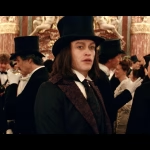


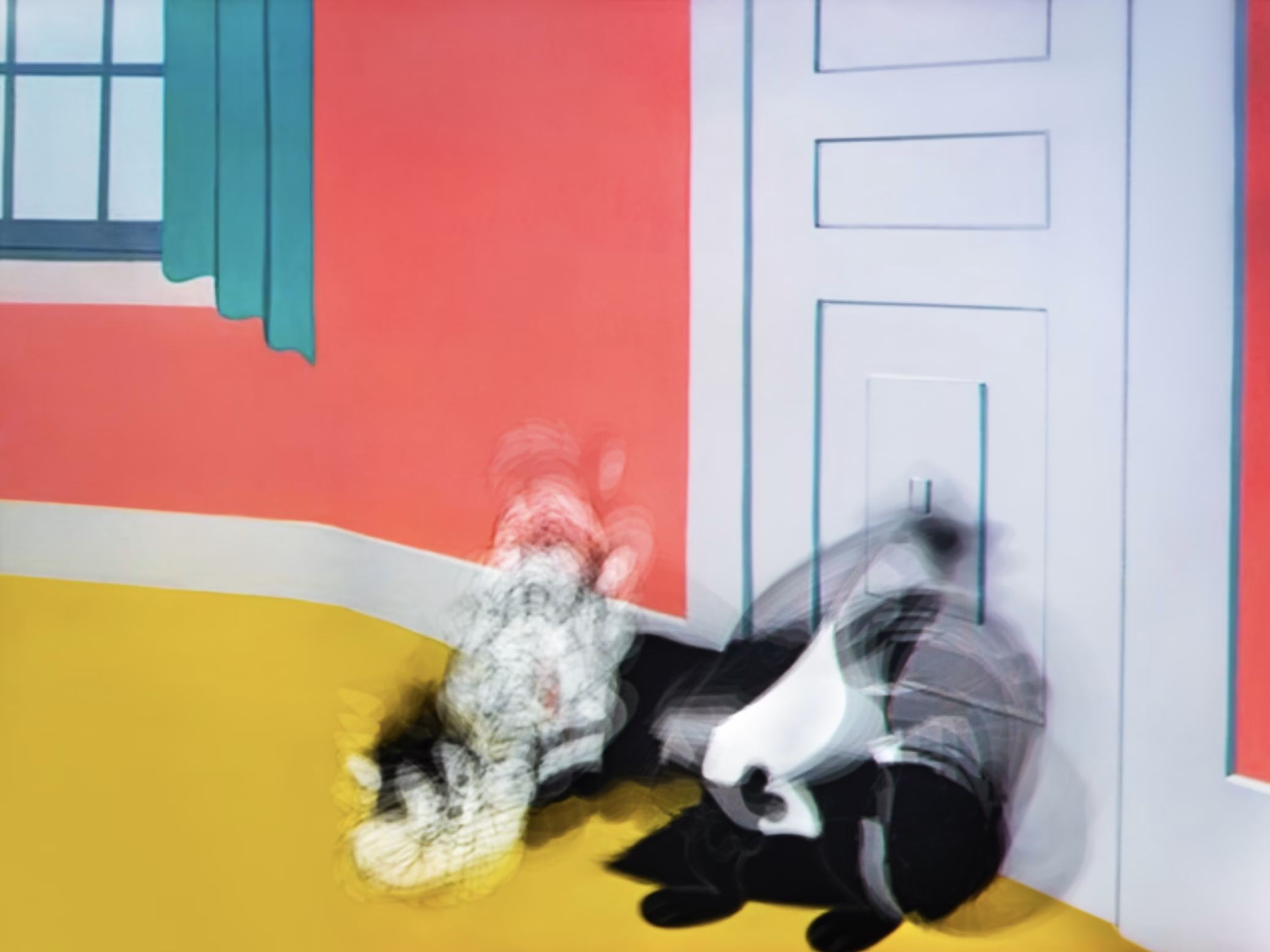
If you were to condense a ninety-minute film—the 130,000 frames flowing through the darkness of a movie theater—into a single moment, what would time look like? Raised in the home of Milton Shulman, one of Britain’s most prominent theater critics, and journalist Drusilla Beyfus, an environment where culture was not just a lifestyle but a laboratory material, Jason Shulman pursues exactly this question. By fixing his camera in front of a computer screen and recording the entire duration of a film—from its first second to the final credits—onto a single negative, his famous Moving Pictures series makes the genetic codes and visual DNA of cinema visible to the naked eye.
When Shulman first began this experiment, he anticipated encountering a vague, muddy brown mass, similar to the murky tone obtained when randomly mixing playdough together as a child. However, the result transformed into a magnificent visual feast that sanctifies the fluidity of time. Each film produced a completely unique visual identity, remaining faithful to its own spirit and color palette. Even black-and-white classics assumed a rich and architecturally complex form layered with shades of gray. For instance, when compressing Alfred Hitchcock’s Rear Window into a single frame, Jimmy Stewart in his wheelchair emerges through fragmented frame lines and ghostly waves of light as a hazy, melancholic silhouette.
The artist’s practice is not limited to dissolving cinema; he has made a obsession out of measuring the uncanny distance between reality and its representation. Whether it is his illusionistic martini glasses crafted from rotating mirror blades that feel almost touchable, dandelions woven from points of light suspended in the air, or forms born from a vortex of fine wire mesh, all feed from the same philosophy. Although Shulman describes this production process as a form of escape for himself, he is actually dismantling the fabric of time and space, separating it into its most elemental parts. Even if you took those 130,000 frames and completely scrambled their chronological order, the spectral image falling onto the negative would remain unchanged; because the entire visual memory of a narrative is already hidden within that whole.
The title of the project, Moving Pictures, utilizes the playful structure of the English language to describe both the motion pictures that form the foundation of cinema and the “moving” (emotionally touching) pictures that stir our souls simultaneously. By freezing the linear and unstoppable flow of time, Shulman shows us that cinema is not just something to be watched, but a space to be breathed in, layer by layer. Creating a significant echo across international contemporary art platforms, most notably at the Rebecca Hossack Gallery, these works stand before us like physical evidence of that hazy residue left in our minds long after leaving the movie theater.
Project Details:
- Artist: Jason Shulman
- Series Title: Moving Pictures
- Core Technique: Ultra-long single-negative exposure of entire feature films.
- Key Themes: Cinematic DNA, the deconstruction of time, and visual memory.