

In an age when screens dominate everything, reading an art book is an act like leaning over the big picture and feeling its texture. 2026 is proving to be an extraordinarily rich year in this field. New titles are coming that appeal to every type of reader, from criticism, catalogues and artist interviews to novels with art themes. We have selected the best ones from the dozens of books announced by Hyperallergic, Phaidon, TASCHEN and Rizzoli since January — both the newly released titles and the major publications expected for the rest of the year.
Biography & Monograph
- The Storyteller: John Berger’s Lives — Tom Overton (Penguin Random House, September 2026)
Many books have been published about John Berger, but what sets Tom Overton’s biography apart is its claim to be the most detailed portrait of Berger to date: a comprehensive life record based on research and conversation between two writers. Berger defined himself as a storyteller; this book asks what fed that storytelling instinct.
Why read it: An essential companion for those who have read Ways of Seeing.
- Ai Weiwei — Updated Monograph (TASCHEN, Spring 2026)
TASCHEN is releasing a fully revised edition of the monograph it published ten years ago this spring. Ai Weiwei’s global practice — from his New York years in the 1980s to the Zodiac series and his LEGO compositions — is being updated. Moreover, this new edition coincides with the artist’s first visit to China in ten years.
Why read it: A fundamental reference for those who want to understand the intersection of art, activism and political exile.
- Laurie Anderson — Retrospective (Rizzoli Electa, May 2026)
This career retrospective covers the multidisciplinary artist’s well-known installations, videos and performances, as well as her new works. Anderson also adds her own thoughts on the ideas that guide her practice.
Why read it: Laurie Anderson is one of those rare artists where sound art, performance and visual culture converge.
- A Natural History of the Studio — William Kentridge (Grove Atlantic, April 2026)
South African artist Kentridge sheds light on his childhood, creative process and the studios he has worked in throughout his career. It is a door that opens both to art history and to the artist’s inner world.
Why read it: For those curious about the artistic production process and studio culture.
- The Lost World: The Art of Minnie Evans — Katherine Jentleson (Delmonico Books, January 2026)
Minnie Evans was one of the first Black artists to have a solo exhibition at the Whitney Museum, yet she had lacked a major exhibition for decades. The Lost World is the catalogue for this comprehensive exhibition at the High Museum in Atlanta.
Why read it: For those who want to read one of the pages of art history that is being rewritten.
Women Artists & Identity
- The Female Body in Art — Amy Dempsey (February 2026)
This book traces the representation of the female body in art through all layers of history, from Botticelli’s Renaissance paintings to Marina Abramović’s performance art and Yuki Kihara’s photographs and videos that challenge gender boundaries.
Why read it: A comprehensive yet accessible introduction to feminist art history.
- Alma Thomas — (Author: Alexis Pauline Gumbs, Autumn 2026)
Gumbs, who received acclaim for her Audre Lorde biography, now focuses on Alma Thomas’s rhythmic paintings, highlighting the artist’s Black community in Washington DC and her legacy of creativity.
Why read it: A rare study that examines Thomas’s understanding of colour and rhythm in both art-historical and social contexts.
- Black Curators Matter (January 2026)
It examines the art, advocacy and criticism of the last 50 years through interviews with six major curators, including Lowery Stokes Sims, Deborah Willis and Kellie Jones. History is not singular; this book seeks both the consensus and the frictions.
Why read it: For those curious about the behind-the-scenes of the museum and gallery world.
Criticism & Theory
- No! The Art of Activism and Complaining — Sara Ahmed (2026)
According to Hyperallergic editors, one of the most anticipated books of 2026: Sara Ahmed’s work that brings the art of complaining together with activism claims to be the guidebook of the year.
Why read it: For those who want to question art’s relationship with social resistance from a philosophical perspective.
- A Sexual History of the Internet — Mindy Seu (2026)
This 700-page monumental work is a synthesis of an artist book, historical research and performance piece. It writes the cultural history of the internet through cyberfeminists, sex workers and marginalised voices, asking how the encrypted network was domesticated.
Why read it: An extraordinary reading experience at the intersection of digital culture, activism and visual art.
- Along the Diagonal: Art/Essays/América — Roberto Tejada (June 2026)
A collection of essays and lectures by poet and critic Tejada on Latinx and Latin American art.
Why read it: To get to know the art discourse of a geography that is often overlooked.
Catalogue & Biennial
- 61st Venice Biennale Catalogue (Edizioni La Biennale di Venezia, 2026)
This catalogue brings together the work of the team appointed to realise the vision of Cameroonian curator Koyo Kouoh, titled “In Minor Keys”, whose sudden death last year plunged the art world into mourning. Kouoh wanted to make visible “the possibilities that lie in the gaps between things and beyond the portals”.
Why read it: Both the document and the manifesto of 2026’s biggest art event.
- Moridja Kitenge Banza: A Thousand Ways to Talk About It (April 2026)
This bilingual monograph on Canadian-Congolese artist Kitenge Banza’s multidisciplinary practice focuses on how he reconstructs histories shaped by colonialism and marginalisation.
Why read it: A strong introduction to postcolonial art theory.
Design & Architecture
- Our World in Ten Buildings — Michael Murphy (April 2026)
Murphy discusses how construction can better serve humanity, drawing a line from the depths of architectural history to his own projects.
Why read it: A clear and powerful manifesto for those interested in architecture’s dimension of social justice.
- Tiffany Silver: The Peter Marino Collection — Peter Marino (2026)
Architect Peter Marino shares his private Tiffany & Co. silver collection with the public for the first time. A rare publication where decorative arts and architectural taste meet.
Novel & Fiction
- Whistler — Ann Patchett (Summer 2026)
The new novel by award-winning novelist Ann Patchett opens with a visit to the Metropolitan Museum. It promises to be one of the rare novels that engages with the art world through fiction.
Why read it: A literary experience in which art functions as both background and character.
Photography & Visual Culture
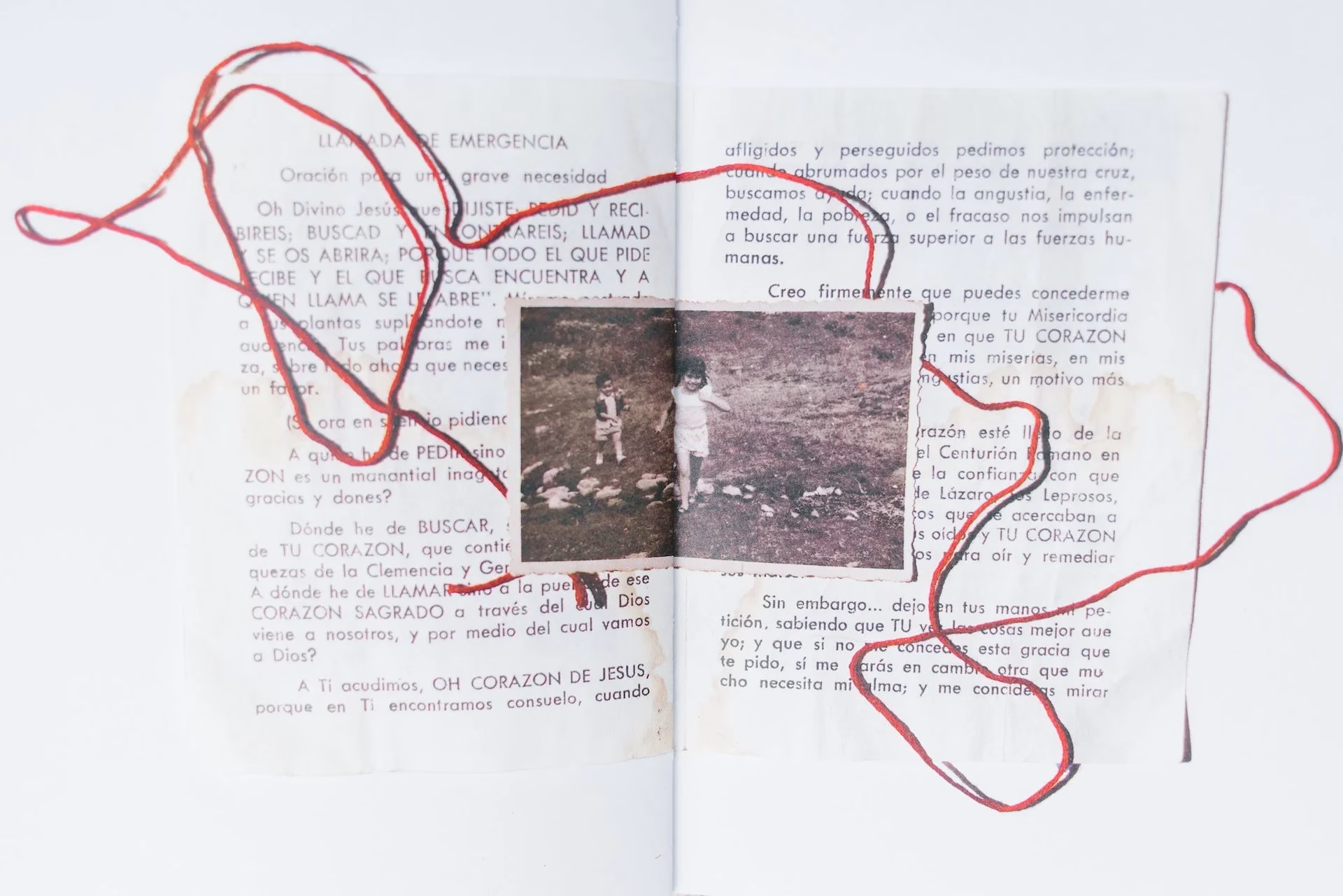
- Va a Llover Toda La Noche — Alicia Vera (End of 2025 / 2026)
This personal archive, in which photographer Alicia Vera documents the final years with her mother before her Alzheimer’s diagnosis, is a work that pushes the emotional boundaries of artistic documentary.
Why read it: A profound book that questions what photography tells us at the meeting point of family memory.
- Nippon: Japan Through the Eyes of Philipp Franz von Siebold, 1832–1852 (Lannoo Publishers, July 2026)
This large-format album is based on von Siebold’s archive documenting Japan through European eyes between 1832 and 1852.
Why read it: A visual history lesson examining Japanese culture through the prism of the Western gaze.
Collection & Market
- Musical Bodies — E. Bradley Strauchen-Scherer (June 2026)
This unusual title traces the relationship between musical instruments and the human body throughout art history — from the sistrum rattles of ancient Egypt to Prince’s symbol guitar — and approaches visual culture from an unexpected angle.
- Painting into Being: Underground Art During China’s Cultural Revolution — Aihe Wang (April 2026)
This study on underground art in China during the Cultural Revolution asks how art survived in the midst of censorship and oppression.
Why read it: For those who want to see the relationship between art and political pressure through a historical lens.
Conclusion: Which Book Should You Start With?
2026’s art book list does not fit into a single theme: the rewriting of history, the visual language of identity, activism and archive, biography and fiction, monograph and manifesto. If you are new to art history, Ai Weiwei or The Female Body in Art make good entry points. For more advanced readers, Black Curators Matter and the Venice Biennale Catalogue are this year’s most valuable reference books.
Reading art books ultimately teaches us this: to understand a work, you first need to understand the language, history and human being surrounding it. And for that, the best tool is still a good book.