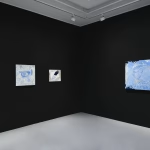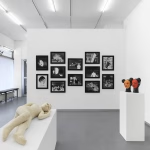


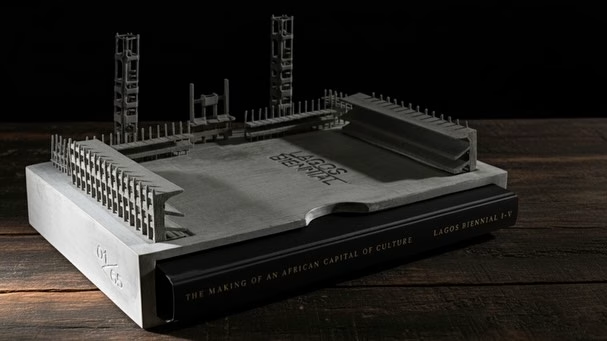
One of the largest stages of contemporary African art, the Lagos Biennial, is set to fundamentally shake the classical, Western-centric understanding of the museum with its 5th edition. Curated by Furen Dai, Chinyere Obieze, and Sam Hopkins, this year’s edition carries an extremely provocative theme: “The Museum of Things Unseen”.
The Voice of the Silenced Stories
This biennial confronts the viewer with shattering questions: What is hidden in the shadows of our museum spaces? Whose stories are being silenced and whose voices are being amplified? If we were to build a museum from scratch, free from structural inequalities, what would it look like? The exhibition brings to light works and experiences that have been excluded from the global art canon due to financial power, political influence, or cultural prejudice — left to rot in storage or deliberately rendered invisible. This is not just an art event; it is a speculative manifesto for rewriting art history from the perspective of the excluded.
A Memory That Spills into the Streets
One of the strongest aspects of the Lagos Biennial is its ability to push art out of sterile white cubes and inaccessible gallery walls. The biennial transforms colonial-era buildings, old railway stations, and Lagos’s dense, chaotic, politically charged public squares into a vast laboratory. Visitors do not merely look at artworks; they come into direct contact with the city’s raw and unfiltered reality.
A Historic Turning Point: The Àkéte Collection
The biggest move that distinguishes the 2026 edition from previous years and is considered a milestone in African art history is the opening of the Àkéte Collection. Designed by renowned architect Tosin Oshinowo, this structure will house Africa’s first permanent, international public collection of contemporary art on the continent. This means that even after the storm of the biennial subsides, Lagos will continue to protect this magnificent legacy on its own soil, without depending on others.
Why the 2026 Biennials Matter as a Whole
The fact that Sydney, Lagos, Gwangju, and Diriyah explode one after another on the same calendar this year is certainly no coincidence. This is the most concrete proof that artistic authority and narrative power are permanently shifting from Europe and North America to the Global South. The world is now talking about:
- what is hidden in the basements of Western museums (Lagos),
- how memories fractured by colonialism can be repaired (Sydney),
- and how local communities are shouting their own realities.