


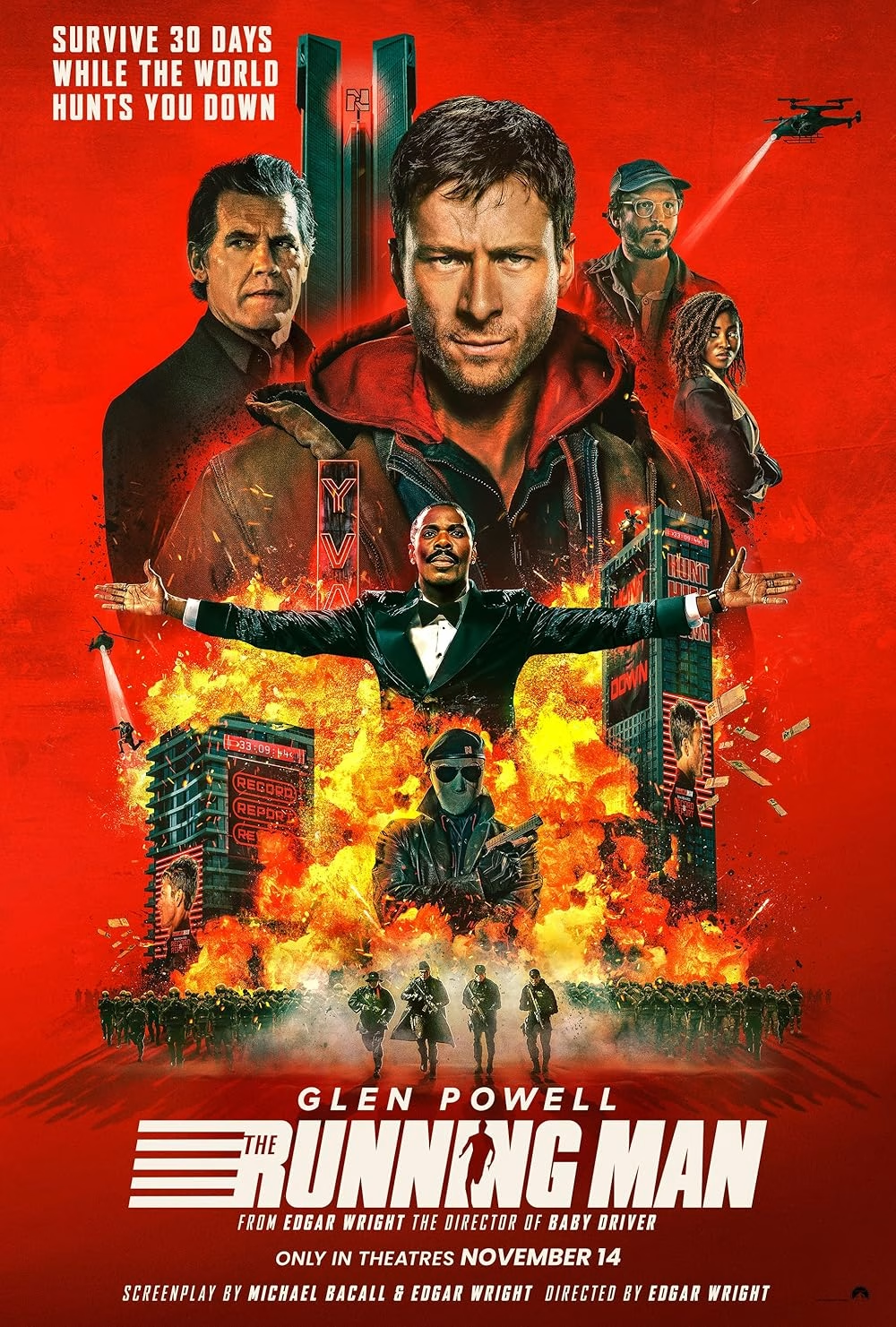
It is 2026, and cinema halls are reverberating with Edgar Wright’s visionary direction in The Running Man (2025), a film that fuses Stephen King’s timeless horror with today’s surveillance society. Adapted from the 1982 cult novel, this production discards the cartoonish action sensibilities of the 1980s and hurls us into an icy reality where algorithmic fame and violence have become content. Glen Powell brings Ben Richards to life: in a dying dystopian world, his only chance to survive and save his family lies in a deadly reality show where he will be hunted in front of billions of eyes. Shaped by the pen of Wright and Michael Bacall, this story is not merely a fight for survival; it becomes a shattering political manifesto that exposes the rottenness of the system and transforms entertainment capitalism into an instrument of execution.
At the center of the story stands Richards, trapped in a game with a simple but merciless rule: he is free to hide anywhere in the world, yet he must escape the elite assassins on his trail. While every step he takes is followed by cameras, Richards simultaneously becomes a global celebrity—turning him into both victim and the system’s greatest threat. Edgar Wright does not merely deliver adrenaline-fueled chases here; by making the audience complicit in the crime, he poses the question: “If you take pleasure in watching this brutality, are you also part of the hunt?” The film critiques modern society’s obsession with turning tragedy into spectacle, and evolves into a breathtaking revolutionary tale as Richards moves from being a pawn to using the game’s rules against its creators.
Edgar Wright infuses the kinetic editing style we know from Baby Driver and Last Night in Soho with a much darker, heavier, and more impactful tone. Unlike the 1987 Schwarzenegger version, the film remains faithful to the unsettling reality of King’s novel, leading the way for the “ethical dystopia” trend. Bulgaria’s industrial and raw landscapes deliver a post-apocalyptic atmosphere with tangible physical authenticity, far removed from green-screen artificiality. Wright’s cinematic genius transforms every chase sequence into a work of art, while Dolby Atmos-supported sound design creates a “live broadcast” effect that carries every heartbeat and bullet sound directly into the cinema auditorium—and right to the back of the viewer’s neck.
The cast is a true constellation of stars that carries the film on their shoulders. Glen Powell brings to Ben Richards not only physical strength but also the moral depth of a man crushed between the gears of the system; his performance is already being hailed as the peak of his career. Emilia Jones shines as a producer wrestling with her conscience amid the machinery of the system, while Lee Pace terrifies audiences as a calculating and cold-blooded master hunter. Josh Brolin’s chilling authority as media baron Dan Killian, combined with the unpredictable presence of heavyweights like Colman Domingo and Michael Cera, turns the film into a tension knot filled with surprises at every moment.
Released at the end of 2025 and quickly becoming one of the strongest contenders of the 2026 awards season, the film has been described by critics as “Wright’s Children of Men moment.” Praised by major outlets such as Rolling Stone and Variety, The Running Man (2025) lands like a hard slap to the 21st-century world where violence is packaged as “content” and empathy is sacrificed to algorithms. Both a visual feast and a devastating social diagnosis, The Running Man (2025) proves that cinema can be not only entertainment but also a revolutionary mirror—before it begins its digital journey on Paramount+ and Apple TV in Spring 2026.