

London’s art scene is buzzing with anticipation for a profoundly unsettling photographic exhibition opening at the end of the month. Internationally renowned Chinese photographer Zhang Kechun will present his new series “The Yellow Desert,” begun in August 2025, at Huxley-Parlour Gallery starting 30 January.
Focusing his lens on the desolate dunes of the Gobi Desert and the complex history of northern China, Kechun invites us not merely to a geography, but to a world where time condenses and inverts itself.
The Gobi Desert: A Surreal Dance of History and Artifice
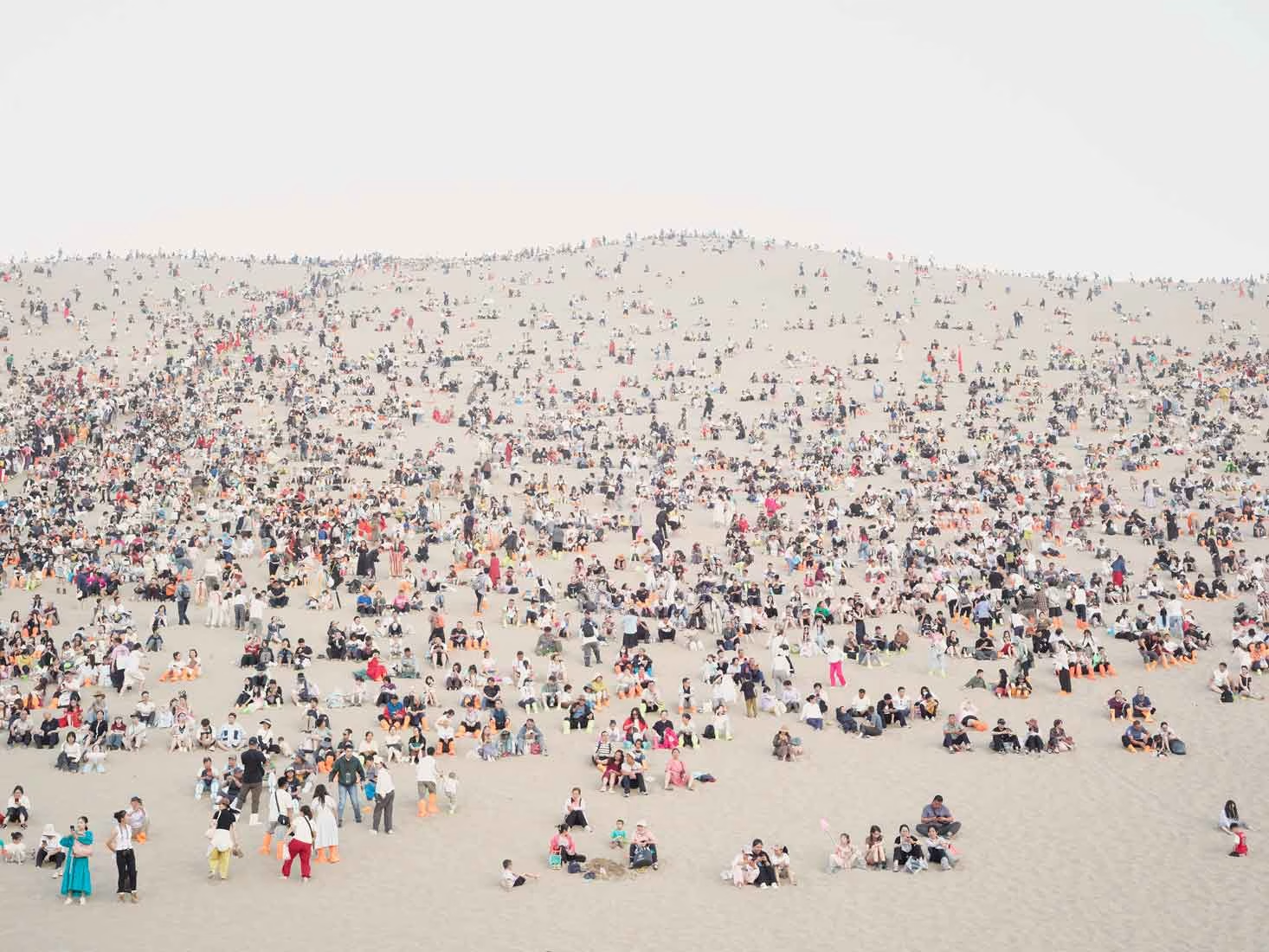
During his journeys across the sand dunes and mountains of northern China and southern Mongolia, Kechun investigates the remnants of human activity scattered both beneath and atop the sands. For the artist, this landscape forms a surreal plane where the sublime coexists with the artificial, history with the present, desolation with life.
The Gobi Desert has now become a popular tourism destination. Yet Kechun’s photographs place this modern mobility directly atop layers of deep history:
- Holidaymakers walking over ancient tombs from the Han Dynasty.
- Once-used film sets, now haphazardly reconstructed ancient religious sites.
- Abandoned oil extraction facilities and ghost towns.
To heighten this surreal quality, Kechun employs a restricted colour palette (dominated by yellow tones) and compositions that isolate monumental markers. This technique makes the boundless expanse of the desert and the strangeness of the man-made intrusions within it even more pronounced.
“Yellow” as a Concept
The “Yellow” in the exhibition title is far more than a colour in Chinese culture; it carries profound symbolic weight. The tones in Kechun’s photographs are far from arbitrary:
- Traditional Meaning: In ancient China, yellow (zhongzheng) was one of the five positive colours, representing centrality, wholeness, and nobility.
- Geographical Identity: Yellow is regarded as “the colour of the earth” and a symbol of life, owing to its association with the Loess Plateau and the Yellow River.
These cultural and spiritual connotations lend Kechun’s photographs a distinct national identity and historical depth. When looking at the images, the viewer sees not only sand, but the ancient roots and contemporary reality of China superimposed on the same plane.