

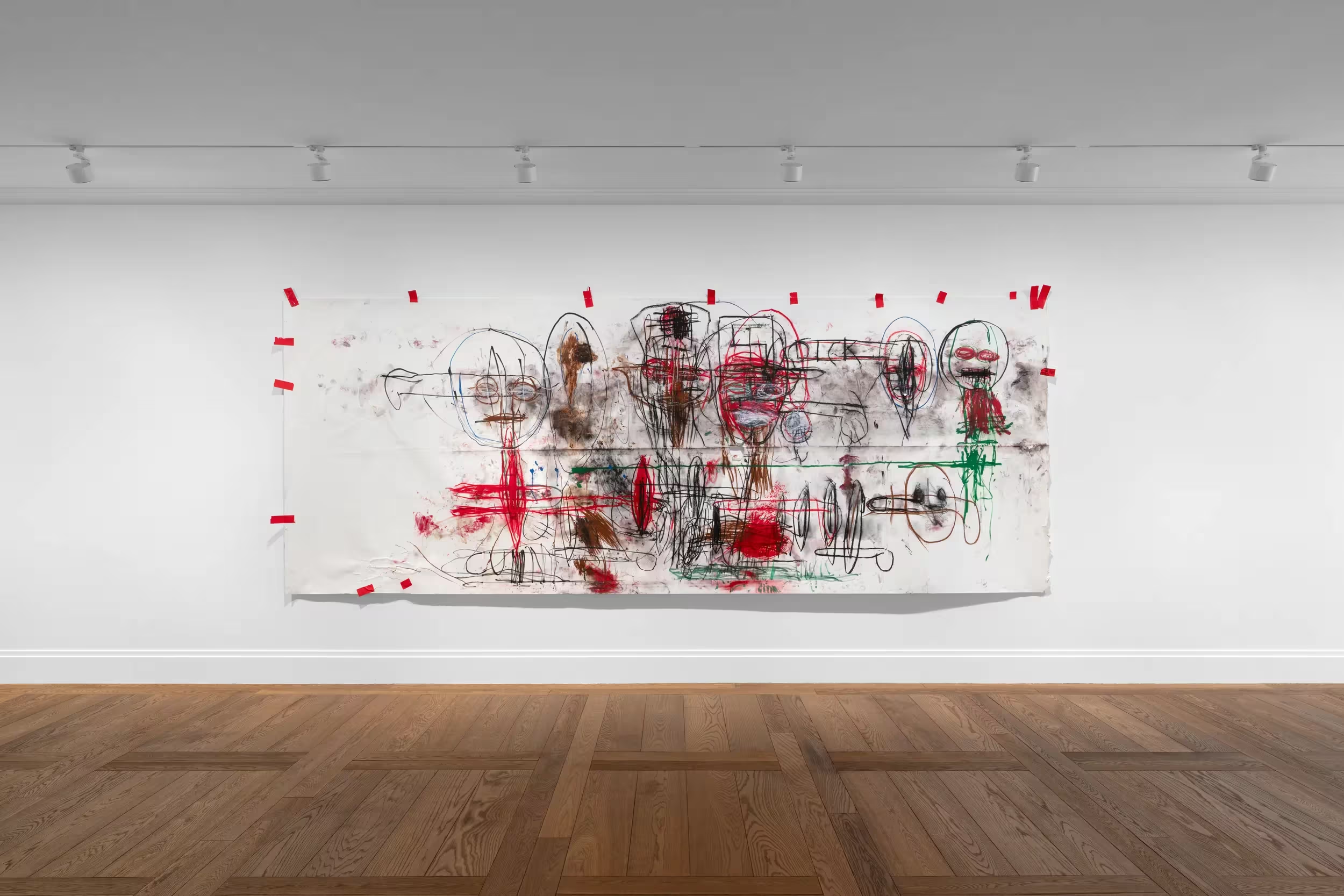
We are leaving the eerie corridors of Madrid and turning our course toward Paris, the capital of art. The provocative genius of American contemporary art who pushes boundaries, Paul McCarthy, is opening a new chapter in his destructive and hypnotic collaboration with German actress Lilith Stangenberg, this time at Hauser & Wirth Paris. The exhibition “SS EE Saint Santa Eva Elf, Drawing Sessions 2025”, which opened on 21 March and will run until 31 May, takes the shattering legacy of the A&E project and builds a brand-new “nightmare” through the most familiar figure of holiday mythology.
McCarthy is known for his over fifty-year career of dismantling social hierarchies, cultural taboos, and the canon of art history. In this new exhibition, his target is an icon we all know very well — one that appears as a symbol of innocence but, in McCarthy’s eyes, carries the ghost of corporate capitalism and fascism: Santa Claus.
Santa Claus as the God of Capitalism
Following the “Adolf and Eva” dynamics in the A&E project, the duo now dons the costumes of Santa Claus and an Elf. This seemingly familiar and adorable pair emerges in the exhibition as carriers of a dark subtext. For McCarthy, Santa Claus is not an ordinary figure; he is the god of capitalism itself. And capitalism, in turn, is a societal psychosis spread through the rituals of commercial culture.
In this equation, the Elf character brought to life by Lilith Stangenberg is not merely a submissive assistant; she takes on a highly enigmatic role as outsider, accomplice, and autonomous agent. The sacred holiday mythology that McCarthy has been probing for over forty years — in works such as “Tokyo Santa” (1996) and “Chocolate Shop” (2014) — reaches its deepest and rawest form in this exhibition through the intensity of his improvisational collaboration with Stangenberg.
“Liquid Theatre” in the House of Childhood
This disturbing yet captivating production process did not take place in an ordinary studio. The filming and drawing sessions lasted a full 13 days inside the “White Snow” set in McCarthy’s Los Angeles studio — an exact replica of the artist’s childhood home in Utah.
With no script, no rehearsal, and no predetermined ending, these sessions become what McCarthy calls a “liquid theatre.” Conscious or unconscious memories of previous performances seep into the present, resulting only in an “entanglement.” The characters living inside the replica of the artist’s childhood home also raise multilayered questions about architecture, memory, and entrapment.
A Confrontation in Red, Green and Six Screens
The works filling the exhibition space are direct recordings of these 13 days of improvisation:
Totemic Drawings: These monumental paper works, created while in character, carry the raw and expressive traces of the process. Adorned with Santa’s red and the Elf’s green, these vertical drawings rise in the exhibition like totems or idols. The artist explains this by saying, “Drawing is a form of analysis. I don’t control it; I just allow it to emerge.”
Six-Channel Video Installation: The multi-angle video recordings of the performances transcend the limits of a single screen and turn into an enveloping environment for the viewer. McCarthy does not assign the viewer a passive role here; as one moves between the different screens, the person constructing the narrative in their mind is now the visitor themselves. “The artist constructs, the viewer constructs.”
“SS EE Saint Santa Eva Elf” unearths the traumas lurking behind the stage sets of our most cherished cultural myths. With entertainment, the grotesque, and an uncompromising critical gaze, it slaps the dark dystopia of mass consumer culture right in our faces.