

Some years cease to be mere “schedules” and instead become the very mood of cities. 2026 looks set to be one of those years: in Paris, a shimmering Renoir romanticism and Rousseau’s strange, ambitious universe arriving with spring; in New York, fresh perspectives on “familiar names”; in Tokyo, a landmark moment for women artists rewriting history; in Madrid, painting (yes, painting) dominating the entire year; and in London, an era of “big beasts” on a grand museum scale… Here, city by city in the same order, is a No:26 agenda.
Paris: Spring Arrives with Rousseau and Renoir
Paris’s rhythm for the year begins with a “last chance” for those catching late January: the Georges de la Tour exhibition at Musée Jacquemart-André remains open until 25 January. The master of candlelight is placed in dialogue with Caravaggio’s influence across Europe; this vein finds another echo in the group exhibition Clair-obscur at Bourse de Commerce (4 March–31 August), exploring the chiaroscuro legacy in modern and contemporary practices.
There is also a large-scale selection tracing the relationship between music and colour: Kandinsky: The Music of Colour at Musée de la Musique (until 1 February) focuses on Kandinsky’s synaesthetic practice, bringing together around 200 works. Musée d’Art Moderne de la Ville de Paris stands out with two strong shows: George Condo (until 8 February) and Otobong Nkanga (until 22 February).
The true “grand rendezvous” of spring comes at Musée d’Orsay with Renoir and Love (17 March–19 July). Centring on Renoir’s “tender and enchanted” world, the exhibition reunites Orsay’s Dance at Le moulin de la Galette with international masterpieces. Around the same time, a version of the Renoir Drawings selection (at the Morgan Library in New York until 8 February) explores the painter’s lesser-seen, more radical works on paper.
And the final note: Henri Rousseau: The Ambition of Painting travels from the Barnes Foundation in Philadelphia to Musée de l’Orangerie in Paris (25 March–20 July), aiming to unite the largest collections of Rousseau in a major stop.
New York: “Unfamiliar” Eyes on Canonical Names
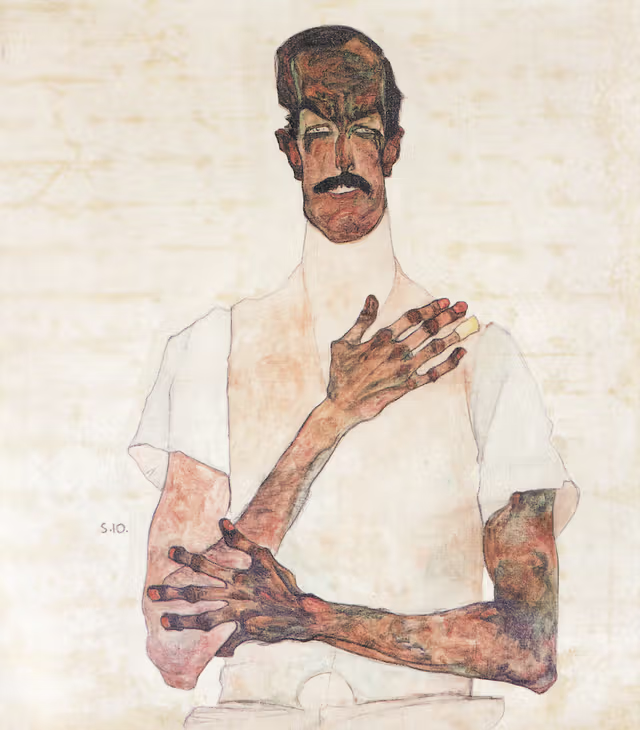
New York’s 2026 lineup carries well the idea of “reacquainting ourselves with artists we thought we knew.” At Neue Galerie, Egon Schiele: Portrait of Dr. Erwin von Graff (12 February–4 May) examines how the relationship between Schiele and a Vienna-based gynaecologist shaped the artist’s sensitive depictions of the human body; the portrait of Dr. von Graff forms the core.
In the same month, the Frick Collection opens Gainsborough: The Fashion of Portraiture (12 February–11 May): Thomas Gainsborough’s portraits are read this time through the lens of “fashion,” reopening discussions on representation, class, and taste codes of the period via more than two dozen paintings.
The Jewish Museum presents Paul Klee: Other Possible Worlds (20 March–26 July), focusing on lesser-known works produced in the final decade of Klee’s life as an artist labelled “degenerate” by the Nazi regime and living in exile.
At the Morgan Library and Museum, the “raw material” of photography takes centre stage: Hujar: Contact (22 May–25 October) exhibits over 110 contact prints by Peter Hujar spanning the 1950s to the 1980s. Not behind-the-camera, but an archaeology of seeing, selecting, and framing.
Tokyo: Women Artists Speak Loudly in Japan
Tokyo’s clearest statement for 2026 is this: Women artists are rewriting history. At the National Museum of Modern Art, Anti-Action: Artist-Women’s Challenges and Responses in Postwar Japan (until 8 February) examines “anti-action” practices of the 1950s and 60s through 14 artists, building a generational reading alongside names such as Kazuko Enomoto, Mitsuko Tabe, and Yayoi Kusama.
To mark its centenary, Tokyo Metropolitan Art Museum presents Edo in Focus (25 July–18 October) with selections from the British Museum’s Japan collection: the cultural multiplicity of the Edo period (1603–1868) is made visible through screens, scrolls, and woodblock prints; the exhibition also travels to Osaka.
For those seeking international resonance: the National Arts Center, Tokyo hosts YBA & Beyond: British Art in the 90s from the Tate Collection (11 February–11 May), bringing the post-Thatcher energy of 1990s British art from the Tate to Tokyo.
And the year’s “long-running” note: a Mariko Mori retrospective at Mori Art Museum (31 October–28 March 2027) spans 80 works intersecting science, metaphysics, and Buddhist-referenced posthumanism; positioned as the artist’s first major show in Japan since 2002.
Madrid: In 2026, Painting Sets the Agenda
Madrid’s 2026 agenda is almost a manifesto: painting is the “main axis” in this city. Two major shows are already open: at Museo del Prado, German Neoclassical painter Anton Raphael Mengs (until 1 March) and at CaixaForum, a Henri Matisse exhibition built from loans from the Centre Pompidou collection (until 22 February).
In spring, 19th-century Scandinavian painting emerges as a strong thread: at Museo Nacional Thyssen-Bornemisza, the first comprehensive survey of Vilhelm Hammershøi in Spain (17 February–31 May) and at Fundación Mapfre, Swedish “Gilded Age” portrait painter Anders Zorn (19 February–17 May).
Women artists are also central in Madrid: Reina Sofía first highlights Galician surrealist Maruja Mallo (until 16 March), followed by Catalan textile artist Aurèlia Muñoz (29 April–7 September), bringing lesser-known 20th-century pioneers to the fore. In summer, Thyssen presents Ewa Juszkiewicz’s works that “sabotage” historical painting (26 May–6 September) and Carmen Laffón’s soft-toned landscapes (23 June–27 September).
On the city’s political memory line, La Casa Encendida’s Inquietude: Liberty and Democracy (until 8 March) looks back at the end of the Spanish and Portuguese dictatorships with over 50 artists (including Joan Miró, Paula Rego, Maria Helena Vieira da Silva), framing the shadow of Franco—who died 50 years ago—into the present.
London: British Art’s “Big Names” Take the Stage
In London, 2026 is a year when institutions open their vast spaces to “familiar and major” names. At Tate Modern, a 40-year Tracey Emin retrospective (27 February–31 August) is one of the most visible titles of the year: My Bed will be included, reopening debate around the work’s own “icon” status.
At National Portrait Gallery, Lucian Freud drawings (12 February–3 May) focus on Freud’s preparatory process on the path to the human body and drawing as a mode of thinking. At Serpentine, David Hockney (12 March–23 August) arrives with recent works and the monumental iPad frieze A Year in Normandy. Courtauld Gallery re-reads Barbara Hepworth (12 June–6 September) through her often-overlooked colourful works.
Tate Britain follows a more historical route: James McNeill Whistler (21 May–27 September) and, towards year-end, the Bloomsbury duo Vanessa Bell & Duncan Grant (12 November–11 April 2027).
And the “profusion of riches” section: at Barbican, Project a Black Planet (11 June–6 September) examines Pan-Africanist influence with a century-long backward glance; at Tate Modern, Frida Kahlo (25 June–3 January 2027) appears with a broad selection. At NPG, Marilyn Monroe (4 June–6 September) marks the centenary of her birth with a visual memory exhibition featuring Warhol, Pauline Boty, Eve Arnold, and others. At Tate Britain, curated by Edward Enninful, The 90s (1 October–14 February 2027) stages pop culture and style history on an institutional scale.