

More Than What We See: Viktoria Binschtok and the Encrypted Visual Language of the Digital Age

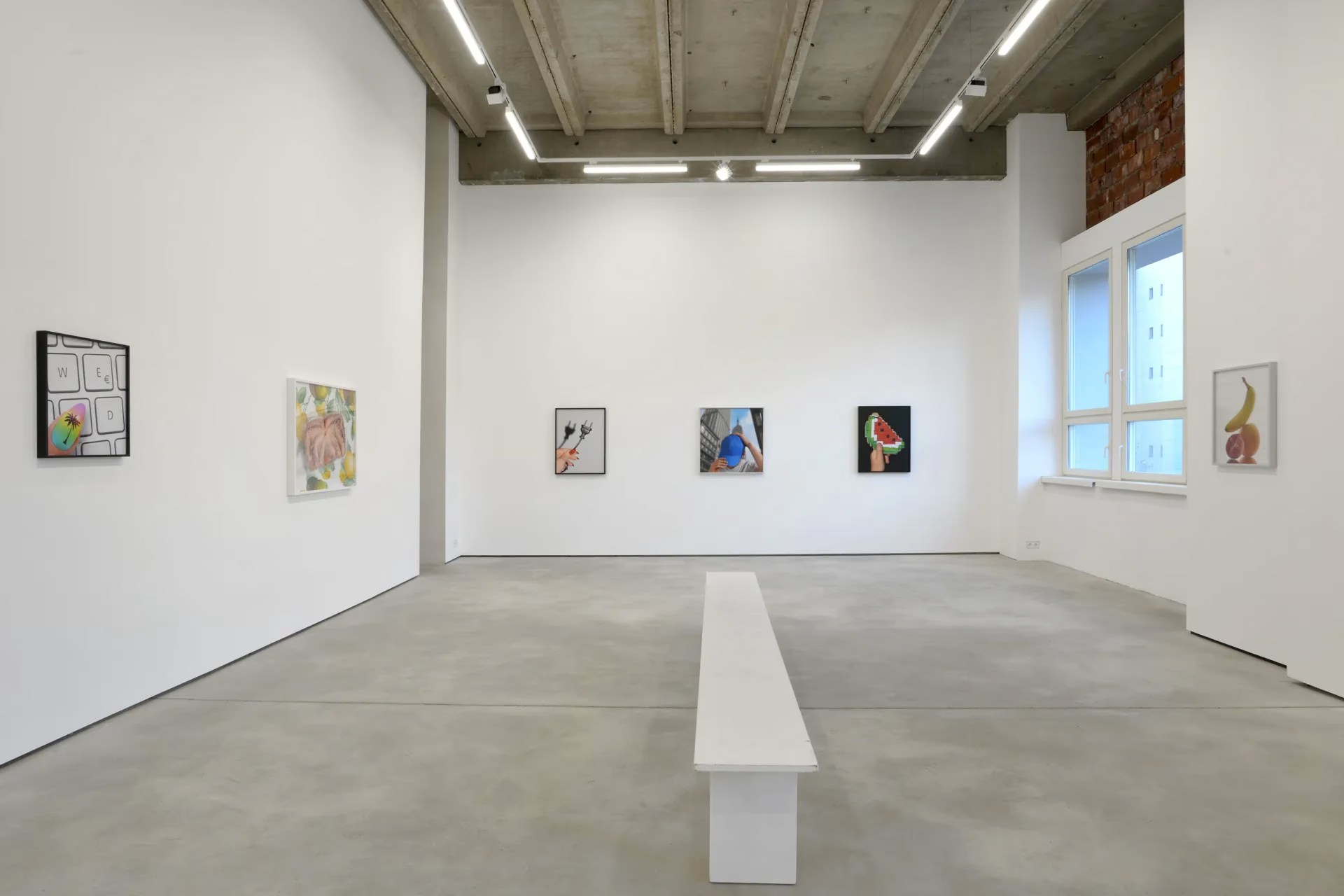
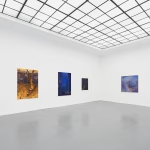
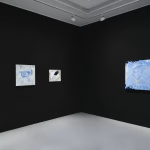
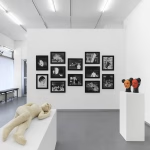
In the heart of Berlin’s Kreuzberg art scene, Klemm’s gallery is currently hosting a profoundly thought-provoking and mind-expanding discussion. Artist Viktoria Binschtok, with her exhibition “Digital Semiotics” that opened last month and continues until early March, invites us beyond our screens and into the hidden meanings concealed between pixels.
If you’re in Berlin right now or simply curious about the visual language of digital culture, this exhibition reveals just how political — and potentially “dangerous” — those tiny yellow faces and fruit emojis we use every day can actually be.
From Screen to Gallery Wall: Constructing a New Language
Binschtok has long been scrutinizing digital culture and image production. In this latest series, she so masterfully blends photography with digital collage, enigmatic still lifes with technological codes that the resulting works serve as undeniable proof of how our online and offline realities have become inextricably entangled.
The core departure point of “Digital Semiotics” is the symbolic language of digital communication: emojis, abbreviations, and internet slang. These are no longer mere “pictures”; they are hybrid forms existing between text and image. The artist treats these symbols as “contemporary artifacts” and transforms them into social barometers.
Emojis Don’t Just Smile: Emotional Data and Encryption
When you look closely at the works in the exhibition, you immediately realize that an object, a piece of fruit, or a body part is never only what it appears to be. Binschtok reminds us that emojis are the modern continuation of historical encoding traditions.
Why Do We Use Emojis?
- Emotional Data: Emojis serve as “emotional data packets” to counteract the soullessness of digital text.
- Plasticity: The meaning of a symbol can shift in seconds depending on who is sending it to whom.
- Camouflage Strategy: Their banal and simple appearance makes them perfect “containers” for hidden messages.
One of the most intriguing points Binschtok highlights is the use of these symbols as a camouflage strategy. Communities that wish to avoid being caught by algorithmic filters develop seemingly irrelevant visual codes to express forbidden or political concepts. At this point, “looking” turns into an act of “deciphering.”
Algorithmic Visibility and Circumventing Filters
In the year 2026, the algorithms of digital platforms decide what we see and what remains hidden. Binschtok reflects precisely on this “opacity” (ambiguity) in the exhibition. The wide repertoire of symbols on display can represent — sometimes a political rebellion, sometimes prohibited content, and sometimes nothing more than a banal everyday moment.
The artist uses the photographic medium not merely as a reflective tool, but as a “projection surface” for visualizing abstract phenomena (such as the algorithmic process of a search engine). The images do not offer a simple translation; rather, they reflect the potential of these codes both to connect us and to separate us — that famous ambiguity.
The Exhibition Experience as a Visual Index
Upon entering the gallery, the group of works that greets you forms a contemporary associative index. Is a photograph of a peach merely a fruit, or is it an anatomical reference? When does a weather vane become a political symbol? Binschtok demonstrates that these transitions do not follow any fixed logic. Sometimes visual similarity, sometimes phonetic proximity, sometimes an implicit agreement between sender and receiver constructs this new language.
The installation at Klemm’s pushes the viewer to question not how much they “see” in the digital world, but how much they actually “understand.” Images are no longer evidence; they have become messages.
Visitor Notes
Artist: Viktoria Binschtok
Exhibition: Digital Semiotics
Venue: Klemm’s, Berlin
Dates: 23 January – 7 March 2026
Why Visit? To see the enormous political and social machinery hidden behind those simple emojis on your screen.
Apartment No:26 Note
Viktoria Binschtok transports the encrypted language of the digital age into the physical space of the gallery, confronting us with the greatest contradiction of the modern world: in an era when everything is more “visible” than ever before, so much is actually being concealed.