

Institutional Memory and the Aesthetics of Justice: A Retrospective Reading of “Provenances. Wayfaring Art” at Berlinische Galerie


We revisit one of the most critical stops in Berlin’s art scene last year—the exhibition “Provenances. Wayfaring Art,” which closed on 13 October 2025—from the perspectives of institutional memory and art-historical justice. As critic Adolph Donath expressed in 1925, the fate of artworks is to travel. Berlinische Galerie’s exhibition presented these compulsory journeys of works not merely as a chain of ownership but as a methodological inventory of the dark political conjunctures in which ownership changed hands.
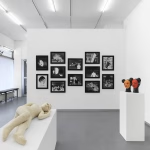
The provenance history of modernist collections—particularly works confiscated under duress from Jewish collectors during the National Socialist period of 1933–1945—is not only a technical archival endeavour but also an act of restorative justice. The exhibition’s structure greeted viewers with an intense salon hanging of around 40 paintings, blending the physical presence of rarely exhibited works with the epistemological depth of provenance research presented through digital media.
The most striking example forming the exhibition’s theoretical backbone was the cycle “Tempeltanz der Seele” (Temple Dance of the Soul), painted in 1910 by Fidus (Hugo Höppener). Identified in 2017 as Nazi-looted art, this group of works saw the museum proactively initiate a restitution process to the original rightful owners, after which they were reacquired for the collection—an ethical precedent in contemporary museology. The original documents on display crystallised the traumatic displacements the object had endured and the awareness of institutional responsibility, beyond the work’s aesthetic value.
The exhibition presented not only its findings but also the gaps and uncertainties in the research with transparent language. Through digital media stations, viewers could observe the missing links in an artwork’s ownership history and ongoing investigation processes. This approach repositioned the artwork from a frozen historical moment to an actor at the centre of a continually expanding network of knowledge and ethical debates.