

The Global Design Forum (GDF), the flagship thought-leadership programme of the London Design Festival (LDF), is taking one of its most ambitious steps in its evolution by announcing its first international edition, to be held in Istanbul from 13 to 16 May 2026. Organised in collaboration with People & Places & Ideas (PPI), the event will bring together pioneering designers, architects, technology experts, curators and academics from around the world to explore the role design can play in the modern world defined by complexity, interconnectedness and coexistence. Rooted in Istanbul’s unique cultural and architectural heritage, this four-day programme will combine high-level academic discourse with public installations across the city, placing at its centre how ideas continuously reshape one another in this unique geography where cultures and histories constantly intersect. Ben Evans, founder of the London Design Festival and the Global Design Forum, describes the Istanbul edition as an exciting new chapter in their mission, emphasising that the city’s position at the crossroads of cultures offers the perfect setting to celebrate local identity while discovering how design can respond to global challenges.
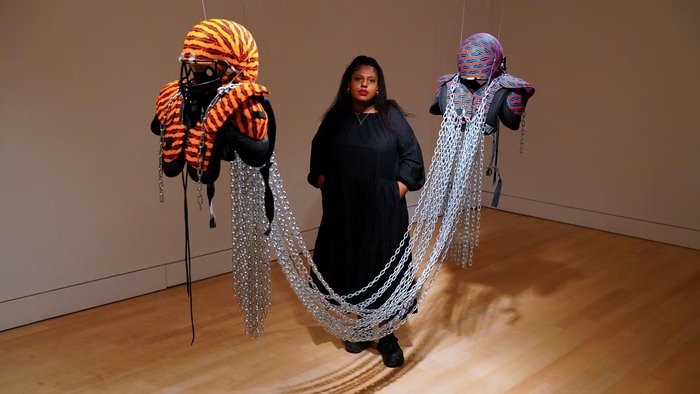
The artistic direction of the Istanbul edition will be led by artist and designer Melek Zeynep Bulut, founder of PPI, while the overall creative framework of the programme is shaped around the vision of Ben Evans and Melek Zeynep Bulut. This visionary team includes art and culture consultant Beral Madra, architectural consultant Celâleddin Çelik, content consultant Beatrice Galilee, and creative consultant Jay Osgerby from Universal Design Studio. According to artistic director Melek Zeynep Bulut, Istanbul is one of the most distinctive places in the world — a city that derives its uniqueness from the way its parts connect, a place that neither begins nor ends. The Forum’s fundamental approach focuses on the relationships between fragments, modes of connection, flows and encounters by looking at the city through this special “in-between” lens. The programme frames creativity as an area of inquiry where systems that stand side by side and ideas that do not naturally align can coexist, giving rise to new attitudes and ways of positioning. Melek Zeynep Bulut states that they imagine the entire process as “a performance in the city”, with the aim of creating an attention that moves between individual fragments and the connections between them, rather than constructing a unified whole.
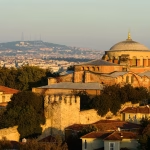
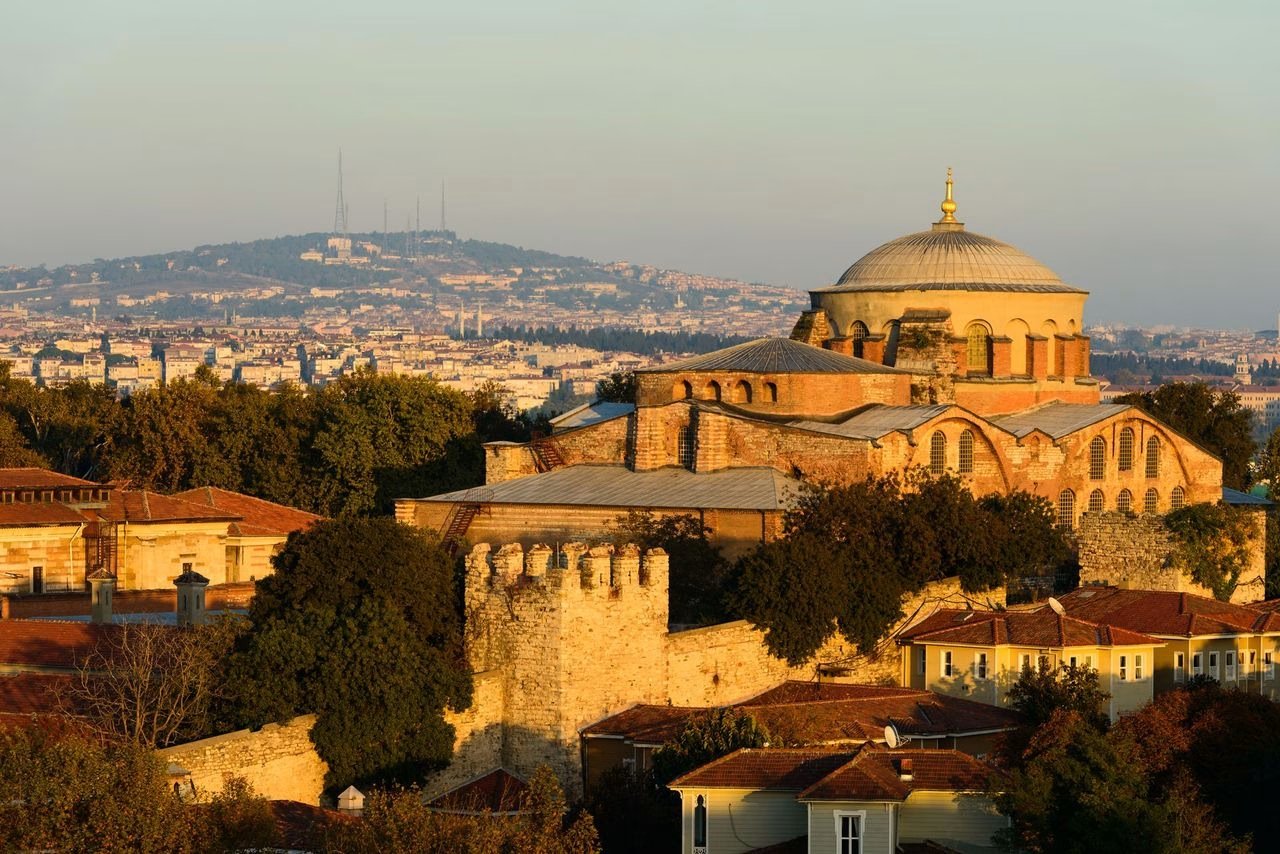
The event will take place within the historic boundaries of Topkapı Palace, where the architectural weight of the venue will provide a powerful backdrop for keynote speeches, panels and conversations. The Forum’s main theme, “Worlds in Contact”, will question what it means to design in an era when inherited frameworks of understanding are no longer sufficient. In a time when societies are grappling with intertwined crises such as ecology, technology, migration and inequality, the Forum will approach design not as a search for a universal language, but as a practice that embraces different ways of living, knowing and producing. Forum Content Consultant Beatrice Galilee emphasises that the Forum highlights perspectives and practices that move across cultures and disciplines, and instead of proposing a single narrative, it encourages this polyphonic dialogue within a reality defined by contact and convergence. The programme flow will begin with a gala dinner on 13 May, continue with full-day Forum sessions, workshops and evening events on 14–15 May, and conclude on 16 May with short-format sessions and a closing brunch.
One of the most important elements of the programme that integrates with Istanbul’s texture is the four creative “happenings” that will take place across the city. The first focus, “Placemaking”, will host a series of interventions and inquiries based on the city’s deeply rooted material heritage and spatial culture. The opening installation within this scope will reinterpret Turkey’s longstanding wooden tradition through the vision of an internationally recognised designer. The second approach, “Rethinking”, aims to reawaken the garden culture at the city’s key threshold points. In order to reinterpret Istanbul’s deep connection with soil, cultivation and garden culture in a modern urban context, an international competition will be launched for a contemporary garden design in the Yedikule area. This initiative will be announced at the Forum’s closing and will offer the city a thoughtful, forward-looking proposal through design.
The third pillar, “Storytelling”, will come to life through the “İstanbullar: Design Route” project, designed as a meta-narrative network that brings together visual, auditory and editorial content. This route will map 40 significant design and art works and notable locations across the city, providing Istanbul with a map, a creativity archive and a storytelling platform. This interactive creative network, shaped by the contributions of editors and the city’s storytellers, will create a layered and collective portrait of Istanbul. Finally, at the heart of all this programme and developed together with Beatrice Galilee, the Forum itself will offer a platform for intellectual exchange and critical reflection. While presenting a strategic vision centred on cultural diplomacy, city branding and sector leadership, the Global Design Forum Istanbul will strengthen the role of design in producing solutions to contemporary challenges by highlighting local talent and student participation. The installations that PPI and the London Design Festival will produce locally in Turkey, while observing artistic and curatorial harmony, will make a bold statement in positioning Istanbul as a global design capital.