

Die My Love (2025): Lynne Ramsay’s Inner Apocalypse on Madness, Motherhood, and Desire

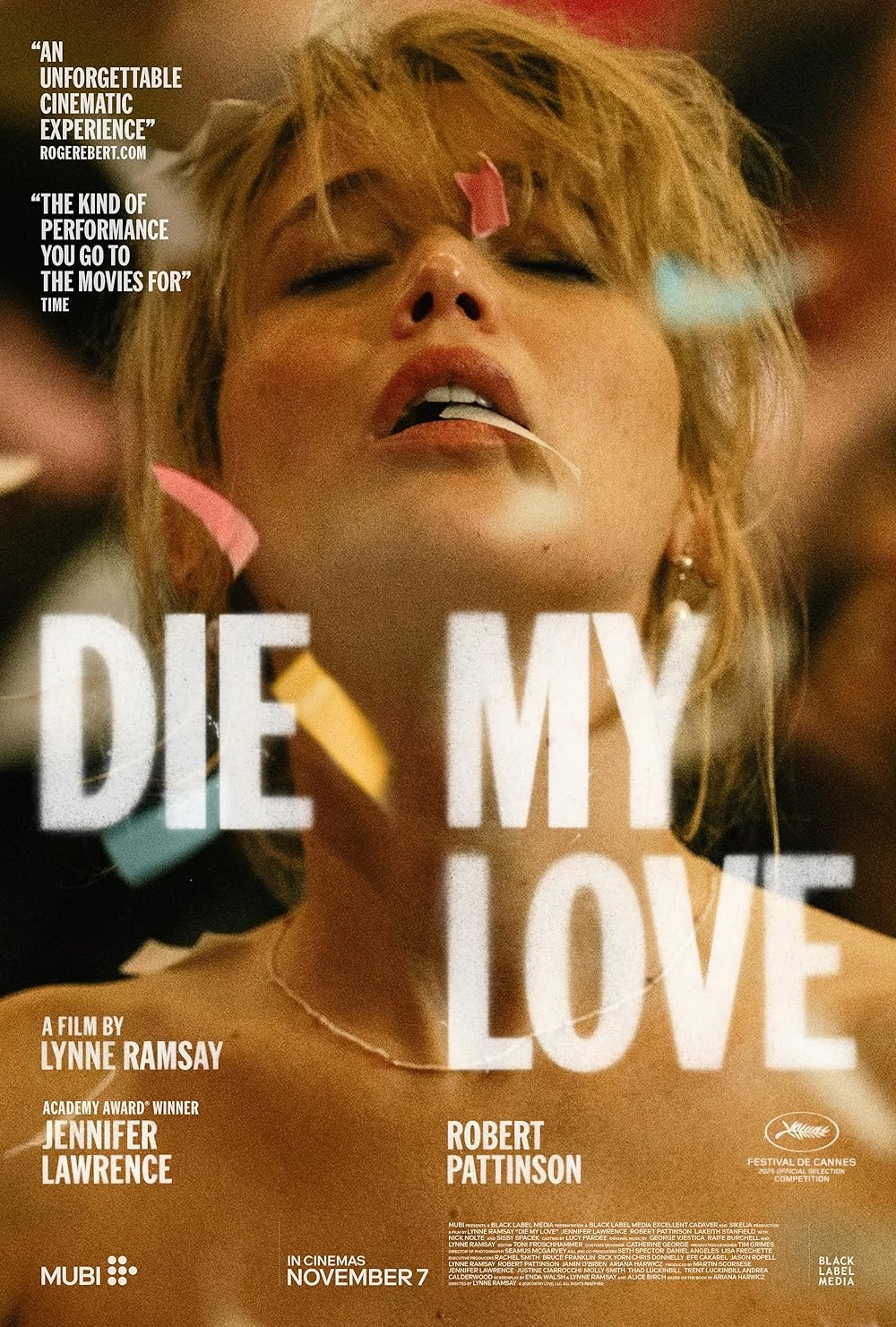
Psychological Drama / Thriller
119 minutes ‧ R ‧ 2025
Director: Lynne Ramsay
Cast: Jennifer Lawrence, Robert Pattinson, LaKeith Stanfield, Sissy Spacek, Nick Nolte
The Silent Apocalypse of the Modern Female Psyche
Lynne Ramsay’s adaptation of Ariana Harwicz’s shattering novel Die My Love transforms an ordinary psychological breakdown into a cinematic storm. Set in the desolate rural expanse of Montana, we follow Grace (Jennifer Lawrence), a newly mothered writer who slowly crosses the boundaries of madness within the spiral of motherhood, marriage, and isolation. Premiering at the 2025 Cannes Film Festival to a 9-minute standing ovation, the film hit theaters on 7 November 2025. Added to the MUBI library on 23 December 2025, it remains one of the most debated “prestige” titles in the digital landscape well into early 2026.
Post-Realist Feminist Horror and the Paradigm of Emotional Minimalism
For film theorists and critics, Die My Love stands as one of the most refined examples of the “Post-Realist Feminist Cinema” wave that crystallized in the mid-2020s. Ramsay constructs the character’s inner turmoil not through conventional dialogue but through an “emotionally minimalist” language, harnessing the tactile power of 35mm film stock. The domestic spaces are stripped of any sense of refuge and turned into existential battlegrounds where the female psyche fractures. Here, motherhood is presented not as a societal sanctity but as an “emotional horror” source in which love and terror intertwine, swallowing the individual’s identity. Ramsay’s vision traps the viewer inside Grace’s hazy reality, weaving every frame into a visual poem composed of light, shadow, and silence.
Why It Became a Social Phenomenon in 2026
The film continues its “long tail” effect well into 2026 because it mercilessly attacks one of the greatest taboos of the modern world: the myth of “perfect motherhood.”
- The Scream of Silence: In the hyper-connected world of 2026, Grace’s absolute solitude in Montana and her unheard cries resonate deeply with contemporary feelings of isolation.
- Radical Surrender in Performance: Jennifer Lawrence completely strips away her Hollywood-star polish to deliver a “wild and raw” performance. The “anti-chemistry” between Lawrence and Robert Pattinson offers one of the most honest portraits of a toxic marriage in which healthy communication has collapsed.
- Digital Catharsis: As a direct counter-reaction to the “performance-driven parenting” trends dominating social media, the “unfiltered collapse” presented in Die My Love provides viewers with a shattering yet necessary emotional cleansing.
Apartment No:26 Note
Lynne Ramsay takes the interrogation of motherhood and guilt she began in We Need to Talk About Kevin to a far more subjective and hallucinatory level in this film. The director frames madness not as spectacle but as lived emotion. The whispers and breathing sounds in the sound design function as extensions of Grace’s subconscious, pulling the viewer out of their comfort zone and forcing empathy. The result is a masterpiece that wanders the boundaries of motherhood, desire, and annihilation — difficult to watch, impossible to forget.