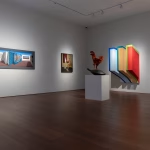


One of the most prolific and influential figures in contemporary art, David Hockney invites viewers at Serpentine North Gallery in the heart of London to rediscover the very nature of the act of looking. Running from 2 March to 23 August 2026, the exhibition titled “David Hockney: A Year in Normandie and Some Other Thoughts about Painting” centers on the artist’s phenomenological approach to capturing the extraordinary details hidden within the everyday.
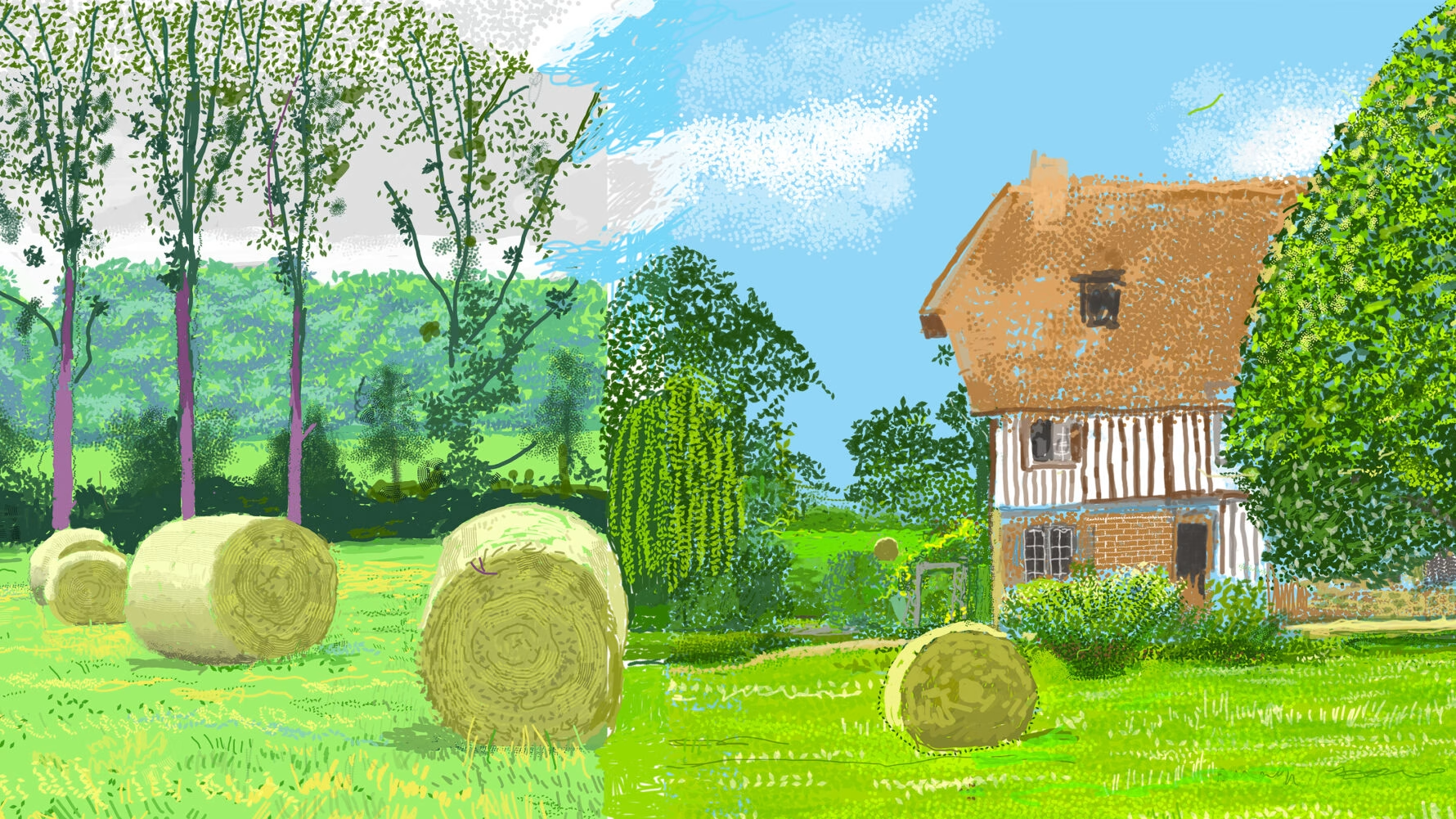
This first exhibition of Hockney’s work at Serpentine blurs the boundaries between digital pictorialism and traditional landscape painting. The composite images he creates on the iPad represent some of the most contemporary examples of how a technological tool can be transformed into a pictorial mode of expression.
Spatial Continuity and Historical References
The centerpiece of the exhibition is the monumental ninety-metre-long frieze “A Year in Normandie,” a vast narrative in which Hockney recorded the seasonal transitions from his studio in Normandy. The work draws inspiration from the Bayeux Tapestry (Bayeux Duvar Halısı), which will also be on display at the British Museum in 2026. By reinterpreting the linear narrative structure offered by this historical weaving technique through a digital medium, Hockney spreads the flow of time across a spatial plane.
Observation and Slowness
The exhibited works encourage the viewer to resist the fast-consuming image culture by “slowing down” and deepening the act of looking.
Dialogue with Nature
The location of Serpentine North Gallery establishes an organic dialogue between the Normandy landscapes depicted by Hockney and the surrounding Kensington Gardens. The pictorial representation inside the space merges with the physical presence outside through the motif of seasonal transformation.
Pictorial Theory and Technical Approach
Hockney’s “other thoughts about painting” advocate for a pluralistic perspective that challenges the traditional limits of perspective and draws the viewer into the composition itself. For the artist, painting is not merely the freezing of an image, but a temporal and spatial synthesis of visual perception. The use of the iPad allows this synthesis to merge with instantaneous sensations, while the vibrant color palette creates an aesthetic language that celebrates the pure beauty of nature.
This exhibition by Hockney proves just how vital and transformative the act of painting remains in a digitalizing world, while celebrating—with academic rigor—the unchanging miracle of nature and the act of looking.