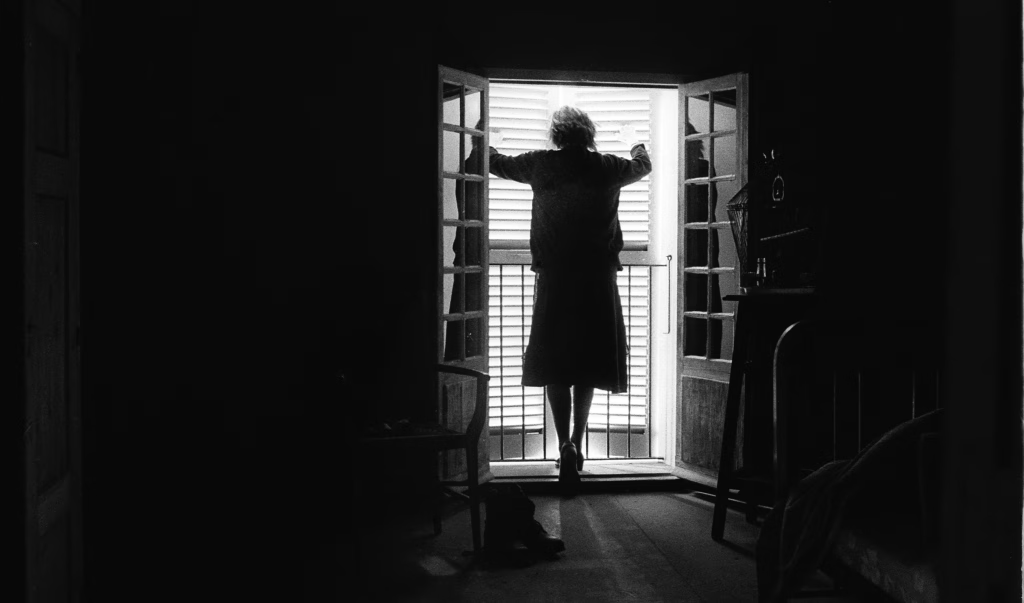


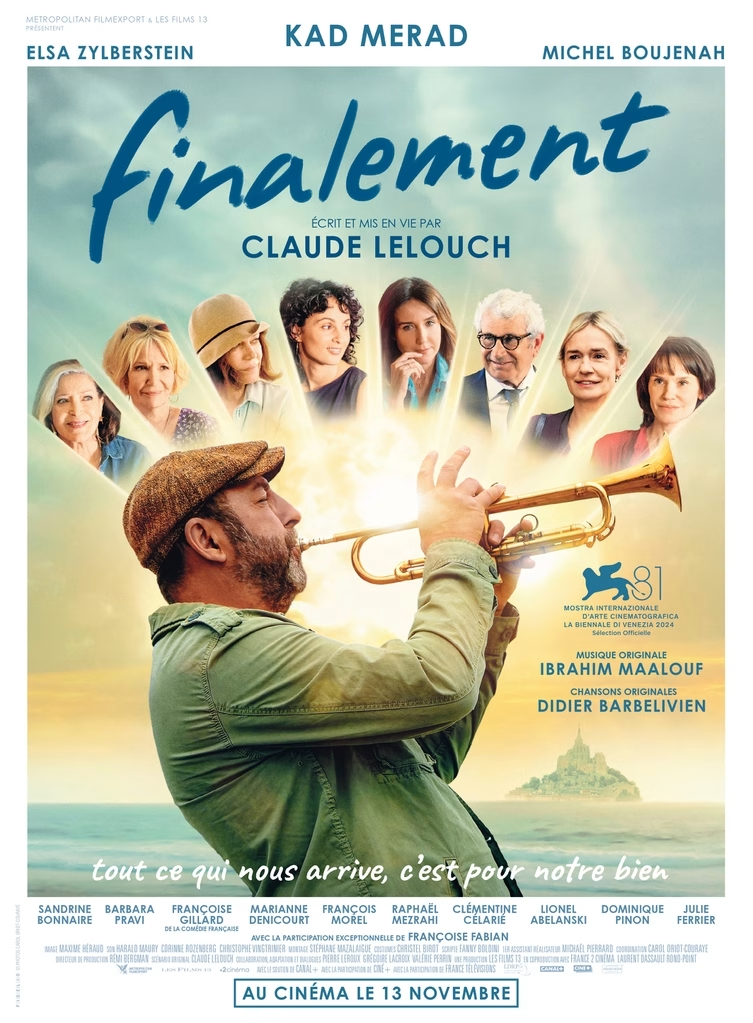
Claude Lelouch’s fiftieth film, At the End of the Day (Finalement), stands as an enchanting musical fable penned by a master in the twilight of his career, boldly shattering all rules. Looking back from 2026, this film resonates not merely as a road story but as a “raw reality” cry from a generation exhausted by digital perfection and filtered lives.
At the heart of this cry is successful lawyer Lino Massaro, who has built his entire career on strategically managing lies as instruments. However, following a health crisis that completely strips him of his ability to tell strategic lies, Lino abandons the comfort of his professional life and drifts into an inner journey of discovery toward rural France. Now, every word that leaves his mouth represents pure, unfiltered truth, bypassing the sieve of social courtesy.
This forced honesty transforms Lino—trumpet in hand—into absurd identities ranging from priest to porn director, while detaching the film’s narrative structure from linear logic and turning it into a free jazz improvisation. Each stop offers a new variation on identity; the common denominator of all these assumed roles becomes an inescapable honesty. Lelouch masterfully directs his characters like instruments in a grand orchestra, without concealing that honesty is not only a virtue but also a potentially devastating social catastrophe.
For the modern viewer weary of today’s performance-driven perfectionism and the false storefronts created by social media, Lino’s affliction actually opens the door to radical liberation. In an era where artificial intelligence manipulates reality and flawlessness has become the standard, the inability to lie transforms from a weakness into a revolutionary superpower. In Lelouch’s vision, reality finds its echo not in logical structure but in a musical fiction that can only be heard when all social conditioning collapses.
The film’s auditory texture, bearing the signatures of Ibrahim Maalouf and Barbara Pravi, elevates this journey beyond a visual feast into a soul-healing symphony. At the End of the Day celebrates not a man losing control but beginning to play the authentic music within himself. In Apartment No:26’s notebook, this film secures its place as a timeless masterpiece reminding us how liberating it is to be beautifully flawed and imperfect in a world dominated by artificiality.