

In Berlin’s Hanseatenweg district, amid the characteristic grey tones of concrete and history, a quiet but profound restlessness can be felt. The Akademie der Künste, with its “Vessel & Voyager” exhibition, drops us right into the middle of crises, losses, and possibilities of rebirth from all corners of the world. While harsh winds outside scatter our minds these days, this exhibition offers an intellectual shelter. The new works developed by 25 international artists within the JUNGE AKADEMIE are conceived not merely as aesthetic experiences, but as collective practices of healing. Why should we be here? Because the world is more complex than ever before, and in this complexity we need—more than ever—the ancient carrying capacity that art provides: vessels and voyagers. This exhibition is an invitation to descend into the wells of memory and to draw maps of the future together. As we wander through the corridors of our minds, the works we encounter force us to become both containers and travellers.
The title “Vessel & Voyager” actually represents the dual spirit that lives inside each of us. On one side, the wide “vessel” that holds narratives, voices, and transformations; on the other, the “voyager” who builds bridges across times and geographies. The atmosphere on this floor is filled with a wind that has swallowed the dust of the past but breathes toward the future. While the artists dig into the deep layers within the body, they translate imagined dialogues with trees and ancestors into lines. Walking among these works, which integrate with the building’s architecture, you sometimes find yourself gazing at the sky in a video piece, and at other times searching for ways to stand upright “while the world is in flames” amid destruction and protest. Like the creative smoke rising from the boiler room, this exhibition is in pursuit of forging a new language from within crises.
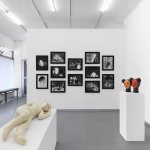
The exhibition’s layout is dominated by a structure where metal sculptures bend toward the viewer, and photography and sound installations intermingle. This is not merely a visual feast; it is a search for a language built on responsibility, vulnerability, and resistance. Running from 13 March to 10 May 2026, the exhibition is not limited to static works. An ecofeminism-focused symposium on 17 April and performances on 25 April further enliven the spirit of the show. This place feels like a sewer where lost stories are whispered; behind every work the silent questions hang: What should we protect? How should we connect? In this urban and modern face of Berlin, the ghosts of the past shake hands gracefully with the realities of today.
Among the participating artists are Ilit Azoulay, Patrizia Bach, Fanny Brandauer, Eva Dessecker, Anna Dobrova & Yuliia Rusylo / MetaLab, Sarah Doerfel, Marie Clémentine Dusabejambo, Nina Emge, Solomon Garçon, gruppe-aja, Thembinkosi Hlatshwayo, Dominique Hurth, Mehdi Jahan, Khensani Jurczok-de Klerk, René Kemp, Josephine Macken, Marina Naprushkina, Thuy-Han Nguyen-Chi, Hrishikesh Pawar, Sophie Seita, Sara Stevanović, Diána Vonnák, Franziska Wenning, Hana Yoo, and Saikal Zhunush. This polyphonic chorus brings a fresh and multi-layered breath to Berlin’s cultural ecosystem.
Exhibition Information:
Venue: Akademie der Künste, Hanseatenweg, Berlin
Dates: 13 March – 10 May 2026
Opening Hours: Tuesday–Friday 14:00–19:00, Weekends 11:00–19:00
Admission: €6 (reduced €4, opening and selected events free)