

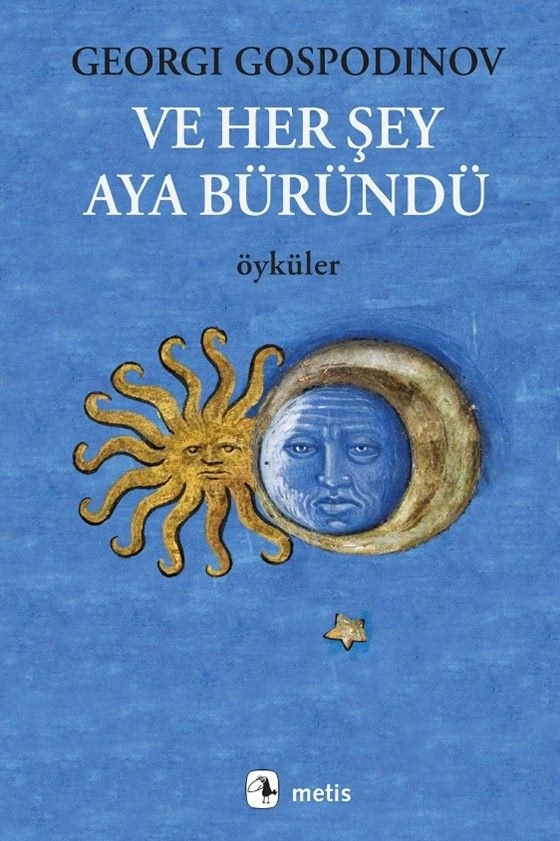
Entering our lives with The Physics of Sorrow and cementing his place in world literature by clinching the 2023 International Booker Prize with Time Shelter, Georgi Gospodinov continues to captivate his loyal readership in Turkey. Published by Metis Yayınları in April 2026, “And All Became Moon” (Ve Her Şey Aya Büründü) takes us away from the author’s massive novel architectures this time, inviting us into the tiny and mysterious door gaps within those structures: his short stories.
The nineteen stories featured in the book are far more than a simple collection of narratives; each works like a polyphonic composition diverging into separate doorways but ultimately arriving at the same shared house. That house is the very embodiment of memory, loss, the razor-thin line between the ridiculous and the sorrowful, and the bizarre yet meaningful bond that a human being establishes with their own existence.
The Small Roots of Large Structures
The arrival in Turkish of these stories, originally published in the Bulgarian author’s native tongue in 2013, actually offers an inverted and highly enjoyable reading experience. Readers familiar with Gospodinov’s mature-period novels will embark on a time travel toward the author’s literary roots—the very first seeds of that famous narrative universe—through this book.
Gospodinov’s texts are not the kind to simply be read and closed; they transform into an endless internal echo that continues to sprout and grow quietly in the reader’s mind. Instead of imposing a single large story, these nineteen stops amplify the inner voice of a fragmented modern world, checking in on another reality and another human possibility on every page.
The Flawless Alliance of the Absurd and Melancholy
There are moments among the stories where you marvel once again at Gospodinov’s genius for placing the absurd at the very heart of emotional reality. In one of the book’s most striking veins, we share the inner voice of an orphanage child who, to soothe his fatherlessness, declares a massive chestnut tree in the courtyard as his “father.”
“It was suitable for being a father, it had everything in place, it was large, it had huge branches…”
The child’s naive acceptance and the tree’s consent to this partnership with its silent, gargantuan posture stand as concrete proof of how minimalism can serve as a magnificent armor for melancholy.
Eastern Europe’s Culture of Silence and Translational Fidelity
These stories also serve as a sorrowful memory map settled within the chaotic fabric of late-twentieth and early-twenty-first-century Eastern European history. Gospodinov’s Bulgaria is not merely a geographical backdrop where untold stories accumulate; it is a memory space shaped by a culture of silence, battered yet stubbornly standing, still carrying the deep wounds inflicted by the communist era.
Feeling this geographical and emotional rhythm identically in Turkish is the result of great translational fidelity. Hasine Şen Karadeniz, who has brought all of the author’s books into our language, succeeds in presenting Gospodinov’s unique tone of voice, irony, and rhythm in a style remarkably close to the original, thanks to this long-standing linguistic partnership.
The magnificent moon symbolism glowing in the title of the book represents that magical threshold in Gospodinov’s world where remembering and forgetting are simultaneously possible. When everything becomes moon, all that remains is a silent sense of closure—indescribable yet never to be forgotten. While And All Became Moon offers a flawless starting point for those new to Gospodinov’s world, it completes the most precious missing piece of this unique literary map for his long-time readers.
Book Details:
- Book Title: And All Became Moon (Ve Her Şey Aya Büründü)
- Author: Georgi Gospodinov
- Turkish Publisher: Metis Yayınları (Released April 2026)
- Translator: Hasine Şen Karadeniz
- Structure: 19 short stories (Originally published in Bulgarian in 2013)
- Core Themes: Eastern European memory landscape, the absurdity of grief, childhood longing, and the architecture of short fiction.