

The Modern Institute, Aird’s Lane Bricks Space, Glasgow · March 13 – May 16, 2026
For a long time in art history, the matter of “decoration” was viewed almost as a point of shame. While canvases were always considered the domain of serious and sublime works, ornamental practices were relegated to porcelains, curtains, and textiles. Elisabeth Kley refutes this rigid hierarchy not with a loud manifesto, but through a far more elegant and effective method: she quietly distills four thousand years of deep-rooted pattern history in her Brooklyn studio and transfers it onto canvas and clay.
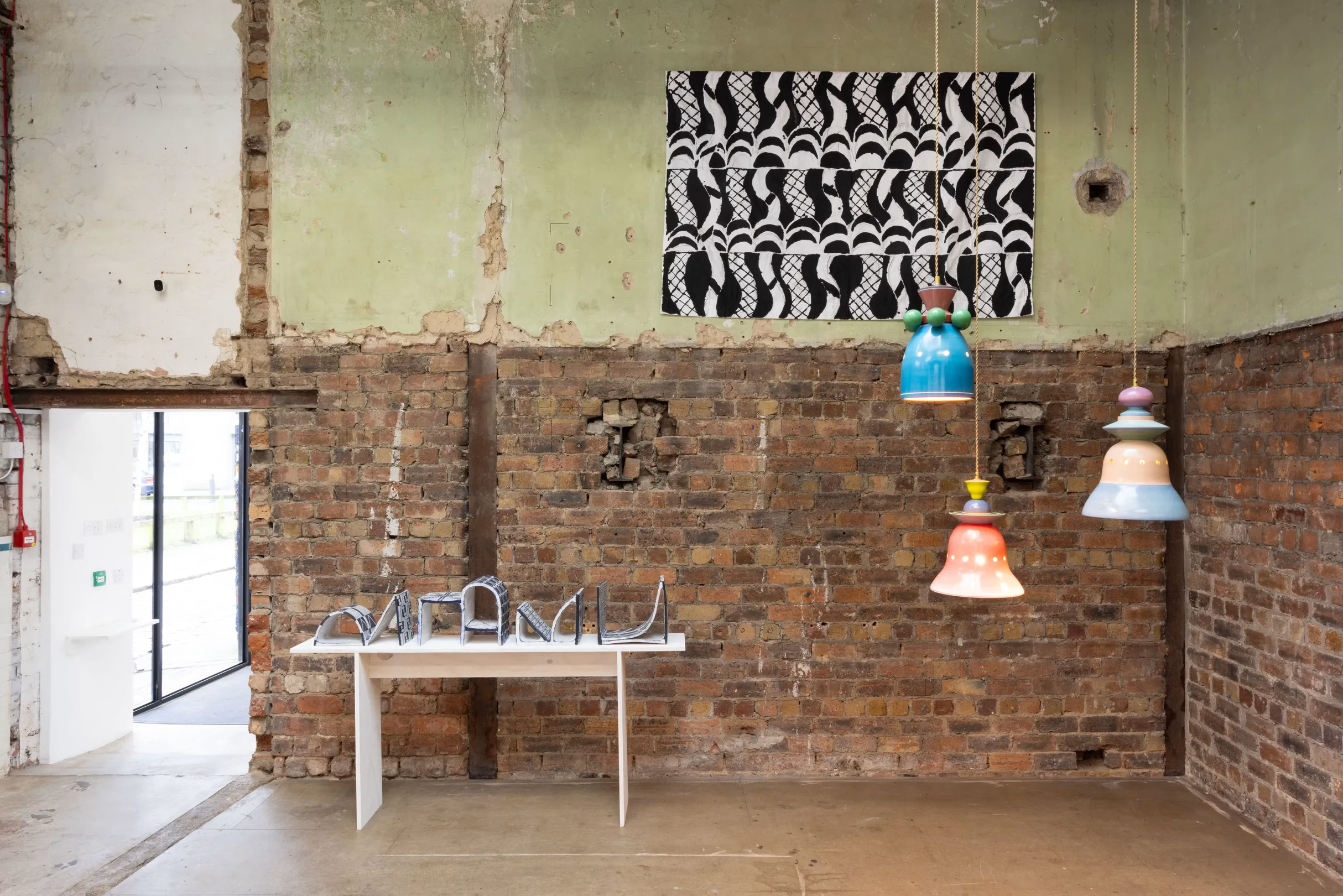
Kley’s slab-built ceramics seamlessly intertwine curves, diagonals, and right angles. When lined up, these forms—reminiscent of small architectural structures—transform into an illegible script or an entirely imaginary alphabet. The dark blue and black glazes on the surfaces subtly nourish the feeling that a written language or an architectural plan lies beneath. Here, the boundary between syntax and form is deliberately blurred. Kley isn’t telling us something specific; she is constructing an entirely new language.
The artist’s sources of inspiration are infinite and complex: Ancient Egyptian friezes, Etruscan and Islamic symbols, pre-Columbian figures, the electric geometry of the Wiener Werkstätte, the folkloric exuberance of mid-century ceramic masters Roger Capron and Stig Lindberg, and the retro-Art Deco drawings of Edward Gorey. However, Kley never directly copies these sources; she digests them within her own mind and translates them into her own vocabulary. The result is not a simple collage of citations, but a visual “Esperanto of motifs.”
The production process itself is an inseparable part of this narrative. For the ceramics that have lost their fragility after the first firing, Kley prepares and attaches paper templates tailored to each surface; she then applies white gold glaze, followed by wax, and adds the final striking layer with cobalt paint. This process represents heavy labor carried out entirely by hand, where absolute control intertwines with graceful coincidence. The resulting works do not possess an accidental or coincidental beauty; they reflect a highly conscious beauty, built deliberately, patiently, and slowly.
In the raw and industrial space of The Modern Institute, suspended quietly between the cold concrete floors and exposed beams, these ceramics provide the best possible answer to the antiquated hierarchy between decoration and high art: by not caring about that hierarchy in the slightest.
The exhibition remains open for visitors until May 16, 2026.