

- Dates: March 28 – May 16, 2026
- Venue: Maureen Paley, London
What happens to a door after it is closed for good? Officially, it is either dismantled or left to rot in situ. In practice, everything that happened behind that door—everyone who pushed it open to enter and every moment shared within—vanishes the moment it shuts. Fiona Connor’s “Closed Down Clubs” project has been chasing this ruthless question for years, providing an answer with a simple yet incredibly powerful gesture: reconstructing that door.
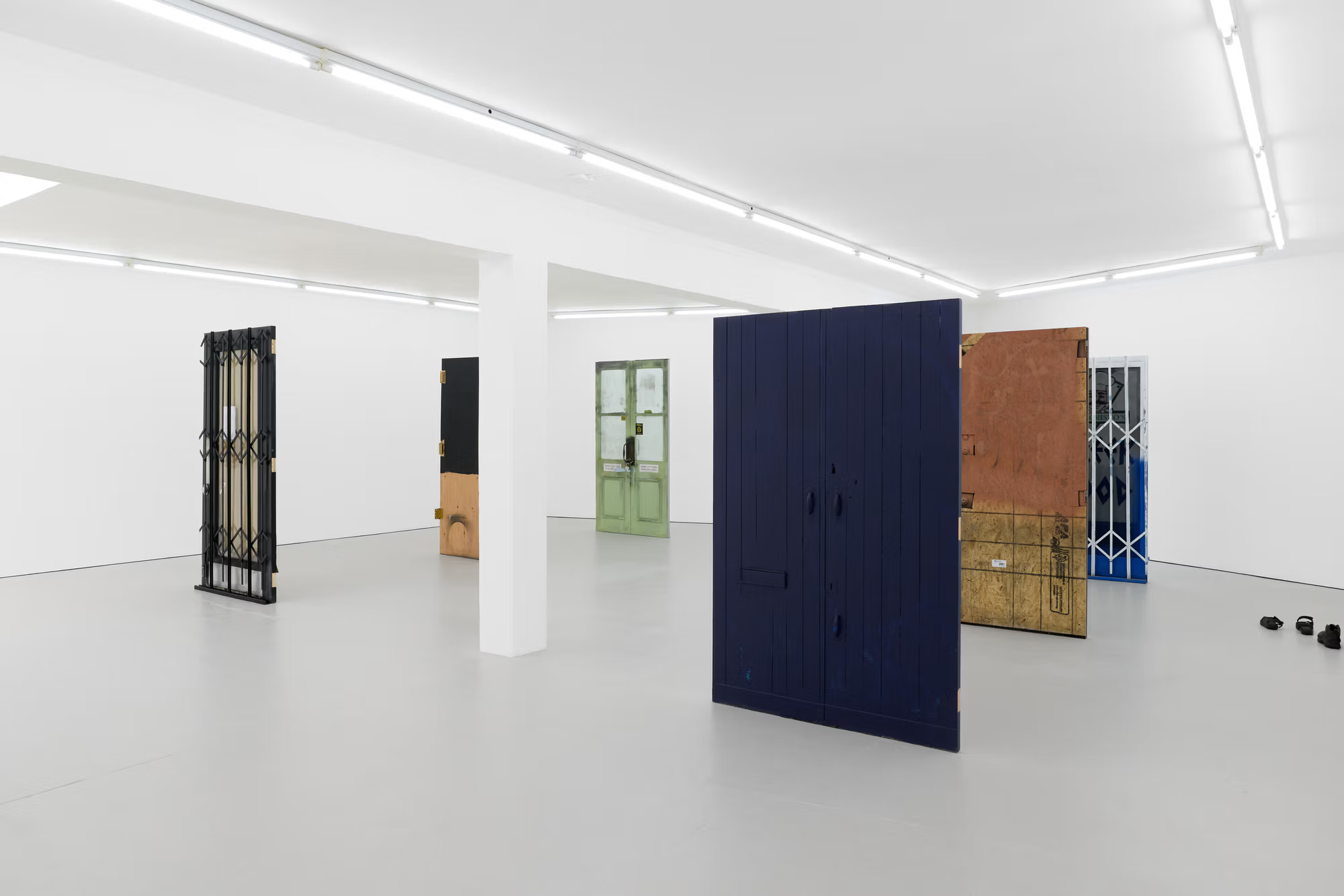
Based in Los Angeles, Connor meticulously reproduces the doors of clubs that have permanently closed across London, the USA, Canada, and her native New Zealand. By transforming her sculptural practice into a method of archiving, she seals these non-existent spaces into eternity. The scratches on the surface, the wear and tear, the posters, stickers, graffiti, and those cold eviction notices… everything is recreated with faithful precision; each one a silent lament for spaces that have been erased.
The conceptual weight of the work lies exactly here: this architectural object functions not only as a historical document but also as a physical ritual of mourning. For instance, The Glory was a queer bar on Kingsland Road that held the city’s pulse until 2023. Today, its door stands in a gallery in Bethnal Green as a work of art. This displacement is not merely a symbolic move; every scratch on that door’s surface physically carries the bodily and social history of the venue into its new environment.
In addition to the doors, the exhibition includes the artist’s bronze shoe casts. These works are a continuation of Connor’s deep interest in environmental forms and spatial details within spaces of communication and exchange. Like the doors, shoes are objects that exist on the threshold: are they inside or outside? Have they just arrived, or have they long since departed? The phrase “I haven’t arrived yet” in the exhibition title captures this exact ambiguity. It is neither a definite wait nor an absolute arrival; it is a frozen moment suspended in limbo.
Maureen Paley, one of the most powerful founding voices shaping East London’s contemporary art scene since 1984, hosts Connor at her fourth location on Herald Street. The harmony between the gallery and the artist is certainly no coincidence; both are stubborn advocates of an uncompromising practice that does not hesitate to center the marginal, the ordinary, and the overlooked.
Visit Information:
- Location: Maureen Paley · 4 Herald Street, Bethnal Green, London E2
- Visiting Hours: Wednesday–Saturday, 11:00 AM – 6:00 PM