

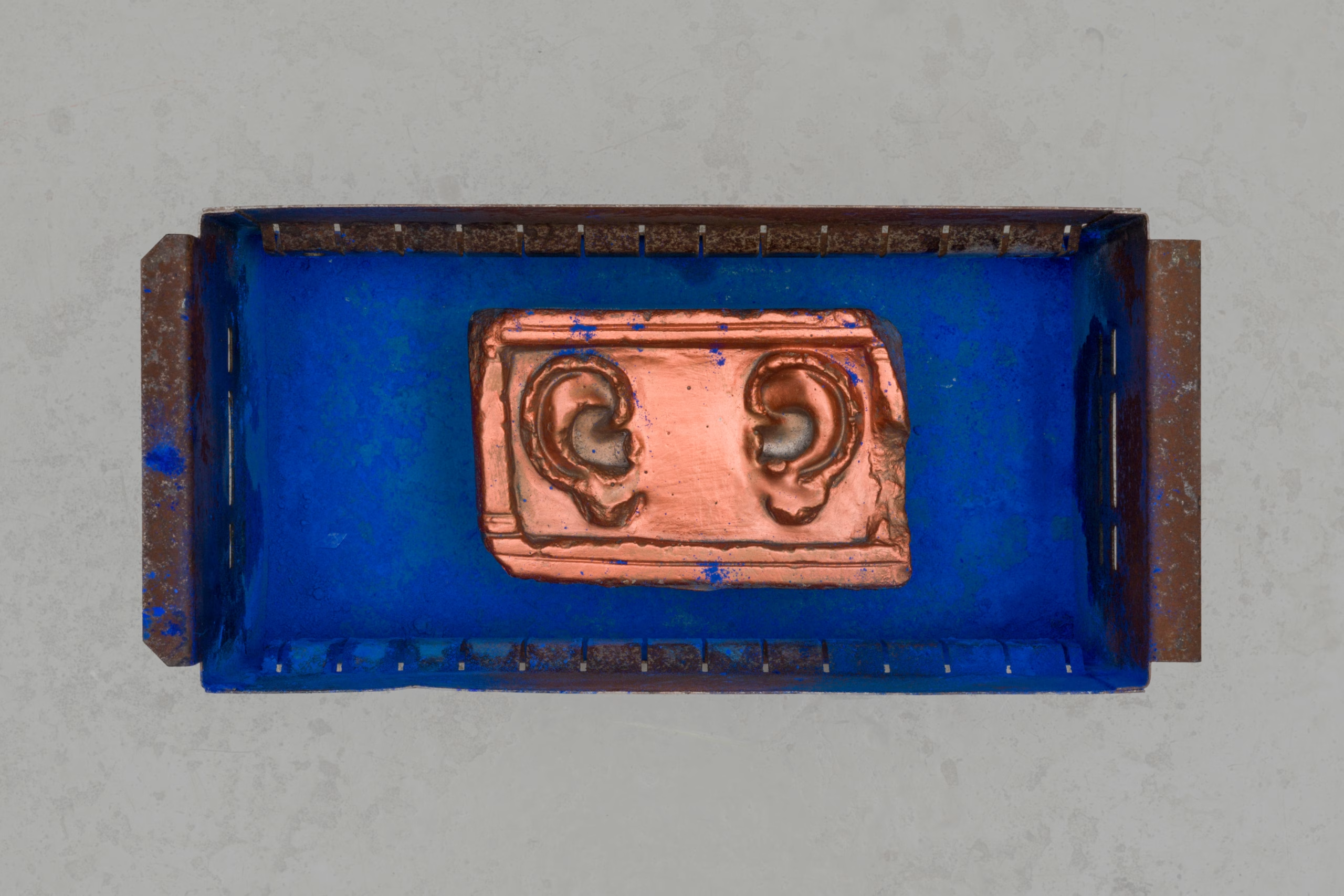
carlier | gebauer has announced “Typus Terra Incognita,” the first solo exhibition of Anna Bella Geiger in Germany. Opening on 14 March, the exhibition presents a comprehensive overview of Geiger’s artistic production spanning more than 50 years, from her birth in Rio de Janeiro in 1933 to the present day.
Geiger is not merely a pioneer of Brazilian art; she is also an explorer who probes the political dimensions of maps, anthropology, and knowledge itself. While the exhibition showcases her masterful transitions across disciplines—video, painting, engraving, textiles, and installation—it centres on her greatest passion: maps.
Is a Map a Reality, or a Display of Power?
In Geiger’s practice, the map appears not as a simple geographical tool, but as a leitmotif. By tearing, folding, and reconfiguring maps, the artist questions cartography’s claim to transparency and verified truth.
Geopoetics: Against the objectivity and omnipotence claimed by traditional cartography, Geiger develops an intuitive and poetic approach. Her maps are not representations—they are translations.
Hegemonic Critique: Historically, cartography has been the effort of the explorer, the coloniser, and the male figure to impose his own dominant perspective onto a heterogeneous reality. To make a map is to name places while simultaneously erasing or ignoring others.
Geiger counters these acts of erasure and omission by defending the local, personal, and subversive power of knowledge. Her maps become spaces of resistance against the desire to control the world.
Scrolls and Fragmented Knowledge: The Archaeology of Information
Another key axis of the exhibition is formed by Geiger’s “Scrolls” and “Little Scrolls” series, which she began producing in the 1990s. These sculptural objects refer to one of humanity’s oldest forms of storing and transmitting knowledge: the scroll manuscript.
Deconstruction of the Encyclopaedia: In her work The Book of Ester, Geiger uses pages from an antique encyclopaedia. Encyclopaedias are vast structures that claim to classify and map all human knowledge.
The Unconscious Text: Geiger renders these pages illegible by leaving only certain syllables visible. In this way, encyclopaedic knowledge is fragmented, and from the subconscious of the text—much like in the technique of “automatic writing”—entirely different meanings erupt.
Mystery and Uncertainty: These scrolls are never presented fully unrolled, reminding us that knowledge always conceals something and that transparency is temporary. Geiger embraces this uncertainty not as a flaw to be rejected, but as an artistic method.
Why You Should See It
Anna Bella Geiger is one of the rare artists who has managed to remain innovative throughout more than 90 years of life. Typus Terra Incognita does not merely narrate Brazilian history or geography; it questions how we perceive the world, what we accept as “knowledge,” and the invisible boundaries that maps draw in our minds. In the first days of spring in Berlin, witnessing this 50-year “geopoetic” journey will be a profoundly moving experience.
Exhibition Information
Artist: Anna Bella Geiger
Title: Typus Terra Incognita
Venue: carlier | gebauer, Berlin
Dates: 14 March – 18 April 2026