

Mitski, one of the most original and profound voices in contemporary music, is widely regarded as such. Her eighth studio album, “Nothing’s About to Happen to Me,” takes listeners on both a theatrical and deeply introspective journey. The record serves as a response to Mitski’s increased visibility in recent years: a sober, in-depth reflection filled with meditations on loneliness and illusion. Once again, it lays bare the evolution of her music and the delicate nuances of her personal expression.
One of the album’s most striking features is its use of live instrumentation from the touring band that accompanied her 2023 album “The Land Is Inhospitable and So Are We.” This choice lends the record an organic, intimate warmth while amplifying the theatrical elements already present in Mitski’s music. The lyrics unfold almost entirely within a single location: Mitski’s once meticulously ordered spiritual home—an attic now abandoned to dreams and mildew, inhabited by opossums. This house functions both metaphorically and literally as the decaying vessel of the album. Recordings were primarily produced by Patrick Hyland in the house itself, reinforcing the work’s intimate, personal atmosphere.
Throughout the album, Mitski’s narrator is haunted by stray street cats, the dogs of dead girls, and crowds eager to mummify her and auction off her belongings. She clings to memory: longing to float forever on her back with a lost lover, devising increasingly manic ways to protect them, and eventually spiraling into a madness where she begins to imagine her own death. These images create powerful, haunting tableaux in the listener’s mind—a testament to Mitski’s lyrical mastery.
In recent years, Mitski has grown increasingly drawn to theatre. Theatre—where meaning resists decay and the fourth wall holds the world in place—remains one of the last remnants of personal, ephemeral experience, and it has deeply shaped her creative process. Currently writing music and lyrics for a stage adaptation of “The Queen’s Gambit,” Mitski channels the instrumentation of “Nothing’s About to Happen to Me” toward a gothic pantomime informed by this parallel work. While the album nods to earlier moments—such as the theatrical lounge music of “I’ll Change for You” from her 2012 debut Lush, the anxious blur of “Where’s My Phone?” from Bury Me at Makeout Creek, and the sophisticated emo of “If I Leave” from Puberty 2—it largely feels like a domesticated continuation of the pastoralism of its predecessor.
As Mitski has gained more visibility in recent years, she has leaned further into Americana sounds. “Charon’s Obol” draws from moonshine blues, while “In a Lake” blends Anglo-Celtic ballad influences with South American traditions, featuring banjos and fiddles backed by upright bass. Unlike earlier records where pastiche often served as comic contrast, here every element exists in aesthetic harmony. Scenes are distinct and tightly formal. The absinthe-dream haze of “I’ll Change for You” is supported by Mitski’s bossa nova lounge music evoking the enchantment of getting drunk in a bar. The frenzied, grandiose finale of “In a Lake” is powered by a full brass section—a vision of madness: a lady in a top hat and tuxedo swimsuit twirling a baton under spotlights, suddenly replaced by a disheveled woman with unbrushed hair, swaying alone.
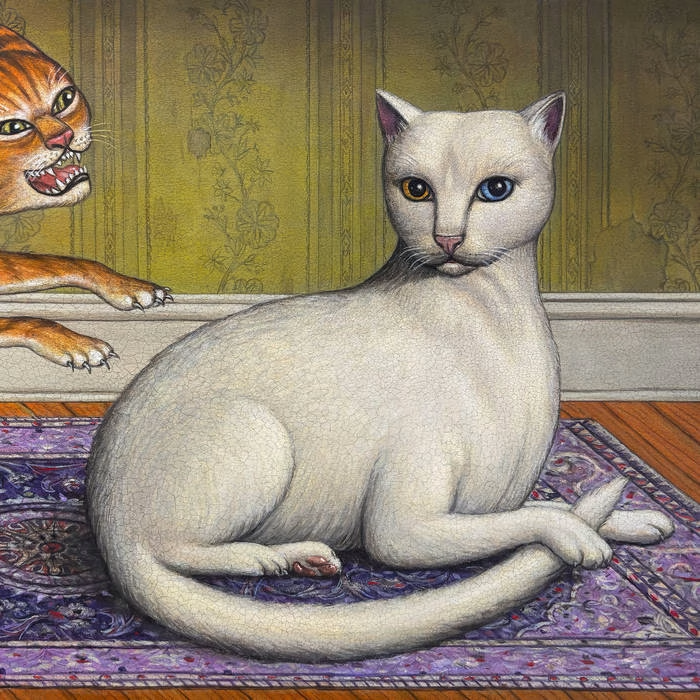
Loneliness, always a complex theme in Mitski’s work, acquires a strangely joyful new value here. The album recalls the domestic nightmares of Shirley Jackson’s stories: houses that isolate their inhabitants only to intensify their sense of identity. The house in “Nothing’s About to Happen to Me” is realized as completely as a stage set. You can see it clearly: a large residence covered in leaves, down a dirty road 200 miles away, a white cat on the front step. This focus on architecture and space feels like a further extension of Mitski’s musical-theatre work, constructing her visuals with dramatic clarity and spectacle. “All the lights around you / The darkness inside is safe,” she sings in “In a Lake” with smoke-free stage diction—using exaggeration and vaudeville as instruments in themselves. She stands alone, aware of her isolation and even drawing energy from it, filling decaying, empty rooms with charged anticipation through stagecraft.
Not every track is so crystalline. The exuberant, band-leader Americana of “That White Cat” strains against its own natural forces—an area where artists like Neko Case dominate simply by existing, and here the fit feels slightly off.
The album is at its strongest when it leans into Mitski’s most comfortable and resilient mode: the self-deprecating love song. “I’d do anything to make you love me again,” she sings, drunk and deliberately pathetic in “I’ll Change for You.” In an era of post-empowerment songwriting that treats romantic abasement as a badge of relatability, cataloguing one’s most humiliating impulses is no longer particularly brave. Yet Mitski—who has often fed from the well of romantic delusion—remains one of the form’s greatest practitioners. She avoids plain confessions, writing instead with strange, faintly magical imagery. “I loiter outside / Watching every car that passes / Like I’m waiting for a school bus,” she sings, creating a perfectly poignant picture. She delivers these songs with immense restraint, never opening the door, allowing the sadness to sit exactly as it is.