

Echoes of Samuel Beckett: “NOT I” Exhibition at Capitain Petzel Berlin and the Fragments of Memory

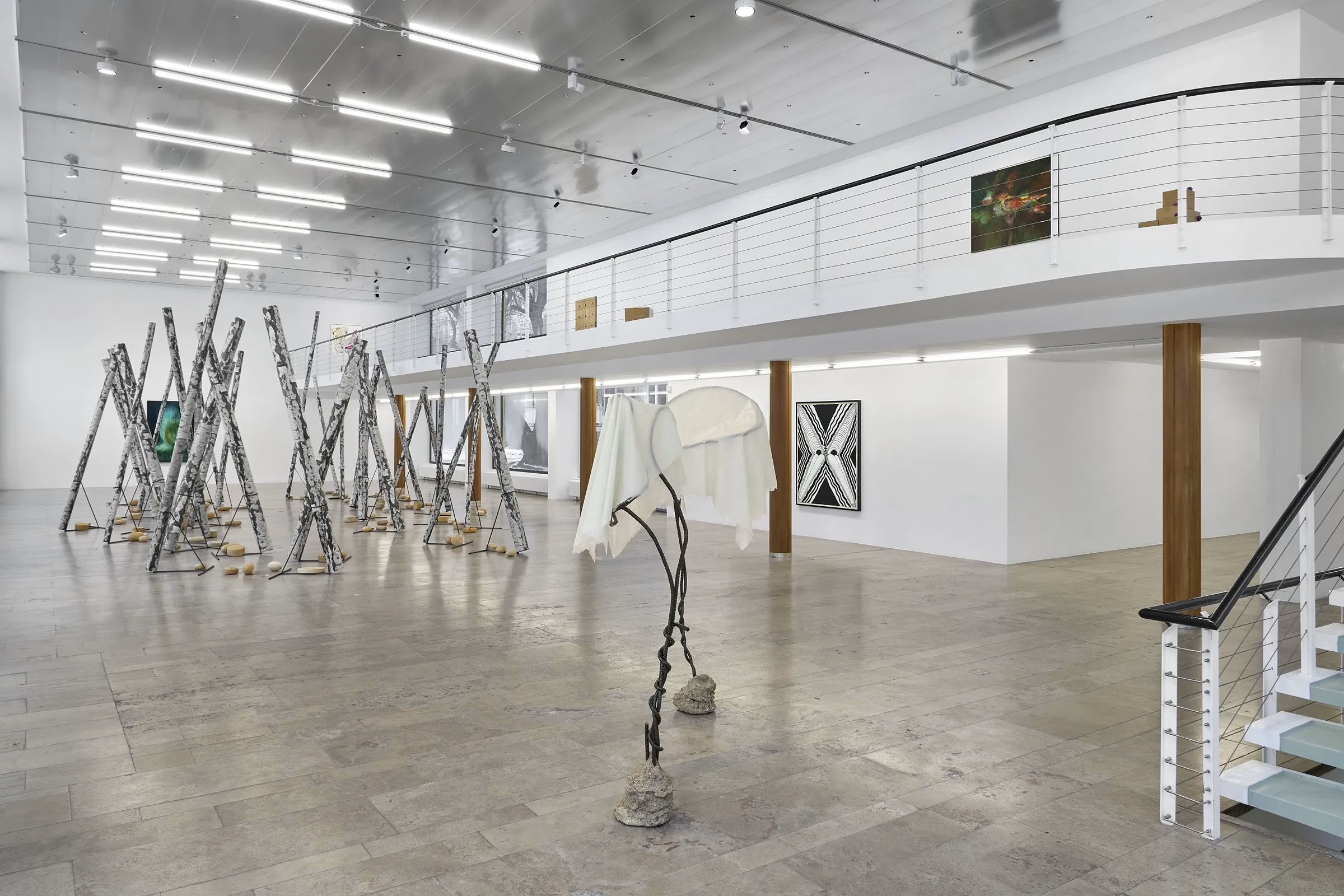
In the uncanny gap between looking and seeing—where the mind continues to cling to an image even after the light has faded—the phenomenon is called “persistence of vision.” At Gropius Bau, Berlin’s architecturally imposing art venue, spring brings us a monumental exhibition that plunges straight into the heart of this concept, debating photography’s power as both document and chemical residue. Bringing together the worlds of Peter Hujar and Liz Deschenes, the show establishes an intergenerational dialogue while proving that the camera is not merely a “recording device,” but also a “time machine” and a “sculptural tool.”
Peter Hujar: The Naked Soul of New York
Looking at Peter Hujar’s photographs feels like touching the raw, filthy yet fiercely intellectual and liberated spirit of New York in the 1970s and 80s. Spanning the explosive moment immediately following the Stonewall uprising and the deep mourning of the AIDS crisis, Hujar was the most faithful chronicler of the city’s underground. Yet his black-and-white frames are never mere documents; they are confessions.
The figures who entered Hujar’s frame were not ordinary people—they were the building blocks of New York’s avant-garde and queer community: Susan Sontag’s piercing gaze, Candy Darling’s tragic elegance, David Wojnarowicz’s famous hand touching an eye… Hujar did not simply photograph these individuals; he etched their vulnerability, exhaustion, and resistance onto silver gelatin paper. In his art, there is no hierarchy between human, animal, or urban ruin: an abandoned building and an artist on their deathbed are equally “alive” and equally “mortal.” Hujar’s vision is uncompromising; while he extracts that sharp light from the darkness, he also forces the viewer to confront this honesty.
Liz Deschenes: A Return to the Materiality of Photography
One of the most fascinating aspects of the exhibition is the placement of Liz Deschenes’s contemporary works amid Hujar’s deeply emotional and figurative universe. Living and working in present-day New York, Deschenes is an artist who questions what photography is—or rather, what it can be. In her pieces, there is no represented “subject”; the subject is the very building blocks of photography itself: light, chemistry, and time.
Deschenes treats photographic paper as sculptural material. She creates enormous silvery surfaces that are exposed to light, oxidized, and reflect the surrounding space. Serving as “interludes” among Hujar’s portraits, these works slow the viewer down and compel reflection on the physical existence of the photograph. When looking at an image, what exactly are we looking at? The chemical trace light leaves on a surface, or the illusion it creates in our mind? Through her abstract approach, Deschenes removes photography from nostalgic memory and turns it into a spatial experience that exists “here and now.” In Gropius Bau’s high-ceilinged halls, these silvery surfaces become living organisms by incorporating the viewer’s own reflection.
A Visual Continuity: The Dance of Two Visions
Curated by Eva Respini and Monique Machicao y Priemer Ferrufino, the exhibition creates not a linear connection between the two artists, but a circular field of interaction. Hujar’s figurative intensity and Deschenes’s material abstraction do not exclude each other—they complete one another. When the sharp blacks of a Hujar portrait meet the metallic grey of a Deschenes installation, you realize that photography is not merely about “an image,” but about clarity of vision.
The exhibition also represents a first for Berlin. As the first major Berlin encounter of this scale for both artists, the project expands the boundaries of photography. Art lovers here do not merely observe New York’s history; they participate in an experiment about how visual perception itself is constructed. If you think photography is simply about pressing the shutter, this quiet yet loud dialogue at Gropius Bau may radically change your mind. Poised to become one of Berlin’s most talked-about exhibitions this spring, this encounter proves just how stubborn and truly “persistent” visual memory can be.
Exhibition: Persistence of Vision
Artists: Peter Hujar / Liz Deschenes
Venue: Gropius Bau
Address: Niederkirchnerstraße 7, 10963 Berlin
Dates: 19 March – 28 June 2026
Curators: Eva Respini, Monique Machicao y Priemer Ferrufino
We are eagerly awaiting to visit this exhibition that is destined to be etched in memory, and if your path takes you there, we highly recommend not missing it.