

Did you know that we have very few visual sources for London’s history? Roughly two-thirds of the city’s past is, unfortunately, an unillustrated void. Yet the Bayeux Tapestry—embroidered in the 1070s and considered one of the most important documents in history—offers us the clearest and most meaningful “photographs” of pre-13th-century London. This monumental work of art is coming to London later this year to be exhibited at the British Museum! Before the exhibition opens, let’s explore how this embroidered cloth preserves London’s history:
The First “Photograph” of Westminster Abbey
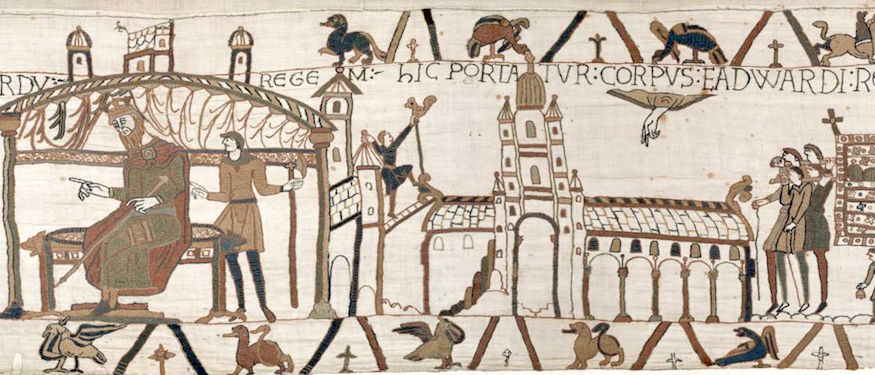
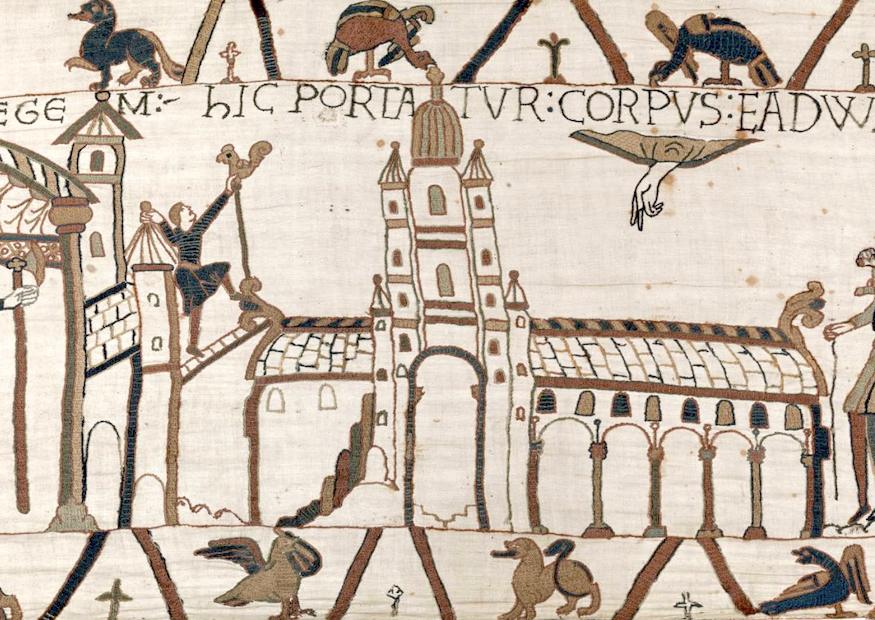
In scene 26 of the tapestry, the inscription reads: “Here the body of King Edward is carried to Saint Peter’s Church.” That is none other than the place we now know as Westminster Abbey!
Historical Significance: This image is the only surviving depiction of the Abbey from that period to the present day.
Time Travel: The church was brand new at the time. Built by Edward the Confessor, it had been consecrated just a few days before his death, on 28 December 1065. In the embroidery, you can see a man attaching a weather vane to the roof of the church—an indication that construction had literally just been completed.
The Palace in Its Earliest Form: Westminster Palace
In the very first scene of the tapestry, we see King Edward seated on his throne beneath enormous wooden beams. It is widely believed that this depicts Westminster Palace (the ancestor of today’s Houses of Parliament). If so, this embroidered cloth holds not only the earliest known image of the Abbey but also the oldest surviving visual record of the very heart of English democracy.
A Visitor from Space: Halley’s Comet
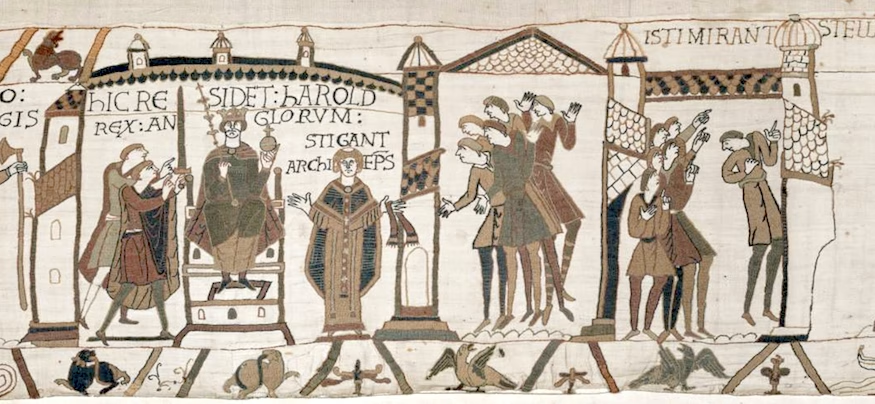
In the scene where King Harold is enthroned, a strange, fiery object blazes across the sky. People below point upward in astonishment.
World First: This is the earliest confirmed depiction of Halley’s Comet anywhere in the world!
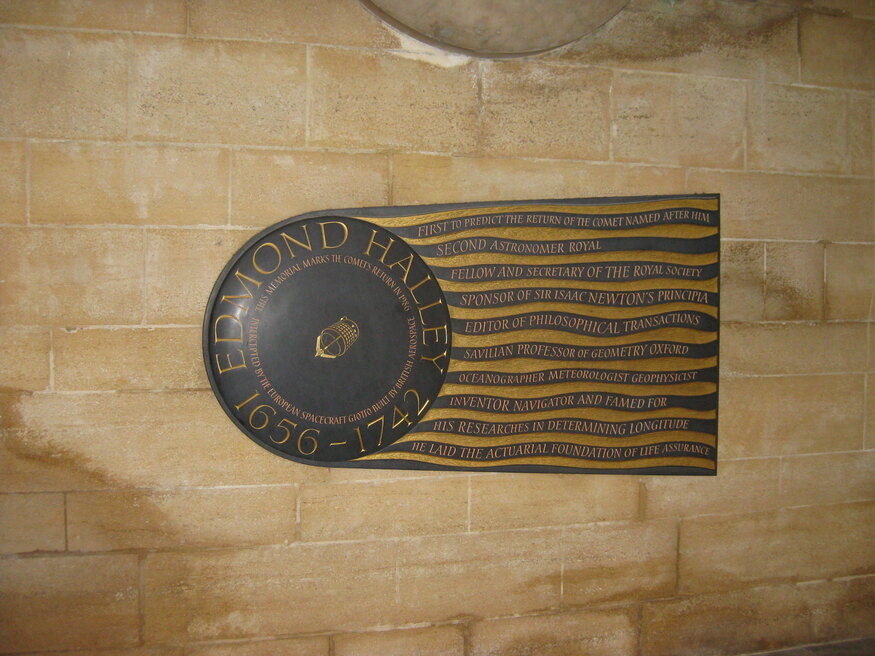
A Fascinating Connection: The London astronomer Edmond Halley—who gave the comet its name—has his memorial in Westminster Abbey today. On that very monument is a relief of the Giotto spacecraft that studied the comet in 1986. So if you visit the Abbey, prepare to see a spacecraft carved inside a medieval church!
Get Ready for the 2026 British Museum Exhibition
The Bayeux Tapestry is far more than a military record of the Battle of Hastings; it is also a unique window into London’s lost centuries. When it goes on display at the British Museum towards the end of 2026, you will be able to see these details with your own eyes.